

Enjoying Winter Squash


My summer garden has long since given way to its fall production. Large orange pumpkins, deep green winter kale, ears of brown dry husked popcorn, and tan butternut squashes now stand where tomatoes, summer squash, green beans, and sweet corn thrived just a few short months ago. It looks like it’s going to be a bountiful fall harvest and I am eagerly anticipating the harvest of our winter squashes.
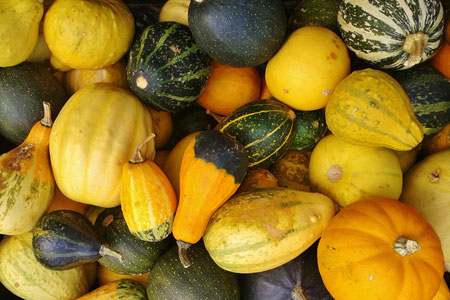
Winter squashes are now in abundance at your farmers' markets and grocery stores. They vary greatly in their size, color, texture, and sweetness. When selecting winter squashes, look for a firm exterior with no bruises, cuts or soft spots. Unlike summer squashes such as zucchini and yellow crooked neck squash, winter squashes have a hard rind that allows them to be stored in a cool, dry location for several months. The exceptions to this are the Delicata and spaghetti squash which can be stored for about 2-3 weeks from the date of purchase.
Some winter squashes, like Hubbards, have challenging hard rinds to cut through and others, like the smooth skinned butternut and Delicata, have thin skins that make peeling or cutting an easy task. Before cutting the squash, rinse it off and wipe it dry with a clean kitchen towel to remove any dirt and debris from the outer surface that may be transferred to the flesh with your knife as you slice or peel the squash. The rinds of some of the varieties will require some effort to cut through them, but a sharp chef’s knife, patience, and a slow steady hand will prevail!
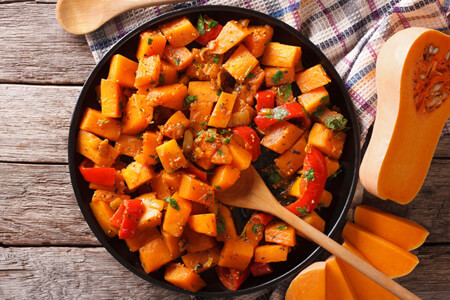
All the varieties of winter squash are delicious and so good for you. The winter squash’s dense flesh is packed full of fiber, beta-carotene, vitamin C, and potassium. My all time favorite is the Waltham Butternut. I think it is the most versatile of them all. You can use chunks of the Butternut flesh for stews and side dishes and the Butternut’s puree is wonderful in soups, baked goods, and sauces. It is often used as a substitute for pumpkin in pies and breads.
This season, despite my fondness for those Butternut squashes, I am going to make it a point to try every variety of winter squash that I can find at my local farmers' markets in the next few months. Why don’t you do the same and find your own ways to enjoy winter squash?


Made with cinnamon, maple syrup, butternut squash, olive oil, kosher salt and freshly ground black pepper
Serves/Makes: 4
- 4 pounds butternut squash, peeled, seeded and cut into one-inch cubes
- 2 tablespoons olive oil
- kosher salt and freshly ground black pepper
- maple syrup
- cinnamon
Preheat the oven to 400 degrees F.
Line a rimmed baking pan with nonstick foil.
Place the squash cubes in a gallon zipper bag and add the olive oil.
Close the bag, removing as much air as possible, and "massage" the bag to evenly coat the squash cubes with the oil.
Put the squash cubes in a single layer on the baking sheet and roast for 20-25 minutes or until the edges begin to brown just a bit and they are fork tender.
Pile the squash on a serving platter, sprinkle generously with salt and pepper. Sprinkle with cinnamon and drizzle with maple syrup. Serve immediately.
Cook's Note: This side dish goes especially well with grilled chicken sausages, pork tenderloin or chops, or oven roasted salmon.


related articles


1 comments
In this article you state that spaghetti squash only lasts a couple of weeks after purchase. I have for years had my spaghetti squash last for months and have 6 in my storage area from 2006, making them over a year old. You an tell from the weight whether they are dried out inside.
Comment posted by cjlucas
Write a comment:
©2026 CDKitchen, Inc. No reproduction or distribution of any portion of this article is allowed without express permission from CDKitchen, Inc.
To share this article with others, you may link to this page:
https://www.cdkitchen.com/cooking-experts/victoria-wesseler/593-winter-squash-varieties/