

Sweet, Savory, Spicy Squash


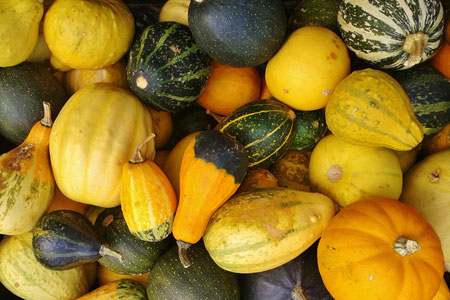
It seems like just yesterday the market was overrun with summer bounty. Then overnight, voila! The winter squash arrived. Great piles of pumpkins ready for jack-o-lanterns. Mountains of butternuts begging to be pureed into soups and pasta fillings. Acorn, kabocha, delicata, hubbard, all waiting to usher your dinner table into the taste of fall.
Winter squash, despite its name, is actually a summer-growing vegetable. These often deep-colored gourds spend months on the vine until the flesh turns from soft to a thick, hardened shell.
Once off the vine, the squash needs another few weeks to mature. So don’t be scared if your butternut has been sitting on the counter for a week untouched. As long as the squash is in a cool, dry place, it can keep for months.
When you are ready to tackle the gourd of your choice, grab your largest, sturdiest knife; that thick skin takes some elbow grease to cut through. A lengthwise cut should always be the starting point to get access to the seed filled center. At this point, trade the knife for a spoon to scrape, scoop, and discard all the seeds and fibers.
From here the options are many. Cut in half, the squash can be brushed with olive, sprinkled with salt and pepper, and roasted simply. They can be cut in thin, long slices, and roasted with rinds still attached. With a bit of extra effort, the rinds can be peeled off, then the flesh cut into one-inch cubes. In this form they are ready to simmer in curry, boil in soup broth, or roast in a hot oven tossed with favorite spices.
Squash have a wonderful adaptability to a range of flavorings. Anyone who has had pumpkin pie or pumpkin bread knows that particular squashes take well to cinnamon, nutmeg, brown sugar, maple syrup, and any other of those “Thanksgiving” seasonings tossed its way.
Butternut squash has a long, oft mimicked history of partnering with fall’s favorite herbs: sage and rosemary. Whether in a saucepan or in the oven, when they are simply brought together with butter or oil, and a couple cloves of garlic, you have a timeless taste combination.
One of the lesser known-pairings, but one of my favorites, is winter squash and curry. In Cambodia, parts of Northern Thailand, and Laos, it is fairly common to see dishes of thinly sliced pork or duck simmered in a rich and spicy broth of coconut and curried chunks of pumpkin or whichever squash happens to be on hand.
At home, I find one large squash can go quite a long way. I might peel a butternut and cube it, saving half to roast or otherwise cook in a completely different fashion later in the week. On day one I might go savory, tossing the cubes with rosemary and garlic. Then days later I might veer Thai by melting duck fat with red curry paste to coat the remaining cubes before sticking them in the oven.
It is rare a vegetable is as versatile as winter squash. Sweet, spicy, savory, stewed, roasted, even fried. It is hard to find a combination that doesn’t work. And with so much to choose from, sharpen that kitchen knife, because it is bound to be a long, delicious, squash-filled fall.


Made with fresh cilantro, butternut squash, duck fat or butter, red curry paste, salt and black pepper, red bell pepper
Serves/Makes: 4
- 4 1/2 pounds butternut squash
- 3 tablespoons duck fat or butter
- 4 teaspoons red curry paste
- salt and black pepper
- 1 red bell pepper, seeded and cut in chunks
- chopped fresh cilantro for garnish
Preheat the oven to 400 degrees F.
Cut the squash in half and remove and discard the seeds. Cut the squash into 1-inch thick slices. Slice the rind off with a vegetable peeler or knife. Cut the peeled slices into 1-inch cubes.
Melt the duck fat or butter in a saucepan over medium heat. Whisk in the curry paste until blended.
Place the squash cubes and bell pepper in a roasting pan. Toss with the curry mixture. Season as desired with salt and pepper.
Place the roasting pan in the oven and bake for 20 minutes at 400 degrees, stirring the mixture halfway through the cooking time.
Set the oven to broil. Stir the squash again and broil for 10 minutes, stirring after 5 minutes. Broil until the squash is tender and slightly caramelized.
Garnish with cilantro and serve.


related articles



Write a comment:
©2026 CDKitchen, Inc. No reproduction or distribution of any portion of this article is allowed without express permission from CDKitchen, Inc.
To share this article with others, you may link to this page:
https://www.cdkitchen.com/cooking-experts/amy-powell/1304-fall-squash/