

Winter Squash Are In Season This Fall


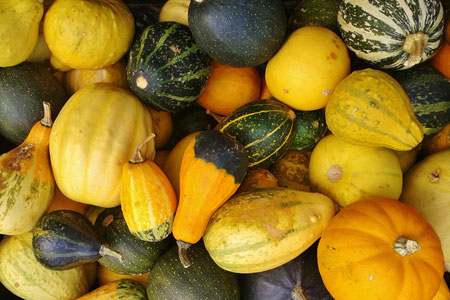
Acorn. Not just for squirrels. Spaghetti. Not always made of dough. Turban. If you think this belongs on someone's head, think again. These are all members of the seasonal, hearty group known as winter squash. Add in buttercup, hubbard, kabocha, and calabaza, and you have a collection of some of the most nutritious and delicious whole foods.
Winter squash varieties are available from August to March, but they peak in October and November. So why not be called autumn squash? Squash are either categorized as "summer" or "winter." Summer squash are thin-skinned with delicate, soft flesh, such as zucchini and pattypan. Winter squash, on the other hand, have thick rinds that protect the hard flesh, making them last much longer than summer squash. Winter squash may be stored without refrigeration in a cool, dry, dark place for a month or more. Once peeled or cut, winter squash must be covered and refrigerated. Like pumpkin and watermelon, winter squash belong to the gourd family.
Originally cultivated in the Americas, winter squash made its way to Europe via Christopher Columbus and has been a beloved foodstuff ever since. Rich in vitamin A (in the form of beta-carotene), vitamin C, potassium, dietary fiber and manganese, winter squash are anti-oxidants touted with helping to prevent heart attacks, high blood pressure, and colon and prostate cancers. In addition, winter squash are good sources of folate, omega-3 fatty acids, vitamin B1, and copper.
The following is a sampling of the more pervasive winter squash we know and love.
Acorn
Named for their shape, acorn squash have deep ridges with thick rinds that range in color from green to black to orange. They are small in size and weight, making them ideal for one or two people, especially when stuffed and baked. The flesh can range from orange to yellow, and is somewhat sweet and mild. Try my Sausage Stuffed Acorn Squash recipe for a sweet and savory one-dish meal.
Butternut
This is probably the most popular of all the winter squash. Shaped like a pear with a long neck, it has a cream-colored skin and a bright orange, sweet flesh. Butternut squash must be peeled and can be baked, roasted, boiled, or steamed. If you want to mix it up this Thanksgiving, prepare my Butternut Squash Gratin instead of candied sweet potatoes.
Hubbard
This is one of the larger winter squash, with a thick, hard, bumpy greenish-orange rind. The orange-yellow flesh texture is a bit grainy, so this squash is often mashed or pureed, instead of roasted and served in slices or chunks. The flavor is not as sweet as other varieties, but is rich and dry.
Kabocha
This squash is newer to the U.S. than many other winter varieties. With a drum shape, and a green rind, kabocha squash has the richest flesh in both color and flavor. The deep orange and intensely sweet flesh is delicious baked, roasted, boiled or steamed.
Spaghetti
Nature knew about spaghetti even before the Italians made pasta! Spaghetti squash was so named because when it is cooked, the tender, yellow, bland flesh separates into spaghetti-like strands. Some people refer to this as vegetable spaghetti. The rind is creamy yellow and the shape is like that of a watermelon. The whole squash can be baked by piercing the body half a dozen times with a pairing knife to create air vents that prevent the squash from exploding. Bake on a sheet pan in a 375F degree oven for 1 1/2 hours or until the flesh is tender when pierced with a knife. Cut the squash in half, scoop put the seeds, and gently remove the spaghetti strands with a fork. Serve with marinara sauce, just like pasta.
Turban
Also named for its shape, this squash has a hard and bumpy rind of varying colors ranging from orange to yellow to green. Turban squash is so beautiful and colorful that it is often used merely for decoration, but it is certainly edible. Bake, steam, or simmer this squash.


Made with Parmesan cheese, gruyere cheese, butternut squash, butter, fresh thyme, salt, black pepper, heavy cream
Serves/Makes: 6
- 3 pounds butternut squash
- 1 tablespoon butter
- 1 tablespoon chopped fresh thyme
- 2 teaspoons salt
- 1 teaspoon ground black pepper
- 1 1/2 cup heavy cream
- 1 cup shredded gruyere cheese
- 3 tablespoons grated Parmesan cheese
Preheat the oven to 400 degrees F.
Trim the squash by removing the stem and then cut the squash into two pieces: the neck and the bottom. Peel the skin of the neck so that the orange flesh comes through (remove the layer of green, like with a melon). Peel the round, bottom part of the squash, then cut in half lengthwise. Using a spoon, scoop out the seeds and stringy pulp. Cut both the neck and the bottom halves into 1/8-to-1/4-inch slices with a knife, mandoline or food processor's slicing blade.
Butter a baking or gratin dish. Place enough squash slices in the dish to form a single layer and sprinkle with some of the salt, pepper, chopped thyme and gruyere. Repeat until all the squash sliced have been used.
Pour the cream evenly over the top of the squash. Cover with the parmesan, and bake for about 35-45 minutes. You may brown the top of the gratin by placing it under a hot broiler for 4 -5 minutes. Serve immediately.
You may make this dish in advance, but do not place it under the broiler to brown the cheese until you are ready to serve.
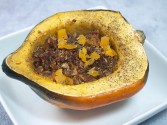
Made with acorn squash, olive oil, sausage meat, shiitake mushrooms, onion, dried apricots, pine nuts, maple syrup, bread crumbs, Parmesan cheese
Serves/Makes: 4
- 2 acorn squash
- 1 tablespoon olive oil
- 1/2 cup sausage meat, removed from the casing
- 1 cup sliced shiitake mushrooms
- 1/2 cup sliced onion
- 1/4 cup dried apricots, diced
- 1/4 cup pine nuts, toasted
- 1/4 cup maple syrup
- 2 tablespoons bread crumbs
- 2 tablespoons grated Parmesan cheese
- 1 teaspoon dried thyme
- 1 teaspoon dried sage
- salt and pepper, to taste
Preheat oven to 350 degrees F.
Heat the olive oil in a small nonstick skillet over medium heat. Add sausage and cook until browned, about 5 minutes. Remove from the pan and coarsely chop, if necessary. Reserve in a bowl.
Add sliced onions to the skillet and cook for about 5 minutes or until tender and golden. Remove and add to the bowl with the sausage.
Add sliced mushrooms to the skillet, which should be pretty dry at this point, and cook until golden brown and tender. Remove and add to the onion sausage mixture.
Combine the sausage, onions and mushrooms, then add the apricots, pine nuts, maple syrup, bread crumbs, Parmesan, thyme and sage. Toss well to coat and season with salt and pepper.
Halve each acorn squash, remove seeds and pulp, and season the four cavities with salt and pepper. If the squash halves do not stand steadily, then cut a small portion of the bottom off to make an even surface area.
Evenly distribute stuffing to each cavity. Pour 1/2 cup water into a baking dish and add the stuffed squash.
Bake at 350 degrees F degrees for 45-60 minutes or until the squash is tender and cooked.
You can reserve the seeds when you remove the pulp from the squash and toast them as you would pumpkin seeds.


related articles



Write a comment:
©2026 CDKitchen, Inc. No reproduction or distribution of any portion of this article is allowed without express permission from CDKitchen, Inc.
To share this article with others, you may link to this page:
https://www.cdkitchen.com/cooking-experts/lauren-braun-costello/183-winter-squash/