

Edible Landscaping Part Two: Should You Really Be Eating Those Flowers?


Edible flowers have become so common that I can now buy them in little plastic clamshell containers at the local grocery store. Many restaurants feature them on their menus and bakeries adorn cakes with them. They are not the source of curiosity that they used to be. But are they as safe as we assume them to be?
Most of us already know that not all flowers are edible. But not all edible flowers are truly fit for human consumption. To be on the safe side, you should eat flowers only when you are absolutely positive that they are edible. Here are a few tips for safely consuming those pretty petals:
• Flowers used for garnish on restaurant served dishes may or may not be edible. Unless you are absolutely certain that they are, leave them on the plate.
• When preparing food with flowers as an ingredient or garnish, NEVER use flowers which are not edible or poisonous—even as a garnish. Always assume that your guests will eat whatever you put in front of them!
• Do not eat, or use as a garnish, flowers from florists, nurseries, or garden centers. To be absolutely safe, it’s best to grow your own flowers for culinary use. If you grow your own edible flowers do not use commercial pesticides, even ones that are labeled organic, on them.
• Do not eat, or use as a garnish, flowers picked from the side of the road or from areas with which you are not familiar.
• Remove pistils and stamens from flowers before eating or using them in a recipe.
• In general, eat only the flower petals. Roses, dianthus, English daisies, and marigolds have a bitter white area at the base of the petal where it was attached to the flower. Break or cut off this portion before using.
• As pretty as they are, not all edible flowers taste good. Taste the flower before you use it in a recipe. Different flavors occur in plants when grown in different locations including different locations on the same property. And the taste of a flower on the same plant can vary from year to year.
• To avoid stomach upsets, introduce flowers into your diet in small quantities. They are best used as sparingly or as a garnish.
• Never give edible flowers to children or persons with compromised immune systems.
• Not all flowers of vegetables are edible. Don’t assume that because the vegetable is edible that the flower is also edible. Flowers from tomatoes, eggplant, and peppers are in the nightshade family and should not be consumed.
• Pick edible flowers early in the morning when the water content is at its highest, gently wash them in cool water, pat them dry and store them in layers of damp paper towels in a closed plastic container in the vegetable bin of your refrigerator. They will last for several hours.
The edible flowers that I grow and use frequently in my cooking and garnishes are: Bee Balm, Borage, Daylilies, Lavender, Nasturtiums, Dianthus, Pansies, Roses, Anise Hyssop, and Squash Blossoms. I like to candy the rose petals and pansies to use on cupcakes and cakes for special events. Last year I grew a pot full of black pansies on my back patio and used them to make the Black Pansy Sorbet from Jerry Traunfield’s The Herbfarm Cookbook. It was every bit as sensational as he promises it will be. The magenta color of the sorbet, delicate floral scent, and subtle minty violet flavor are unlike anything I have ever experienced. A tiny scoop of this sorbet floating in a glass of Prosecco served on a warm summer evening is an indulgence you will not soon forget.
If you want to try growing some edible flowers of your own, I recommend starting with nasturtiums. They are an easy flower to grow in a patio pot or home garden. They thrive in poor soil, need very little attention other than a bit of water from time to time, come in a wonderful assortment of colors, and are very tasty. The flowers are mild and the leaves have a peppery bite to them. You can use the petals and leaves in salads, add them to rice dishes, combine them with mayonnaise or cream cheese, and use them to make a delicious compound butter. Toward the end of the summer, I make several batches of nasturtium-lemon butter to use in the colder months and to give as holiday gifts.
To learn more about growing and safely cooking with edible flowers, check out some of my favorite publications and websites on the topic:
COOKING WITH FLOWERS, Jekka McVicar, 2003, Kyle Cathie Limited.
EDIBLE FLOWERS: Desserts and Drinks, Kathy Wilkinson Barash, 1997, Fulcrum Publishing.
EDIBLE FLOWERS: From Garden to Kitchen: Choosing, Growing and Cooking Flowers, Kathy Brown, 2003, Aquamarine.
TAYLOR’S 50 BEST HERBS & EDIBLE FLOWERS, Storey Communications, Inc. 1999, Houghton Mifflin Company.
THE EDIBLE FLOWER GARDEN, Rosalind Creasy, 1999, Periplus Editions.
THE HERBFARM COOKBOOK, Jerry Traunfeld, 2000, Scribner.
THE LAVENDER COOKBOOK, Sharon Shipley, 2004, Running Press.
www.homecooking.about.com: Contains excellent information about edible and poisonous flowers as well as recipes.
www.whatscookingamerica.net: Has guidelines for culinary use of edible flowers along with helpful photos.
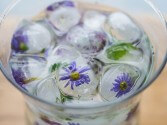
Serves/Makes: 16
- distilled water
- unsprayed flower petals (edible variety, such as rose petals, borage, and violets)
Pour distilled water into an ice cube tray, filling the sections halfway full and freeze until firm.
Add your unsprayed flower petals (rose petals, borage, and violets are especially pretty when used this way), then cover with distilled water and freeze until completely hardened.
Use in your favorite beverages. The flower ice cubes are especially pretty when used in glasses of club soda or sparkling water.
NOTE: Flowers which have been sprayed with pesticides should NEVER be used for culinary purposes either as an ingredient in a recipe or as a garnish. NEVER give edible flowers to children or persons with compromised immune systems.
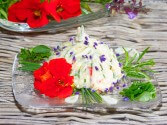

Made with fresh edible flower petals, butter, confectioners' sugar, almond, vanilla, lemon, or orange extract
Serves/Makes: 12
- 1/2 cup butter, softened
- 3 tablespoons confectioners' sugar
- 1 teaspoon almond, vanilla, lemon, or orange extract, optional
- 1/4 cup fresh edible flower petals, washed and dried
Place the butter, confectioners' sugar, and extract in a food processor. Process until well blended. Add the flowers and pulse-process just enough to distribute the flower petals. The butter should be speckled with flowers.
Scrape the butter from the food processor onto a piece of waxed paper. Roll the butter into a log shape inside the waxed paper. Place in the refrigerator until chilled. When ready to serve, slice the butter into thin rounds.
Alternately, you can place the butter in a shallow dish and serve that way (garnish the top with a fresh, whole flower if desired)
Made with nasturtium blossoms, sweet paprika, nasturtium leaves, brown rice, white rice, butter, sea salt, black pepper, nasturtium petals
Serves/Makes: 4
- 1 cup cooked brown rice, warm
- 1 cup cooked white rice, warm
- 1 tablespoon unsalted butter
- sea salt
- freshly ground black pepper
- 2 tablespoons finely chopped unsprayed nasturtium petals
- 2 tablespoons finely chopped unsprayed nasturtium leaves
- sweet paprika
- 1 handful whole unsprayed nasturtium blossoms, optional
Combine the warm rices in a medium sized serving bowl and toss with the butter until the butter is melted. Add salt and pepper to taste.
Gently blend in the chopped nasturtium petals and leaves. Sprinkle lightly with the paprika and, if using, garnish with the whole blossoms.
Serve immediately.
NOTE: Flowers which have been sprayed with pesticides should never be used for culinary purposes either as an ingredient in a recipe or garnish. Never give edible flowers to children or persons with compromised immune systems.


related articles

Write a comment:
©2026 CDKitchen, Inc. No reproduction or distribution of any portion of this article is allowed without express permission from CDKitchen, Inc.
To share this article with others, you may link to this page:
https://www.cdkitchen.com/cooking-experts/victoria-wesseler/518-edible-landscaping-flowers/