

cdkitchen > cooking experts > rebecca michaels

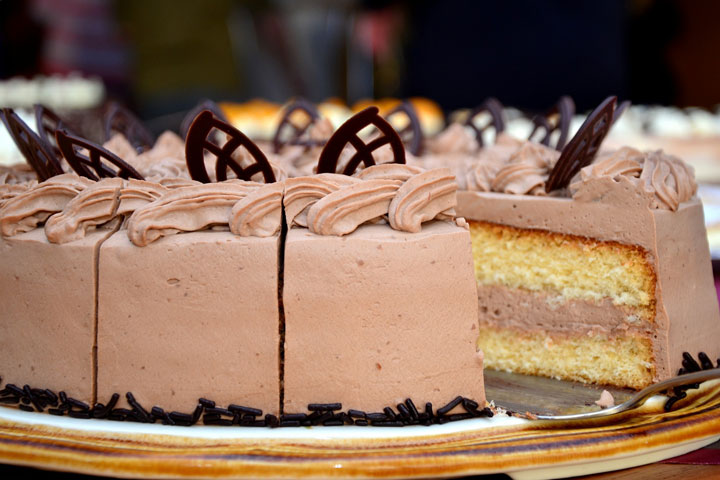
Teaching cake decorating in an article is an impossible task, and there are certainly plenty of books on the subject. But I'm going to give you some helpful tips that I've learned that will make icing your cake a little bit easier if you're still a novice at it. It may seem a little daunting at first, but with some practice and the right tools, you'll have a lovely cake well worth showcasing.
Having the proper equipment will save you a lot of trouble. Take a trip to a local cake supplies store or shop online if you plan ahead. Before you embark on this adventure, make sure you have everything you need rather than running here and there for different items at the last minute.
Buy large and small offset spatulas. I find them much easier to work with than straight spatulas (and when I say 'spatula' I mean the kind with a handle and a dull metal straight edge, not the plastic kind that you mix your batter with or the kind that you use to flip burgers. It's very confusing, I know).
Get yourself some cardboard cake rounds the size that your cake will be. Moving and storing cake layers will be much easier and frosting the cake will be a snap, since you won't have to worry about smearing icing on the edge of your board. Don't use a dinner plate; it dips inward too much and will give you a saggy cake. If you think you'll be practicing often, a cake turntable is a good investment. I like the heavy metal kind that sits on a pedestal. It will last forever.
Sometimes I find that my cake board is sliding around on the turntable too much. So I temporarily anchor it with a piece of damp paper towel. It will give you a firm grip with no mess.
It goes without saying that you must practice practice practice to get frosting down pat. Make either French or American buttercream and practice with it. It will keep for a week in the fridge, longer in the freezer. These frostings are easier to work with than ganache, which needs to be the correct consistency, or cream cheese frosting, which doesn't hold its shape very well. Hold off on shiny chocolate glaze until you get your frosting under control; glaze will show every little bump or lump in your finished product. Besides, you should crumbcoat your cake first to give the cake the straightest smoothest appearance. So, first things first.
When you first start, keep your decorating simple. Practice some piping and writing skills on parchment paper or your counter top first. Learn how to make a paper cornet, the little paper pastry bag that every pastry chef can make in her sleep. They are a little tricky at first, but are a quintessential part of pastry decorating of all kinds. Try using fresh, edible flowers on the cake in a couple of small 'bouquets' on the top and sides. Nasturtium and miniature roses are very pretty. Just make sure your flowers are free of pesticides.
So I think those tips should get you started on your quest. Good luck! You'll get the hang of it!
1 comments
©2026 CDKitchen, Inc. No reproduction or distribution of any portion of this article is allowed without express permission from CDKitchen, Inc.
To share this article with others, you may link to this page:
https://www.cdkitchen.com/cooking-experts/rebecca-michaels/160-icing-on-the-cake/
The Icing on the Cake
Teaching cake decorating in an article is an impossible task, and there are certainly plenty of books on the subject. But I'm going to give you some helpful tips that I've learned that will make icing your cake a little bit easier if you're still a novice at it. It may seem a little daunting at first, but with some practice and the right tools, you'll have a lovely cake well worth showcasing.
Having the proper equipment will save you a lot of trouble. Take a trip to a local cake supplies store or shop online if you plan ahead. Before you embark on this adventure, make sure you have everything you need rather than running here and there for different items at the last minute.
Buy large and small offset spatulas. I find them much easier to work with than straight spatulas (and when I say 'spatula' I mean the kind with a handle and a dull metal straight edge, not the plastic kind that you mix your batter with or the kind that you use to flip burgers. It's very confusing, I know).
Get yourself some cardboard cake rounds the size that your cake will be. Moving and storing cake layers will be much easier and frosting the cake will be a snap, since you won't have to worry about smearing icing on the edge of your board. Don't use a dinner plate; it dips inward too much and will give you a saggy cake. If you think you'll be practicing often, a cake turntable is a good investment. I like the heavy metal kind that sits on a pedestal. It will last forever.
Sometimes I find that my cake board is sliding around on the turntable too much. So I temporarily anchor it with a piece of damp paper towel. It will give you a firm grip with no mess.
It goes without saying that you must practice practice practice to get frosting down pat. Make either French or American buttercream and practice with it. It will keep for a week in the fridge, longer in the freezer. These frostings are easier to work with than ganache, which needs to be the correct consistency, or cream cheese frosting, which doesn't hold its shape very well. Hold off on shiny chocolate glaze until you get your frosting under control; glaze will show every little bump or lump in your finished product. Besides, you should crumbcoat your cake first to give the cake the straightest smoothest appearance. So, first things first.
When you first start, keep your decorating simple. Practice some piping and writing skills on parchment paper or your counter top first. Learn how to make a paper cornet, the little paper pastry bag that every pastry chef can make in her sleep. They are a little tricky at first, but are a quintessential part of pastry decorating of all kinds. Try using fresh, edible flowers on the cake in a couple of small 'bouquets' on the top and sides. Nasturtium and miniature roses are very pretty. Just make sure your flowers are free of pesticides.
So I think those tips should get you started on your quest. Good luck! You'll get the hang of it!
share this article:


related articles



1 comments
It was interesting and informative. Please give us more information on how to decorate cakes, I would like to learn more. Thanks! Terry S.
Comment posted by Wildducktoo
Write a comment:
©2026 CDKitchen, Inc. No reproduction or distribution of any portion of this article is allowed without express permission from CDKitchen, Inc.
To share this article with others, you may link to this page:
https://www.cdkitchen.com/cooking-experts/rebecca-michaels/160-icing-on-the-cake/