



In a cooking rut? Try one of these taste-tested, family-approved recipes using ground beef.
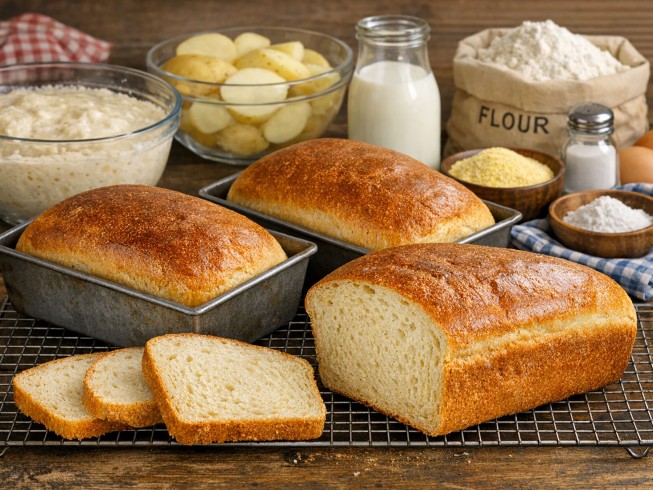
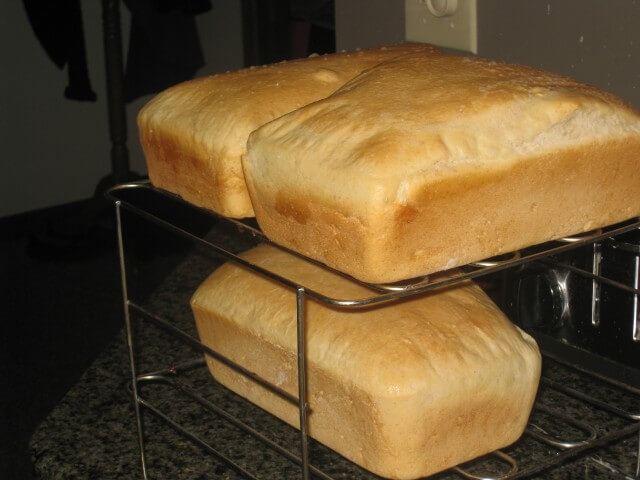


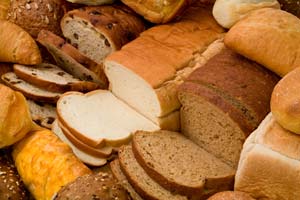
Say goodbye to ordinary loaves and hello to salt-rising bread, where a bit of science and a touch of nostalgia come together in a moist and chewy masterpiece. Bake it, taste it, and probably fall in love with it.

Starter
2 medium-size potatoes peeled and sliced thin
1 quart boiling water
1/4 cup nondegerminated cornmeal, such as stone-ground
2 tablespoons sugar
1 teaspoon salt
Sponge
1 1/2 cup milk
1/4 teaspoon baking soda
4 cups all-purpose flour
Dough
6 cups all-purpose flour
2 1/2 teaspoons salt
6 tablespoons vegetable shortening
To make the starter: Put the potatoes in a large bowl, pour the boiling water over, then stir in the cornmeal, sugar, and salt. Place the bowl in a larger bowl of hot water, and set in a warm place where the temperature remains fairly steady-a gas oven with just the pilot light on, or an electric oven with the interior light on, or on top of the water heater. Replace the hot water two or three times-or whenever you think of it and it's convenient-over the next 24 hours. Then remove the potato slices from the bowl, and continue on with the sponge.
To make the sponge: Heat the milk until it is comfortably warm to your finger, then add it to the starter, along with the baking soda and 3 1/2 cups flour. Beat briskly until smooth-a hand rotary beater helps to smooth out the lumps. Cover with plastic wrap and again place in a larger bowl of hot water. Set in a warm place (see preceding suggestions), and let the sponge double in bulk-this usually takes 2 to 3 hours, but check it after 1 1/2 hours. When doubled, it will look creamy and light. Don't let it sit longer after it is creamy and light or it will lose its "cheesy" flavor and become sour.
To make the bread dough: Put 4 cups of the flour in a large bowl. Add the salt and mix lightly with a fork. Drop in the shortening and blend it in with your fingers- as though you were making pie dough-until the mixture looks like fine meal. Add the flour mixture to the sponge and beat until well mixed. Add enough more flour-1 or 2 cups- to make a soft, manageable dough you can knead. Turn out onto a floured surface and knead for a minute or two. Let rest for 10 minutes.
Resume kneading until the dough is smooth (this dough is heavy and rather puttylike)-about 10 minutes. Divide in thirds and shape each piece into a loaf. Place in greased loaf pans. Cover with plastic wrap, set the pans in a larger pan of hot water, and again set in a warm place to rise. This final rise will take about 3 hours, and the loaves should increase in volume by about one third-this is less than the usual doubling in bulk. Bake in a preheated 350 degrees F oven for 45 to 55 minutes, until golden brown. If in doubt, better to bake a few minutes longer than underbake. Turn out of the pans and cool on a rack.
ABOUT SALT-RISING BREAD (from the Fanny Farmer Baking Book)
Salt-rising bread is something to get excited about! It was dearly loved an considered very wholesome and nutritious during the late nineteenth and early twentieth centuries, but we lost the method of making it-a result of modern technology, I think. It seems our milling process became so refined that we took the germ out of the corn kernel when milling cornmeal, and thus lost the vital nutrient needed to capture the yeast for the salt-rising bread starter. I'm happy to say the following recipe works extremely well, but you must use a nondegerminated cornmeal, such as a true stone-ground cornmeal found in health-food stores - which keeps the germ in the milling process.
The name "salt-rising bread" stems from the original method of keeping the dough warm: the bowl of dough was set in a large container of warmed rock salt, which held the heat for a long time. It's no longer necessary to keep the dough warm with salt, although it does need to be kept warmer than conventional yeast doughs-about 100 degrees F. In the recipe, I've given suggestions for convenient warm places found in almost every home.
Salt-rising bread is a great adventure to make and to eat. It is rather dense and heavy, with a creamy texture and a wonderful "cheesy" taste and aroma it will not rise quite as high as other yeast breads, but its rather compact, chewy texture makes it fabulous for toasting, and it makes the best grilled-cheese sandwiches you've ever had.
margjohnson



In a cooking rut? Try one of these taste-tested, family-approved recipes using ground beef.

Ranking #1 in nearly every "favorite cookie" poll, the chocolate chip cookie is pretty much the go-to cookie of choice for both kids and grownups alike.

Pumpkins aren't just for pies or Halloween decorations. These large, orange gourds - while naturally sweet - also work well in savory dishes. They pair well with poultry and pork (and especially bacon) and their creamy-when-cooked texture blends easily into soups.
reviews & comments
December 28, 2020
The recipe looked great and everything worked well once I used organic stone ground corn. Everything was fine until the dough was placed in the loaf pans. It did not rise after that. I believe that kneading for 10 minutes may be a bit too long. The bread tastes wonderful; too bad the loaves are so flat.
You are just supposed to knead until the dough is smooth, which can take up to 10 minutes but you do not have to knead the entire 10 minutes.
I just read Frosty's comment and I remembered that when we would make toast out of it that we always said it smelled like "stinky feet"!! Toasted with butter, only way to eat it--perfect!!!!!!
I just stumbled upon this recipe. I am so excited that I had to comment before even making. I grew up and still live in Southern California. In the 50's & 60's we could always buy Salt Rising Bread from VanDeKamps bakery in the stores. I think they discontinued it in the 70's. Have been craving for it ever since. Can't wait to try this. Thank you!! Melaney from SoCal.
I am rating this recipe at this time. I grew up in Kentucky and my parents owned a bakery there. We always made Salt Rising bread, even when the bakers of Jefferson County went on strike. All the private bakeries went into overdrive. Our bakery's recipe was to difficult to reduce to home making, but this recipe looks right on. I will let you know how it goes. Thanks
April 6, 2019
I can't say I followed this exact recipe but one very close with complete success after some false starts. 1) my oven maintains 110°F with the pilot. This is an ideal temperature. 2) I use regular DEGERMANATED Albers yellow cornmeal and it works fine!
March 17, 2017
I grew up in NE Ohio and my parents would stop by a bakery if we happened by just to get this bread. It wouldn't last very long! Unfortunately the bakery has long since closed. This recipe seems to have the most flavor of any SRB recipe I have tried... I also found out that adding a pinch of baking powder to the starter adds extra flavor! I also used the crockpot method to keep it warm. I find it fun (the smell really confused my hubby once lol) to make this bread and even better to eat!
I tried the heating pad and it didn't get hot enough. This was starter number 3. The other starters didn't have the potato.
I did buy stoneground corn meal..doesn't work with regular degermanated kind
January 14, 2016
This is almost exactly like my Mom's recipe..got the starter going now, looks good and bubbly!
I'm making a salt rising bread following a recipe handed down by my father. Final rise going on right now--which can take a while. I make this a couple times each winter, and usually around the holidays. My recipe is close but a bit different - am glad to share. Thanks for posting the origins of the name in your description. I never knew that!! Salt rising bread makes the best toast - bar none! I make the starter in a quart canning jar that I wrap with a heating pad on low. Usually takes 18-24 hr to get "ripe." My recipe calls for an additional step - after the starter is ready it is mixed with flour, salt, small amounts of baking soda, baking powder, and salt in a glass/crockery bowl and goes thru and additional rise/ripening before the milk, flour and a few other final ingredients are added. Give yourself time - generally from starting the starter to coming out of the oven ready to eat may take 36-48 hours. Well worth the wait!!
July 27, 2014
Thank you so much for posting this! This is the tastiest bread!!!
December 8, 2011
After lots of web search, I like this recipe. I see many people trying to get the warming correct. My hottub is perfect, but what do you do with 500 gallons of starter? Actually, what I found that was helpful was to use a crock-pot on the lowest setting. You fill it half full of water and invert the lid. You then place several hot pads or cloths on the lid. You place your starter in a large ceramic or glass bowl, cover with plastic wrap and cover the top of the bowl with a thick towel. I maintained a constant 101 degrees.
October 20, 2011
After 8 attempts at making the starter for Salt Rising bread (using other recipes) I finally got it right. The temp. is the most important part in success. This is the recipe I followed and it is wonderful. Stinky....yes and worth all the effort. The only thing I did different was the water temp. I got it to 190 degrees and cooled it to 130 before I put it on potatoes. I kept it at 101 degrees for 21 hours. I tried every possible thing I could think of to properly warm this and I finally decided to turn oven on to 200 degrees and put a pan of water on back burner on simmer and set my starter on top of stove covered with plastic wrap, a dish towel and a bath towel. Perfect. Loved this recipe.
July 22, 2010
THe crockpot trick worked great for getting the tempright with this recipe. Thanks for the suggestion. I didn't love the texture but it was ok.
August 2, 2009
This recipe was the 4th or 5th one I have tried to replicate the delicious (and greatly missed) Van de Kamp's Salt Rising bread from the 1950s - 1970s in Southern California. This recipe comes darn close, if not perfect in taste, texture and "toastability". It wasn't too difficult to make and definitely worth the effort. Yummy!
December 13, 2008
Note 1: I let my starter sit for fifteen hours in my oven with the light on (about 90 degrees F) and it showed almost no activity. I almost threw it out, but decided to do a little more research. What I found was that salt-rising starter and dough needs to rise at a higher temperature than commercial-yeast bread; at about 100-105 degrees F. Turning the oven on low brought the starter to life quickly. If your oven doesnââ¬â¢t go that low, turn it on briefly every hour or so. But be careful not to get the oven too hot or youââ¬â¢ll kill the bacteria. Using the same heat, the sponge and dough completed their activity much quicker than the directions indicate. So, use appropriate heat and watch your times. Note 2: After the sponge is ready and youââ¬â¢re preparing the dough, you can add more water and flower to make as many loaves as you want. However, the sponge is voluminous ââ¬â almost a heavy foam. So youââ¬â¢ll need to first mix the ingredients called for in the recipe so the foam is incorporated into the dough, before adding any extra flour and water. Because of the large amount of foam in the starter youââ¬â¢ll also need a very large bowl to mix everything in, like a soup pot. Note 3: This dough does not need much kneading. If you over-knead, the dough will be tough.
OK, I have made salt rising bread before , and I dont know what reality your nose lives in , but it does not smell worse than rotting corpses. You must be really weak stomached. At the most it smells like asiago cheese. I've noticed that the first batch of bread made from the first ferment is stronger is smell than the subsequent batches made from the same starter. Just reserve about a cup aside after you sponge the starter. By the way, my starter recipe is by an old woman who has been baking it for 80 yrs-she's quite old. It uses NO potatoes in the starter recipe. Hmmmmmm
November 7, 2006
Okay, my friend Gary was telling me how much he enjoyed "salt rising bread" he use to get back in New York State. I of course, being the person that I am (in Texas), went to the internet and dug up a recipe and decided to try and make this unusual style bread. He warned me about the odor this bread produces when you make it but geeze I had no idea something like bread could smell so bad. Yesterday I started the "starter" for this old world style bread and let it ferment in the oven overnight with a 100 watt light on to keep the temperature constant, when I awoke this morning I could smell what the recipe describes as a rotten cheese smell, but I would describe it more like rotten feet or really bad smelly socks! About 1 pm today I started making the "sponge" for the recipe and let me tell you it didn't look anything like what I expected. I almost up chucked at the smell, it was that bad. The sponge was very wet and didn't double in size at all, I let it rise for three hours like the recipe calls for and the smell just got worse, not like what I prefer to smell when I am baking bread. This stuff was worse smelling than some of the calls I had back when I worked for the mortuary on county contract! I mean seriously, I have a strong stomach and this recipe was turning it over something terrible. Well after I finally got the dough made and let it rise again in the pans (3 loafs) it is finally baking and the whole house now wreaks of that odor. It's got to be some nasty stuff because it sure smells that way to me. Even Gary's son Justin told me several times "that smells rotten you better throw it out" and he usually loves my baking. While I was writing this the bread finished baking, the whole house now wreaks of a dirty socks/rotten cheese kind of smell... All I can say is Gary, I hope you enjoy this "salt rising bread" stuff, if it doesn't taste absolutely "to die for" I don't think I will be making it again. Frosty PS: It did rise when in the loaf pans, more so than expected.