

Preserving Tomatoes


Right now, I am having a love/hate relationship with my tomato plants. For weeks, I could hardly wait for the first one to ripen. Now, at the peak of their harvest, as I lug boxes and boxes of them from the garden to my kitchen every morning, I tell myself that if I never see another tomato it will be too soon.
But by December, I will have changed my tune and offer to sell my soul for just one garden fresh, sun-warmed tomato. In its absence, I’ll settle for the next best thing: a jar of canned tomatoes from my basement or a bag of roasted Romas from my freezer.
If you come to my home during tomato harvest season, you’ll see kitchen counters crowded with glass canning jars, bands and lids, all sorts of canning equipment, boxes of tomatoes and a copy of what I consider to be the ultimate authority on food preservation, the Ball Blue Book: Guide to Home Canning, Freezing and Dehydration.
I have been canning for about five years. I was taught by my husband who helped his mother and his grandmother with that activity every summer while he was growing up. Canning, or “putting up” tomatoes isn’t as difficult as you might think. While it is time consuming, the results are worth it. I actually find the whole process relaxing. There is something oddly soothing about the slow, methodical rhythm of preserving food in my kitchen on a summer afternoon.
For many people, like my husband, food preservation is a time honored family tradition with processes and recipes being passed down from one generation to the next. However, many older recipes and processes may not be safe to use. The National Center for Home Food Preservation (www.uga.edu/nchfp ) cautions that only boiling water or pressure canning methods are currently recommended for home canning activities. Older methods, such as oven canning and open-kettle canning, have now been discredited by the USDA because they can result in unsafe food products.
You may have seen “steam canners” advertised recently. According to Judy Harrison, Ph.D., Extension Food Safety Specialist with the Cooperative Extension at the University of Georgia, steam canners would need more testing before they could be used with USDA canning recommendations. She notes that the current USDA canning recommendations were developed using boiling water and pressure canning. The recommendations cannot be assumed to be safe for use with steam canners. She recommends that individuals only use boiling water and/or pressure canners if they are following USDA guidelines like those in So Easy To Preserve from the University of Georgia Cooperative Extension or the Ball Blue Book.
Just as the proper equipment is important when home canning, so is the use of proper recipes. Dr. Harrison states that when canning tomatoes, the process of acidification, adding citric acid or bottled lemon juice to the tomatoes, is a critical step in the process to assure a safe food product. Despite what you may have been told by relatives and friends who have used certain canning or food preservation methods without problems for years, your best strategy is to refer to the most current Ball Blue Book, visit The National Center for Home Food Preservation (www.uga.edu/nchfp) or contact your local Cooperative Extension Service office and follow their recommendations to the letter.
But traditional canning isn’t your only option for preserving summer tomatoes. They can be also be preserved by drying, freezing, or pickling. You can also use them to make tomato jam which is wonderful when spread on warm baking powder biscuits.
The recipe below, actually more of a process than a recipe, is a quick and easy way to preserve Roma tomatoes. The tomatoes can be rough chopped and served over hot pasta, ravioli or tortellini topped with parmesan cheese, torn basil leaves, and a generous drizzle of warm olive oil in which you have sautéed some finely chopped garlic. Or use them whole to top grilled bread slices or homemade pizza.
An even easier way to preserve Romas is to rinse and dry them; then place them in freezer storage bags in your freezer. These tomatoes can be thawed and used in stews, soups and sauces. When you want to use them, simply run a bit of warm water over the frozen Romas and the skins will slip right off. Or you can just toss the frozen tomatoes into a hot pot of stew or soup and the peel will float to the top.
Tomato season always ends too soon. So, take an afternoon and preserve some of those beautiful tomatoes for a little bit of summer on a cold winter’s day.
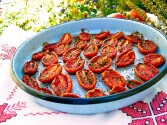

Made with Roma tomatoes, olive oil, white granulated sugar, kosher salt, fresh thyme, black pepper
Serves/Makes: 24
- 12 Roma tomatoes
- olive oil
- 2 tablespoons white granulated sugar
- 1/2 teaspoon kosher salt
- 1/2 teaspoon coarsely ground black pepper
- chopped fresh thyme, optional
Heat oven to 300 degrees F.
Slice Roma tomatoes in half lengthwise, gently remove the seeds with your fingers and lightly brush the cut tops of the tomatoes with olive oil.
Place the tomatoes, cut side up, in a single layer on a cookie sheet that has been lined with non-stick foil.
In a small bowl, mix remaining ingredients (except the optional thyme). Sprinkle some of the mixture lightly over each tomato half. You may also sprinkle a tiny bit of chopped fresh thyme over them.
Bake the tomatoes in the oven for 3-4 hours or until they are nicely browned on the edges.
Use immediately or let cool completely and place them in freezer storage bags in your freezer for later use.
When you want to use your Romas, thaw them in the refrigerator and heat them, covered with a paper towel on a microwave safe plate, for a few seconds at a time on 70% power in the microwave until they are warm.


related articles



1 comments
I roast and can all our end of the summer tomatoes. Nothing goes to waste. Frankly, I prefer the roasted ones because the flavor is so much richer. Great article on the canning safety!
Comment posted by Liv
Write a comment:
©2026 CDKitchen, Inc. No reproduction or distribution of any portion of this article is allowed without express permission from CDKitchen, Inc.
To share this article with others, you may link to this page:
https://www.cdkitchen.com/cooking-experts/victoria-wesseler/349-preserving-tomatoes/