

cdkitchen > cooking experts > amy powell

Close your eyes and let your finger drop at random on most Italian-American restaurant menus and there is a fairly good chance your dish of choice will contain the stringiest of Italian cheeses, mozzarella. Mozzarella has infiltrated the American diet in the last century, emerging as the definitive topping of pizza, the glue that binds lasagna, the on-the-go snack (when formed into a stick), and the quintessential breaded, deep fried bar food. The once humble fresh Italian cheese made from the milk of water buffalo has morphed into a mass produced staple of the food service industry. Now, like with many foods, Americans are slowly beginning to rediscover the original mozzarella and what they are finding is far more than an oozing pizza topping would suggest.
Mozzarella most likely gets its name from the Italian words mozza, cut, or mozzare, to cut off. Long before mozzarella morphed into the mass produced form of the cheese used in the United States, it was a simple, hand-crafted fresh cheese made from the milk of domesticated water buffalo. It is unclear when buffalo mozzarella was first produced, but it has been made in Italy, specifically the Campania region for at least 500 years.
In its original form, rennet is first used to coagulate warm milk. The curds that form are then gathered together and plunged into a warm bath of whey or salted water. The cheese maker then kneads the curds as one would knead bread dough forming the traditional stringy characteristic of the cheese. The cheese is then shaped and cut into whatever form is desired.
Somewhere between the water buffalo of Italy and the cows of the United States, low moisture mozzarella hit the dining scene. Low moisture mozzarella is made from whole or skim cow’s milk and has a significantly longer shelf life than the fresh variety, hence its appeal to the industry of mass food production.
At some point in the last 15-20 years Americans started to get a hankering for the real thing. What started as a bit of a fad on the appetizer portion of the menu quickly became a staple as more and more people came to expect fresh mozzarella to be served alongside tomatoes and basil, drizzled in olive oil, in the form of a caprese salad. In higher end pizza joints it is now quite common to find the Americanized mozzarella swapped out for oozing rounds of fresh buffalo mozzarella over a sweet tomato sauce on a crispy, thin crust Neapolitan-style pizza. And if there was any wonder that the artisanal cheese has gone mainstream, it is now possible to find this cheese in just about any supermarket as well as super-sized packs in the box stores.
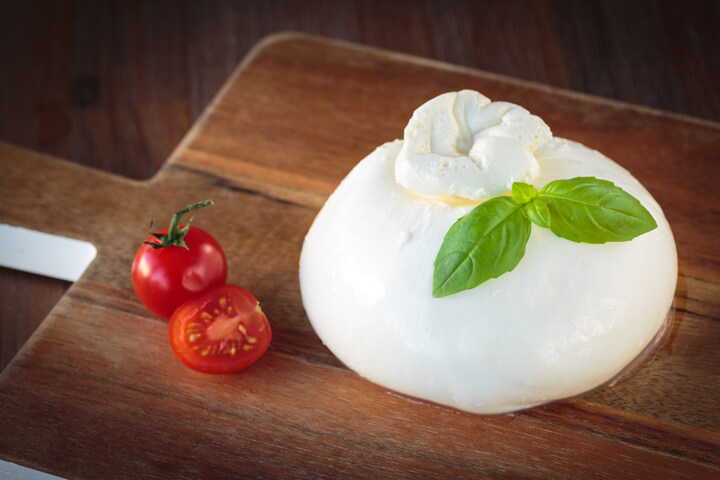
Now that the interest in mozzarella has moved back to the artisanal fresh variety to the point that the fresh cheese is being mass produced, cheese lovers may be wondering where to look next. The answer probably lies with mozzarella’s cousin, burrata. Burrata is made in the same fashion of traditional fresh buffalo mozzarella with the exception of when the cheese is being formed into individual balls. At this point the cheese maker forms a small pouch in the mozzarella, into which he or she pours cream and scraps of mozzarella. The cheese is then sealed to form what is essentially fresh mozzarella but with a deliciously cream filled center.
Burrata can take the place of mozzarella in many recipes and works particularly well in salads and appetizers where the creamy burrata center can be appreciated in all its glory. Consider burrata when making summer caprese salads paired alongside heirloom tomatoes. In the winter, roasted cherry tomatoes drizzled with basil oil make a lovely hot-cool contrast with the creamy cheese center. Burrata and arugula on toasted crostini make simple and elegant hors d’oeuvres. Bring all those flavor profiles together on country bread with a pancetta, tomato, arugula and burrata sandwich that will make you never look at a BLT the same way again.
Part of the joy of our ever evolving food culture is the rediscovery of traditional foods, such as fresh buffalo mozzarella, which can then act as a gateway for new discoveries like burrata. The typical Italian-American restaurant may never completely do away with its dependence on Americanized cow’s milk mozzarella, but the demand for more artisanal items like fresh mozzarella has made it almost as widely available as the other variety, if only in caprese salads. If today’s curiosity is tomorrow’s culinary trend it stands to reason that much like its buffalo milk cousin, burrata might soon finds itself not only on the plates of many Americans but perhaps even super-sized, coming to a Costco near you.
©2026 CDKitchen, Inc. No reproduction or distribution of any portion of this article is allowed without express permission from CDKitchen, Inc.
To share this article with others, you may link to this page:
https://www.cdkitchen.com/cooking-experts/amy-powell/1009-mozzarella/
Coming to a Costco Near You: Burrata

Close your eyes and let your finger drop at random on most Italian-American restaurant menus and there is a fairly good chance your dish of choice will contain the stringiest of Italian cheeses, mozzarella. Mozzarella has infiltrated the American diet in the last century, emerging as the definitive topping of pizza, the glue that binds lasagna, the on-the-go snack (when formed into a stick), and the quintessential breaded, deep fried bar food. The once humble fresh Italian cheese made from the milk of water buffalo has morphed into a mass produced staple of the food service industry. Now, like with many foods, Americans are slowly beginning to rediscover the original mozzarella and what they are finding is far more than an oozing pizza topping would suggest.
Mozzarella most likely gets its name from the Italian words mozza, cut, or mozzare, to cut off. Long before mozzarella morphed into the mass produced form of the cheese used in the United States, it was a simple, hand-crafted fresh cheese made from the milk of domesticated water buffalo. It is unclear when buffalo mozzarella was first produced, but it has been made in Italy, specifically the Campania region for at least 500 years.
In its original form, rennet is first used to coagulate warm milk. The curds that form are then gathered together and plunged into a warm bath of whey or salted water. The cheese maker then kneads the curds as one would knead bread dough forming the traditional stringy characteristic of the cheese. The cheese is then shaped and cut into whatever form is desired.
Somewhere between the water buffalo of Italy and the cows of the United States, low moisture mozzarella hit the dining scene. Low moisture mozzarella is made from whole or skim cow’s milk and has a significantly longer shelf life than the fresh variety, hence its appeal to the industry of mass food production.
At some point in the last 15-20 years Americans started to get a hankering for the real thing. What started as a bit of a fad on the appetizer portion of the menu quickly became a staple as more and more people came to expect fresh mozzarella to be served alongside tomatoes and basil, drizzled in olive oil, in the form of a caprese salad. In higher end pizza joints it is now quite common to find the Americanized mozzarella swapped out for oozing rounds of fresh buffalo mozzarella over a sweet tomato sauce on a crispy, thin crust Neapolitan-style pizza. And if there was any wonder that the artisanal cheese has gone mainstream, it is now possible to find this cheese in just about any supermarket as well as super-sized packs in the box stores.
Now that the interest in mozzarella has moved back to the artisanal fresh variety to the point that the fresh cheese is being mass produced, cheese lovers may be wondering where to look next. The answer probably lies with mozzarella’s cousin, burrata. Burrata is made in the same fashion of traditional fresh buffalo mozzarella with the exception of when the cheese is being formed into individual balls. At this point the cheese maker forms a small pouch in the mozzarella, into which he or she pours cream and scraps of mozzarella. The cheese is then sealed to form what is essentially fresh mozzarella but with a deliciously cream filled center.
Burrata can take the place of mozzarella in many recipes and works particularly well in salads and appetizers where the creamy burrata center can be appreciated in all its glory. Consider burrata when making summer caprese salads paired alongside heirloom tomatoes. In the winter, roasted cherry tomatoes drizzled with basil oil make a lovely hot-cool contrast with the creamy cheese center. Burrata and arugula on toasted crostini make simple and elegant hors d’oeuvres. Bring all those flavor profiles together on country bread with a pancetta, tomato, arugula and burrata sandwich that will make you never look at a BLT the same way again.
Part of the joy of our ever evolving food culture is the rediscovery of traditional foods, such as fresh buffalo mozzarella, which can then act as a gateway for new discoveries like burrata. The typical Italian-American restaurant may never completely do away with its dependence on Americanized cow’s milk mozzarella, but the demand for more artisanal items like fresh mozzarella has made it almost as widely available as the other variety, if only in caprese salads. If today’s curiosity is tomorrow’s culinary trend it stands to reason that much like its buffalo milk cousin, burrata might soon finds itself not only on the plates of many Americans but perhaps even super-sized, coming to a Costco near you.
Roasted Cherry Tomato Salad with Burrata and Basil oil


Made with balsamic vinegar, sea salt, salt and pepper, cherry tomatoes, burrata, basil, olive oil
Made with balsamic vinegar, sea salt, salt and pepper, cherry tomatoes, burrata, basil, olive oil
Serves/Makes: 4
- 1 1/2 pint cherry tomatoes
- 4 rounds burrata
- 3/4 cup packed basil leaves
- 3/4 cup olive oil, divided
- salt and pepper
- sea salt
- aged balsamic vinegar
Preheat oven to 400 degrees F.
Toss cherry tomatoes with salt, pepper, and 1/4 cup olive oil on a large baking sheet. Place tomatoes in oven and roast for about 10 minutes until tomatoes are hot and the skins begin to burst.
Meanwhile, bring a small pot of water to a boil. Blanch basil leaves for 10 seconds, drain, then immediately transfer to an ice water bath. Drain again.
In a blender, puree basil leaves with 1/2 cup olive oil. Season to taste with salt and pepper.
To serve, arrange one round of burrata and some of the roasted tomatoes on individual plates. Drizzle with the basil oil, sprinkle with a bit of coarse sea salt, and dot with a few drops of aged balsamic.
share this article:


related articles




Write a comment:
©2026 CDKitchen, Inc. No reproduction or distribution of any portion of this article is allowed without express permission from CDKitchen, Inc.
To share this article with others, you may link to this page:
https://www.cdkitchen.com/cooking-experts/amy-powell/1009-mozzarella/