

cdkitchen > cooking experts > rebecca michaels

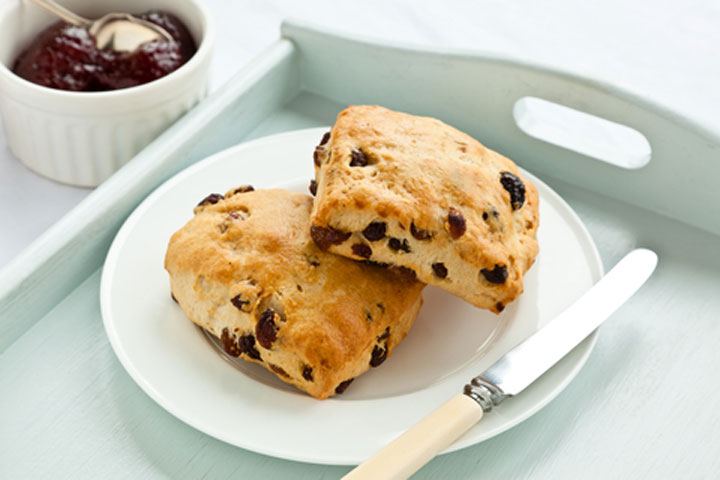
We’ve been deluged by requests to make scones for some of our wholesale clients, so scones have been on The Monkey’s brain in recent days. Whenever we’ve had some spare time, we’ve been playing around with different recipes and reading as much as we can about making scones.
Let’s start out with the basics. A scone is a sweet biscuit. And a biscuit is a savory scone. The only difference is the choice of words across the pond. Americans use the word ‘biscuit’ to describe a fluffy, butter-laden, chemically leavened (meaning baking powder or baking soda is used instead of yeast (a natural leavener) or eggs (a mechanical leavener)) individual-sized bread product. Britons use ‘biscuit’ to describe cookies. But that’s another article.
Scones are deceptively simple to make. The ingredients are basic: flour, sugar, salt, baking powder or soda, cream, and butter. Sometimes recipes contain eggs, but this is not your traditional scone. Putting these ingredients together, however, requires a little bit of know-how so that you get a supple, fine-crumbed product that won’t break a window or your teeth.
The key to a beautiful scone is mixing the ingredients as little as possible. Combine your dry ingredients in one bowl. No need to sift – just whisk together to aerate a little bit. Cut your butter up into very small pieces and keep it in the fridge until you're ready to use it. Cold butter is essential to creating flaky scones (just like making a pie crust). Next step: cut your butter into your dry ingredients. Personally, I like using my fingers to rub the butter into the flour until the mixture looks slightly wet and clumpy. Then gently fold your cream and whatever other accoutrements you plan on adding into the mixture.
You can shape your scones in a number of different ways. The easiest method is the drop method. Take your scone dough and scoop out scoopfuls with an ice cream scoop onto a parchment lined sheet tray. They will look more ‘biscuity’ this way. Or you can go a little more fancy and roll out the dough onto a heavily floured countertop. Roll out to about 1/2 inch thick. Now, you can use a round cutter for your scones, but I don’t recommend this. You really need to cut your scones in such a way that the sides aren’t smushed down; they will not rise properly if they are cut in ‘press-n-wiggle’ style, if you will. A safer route is perhaps the most traditional shaping method: the bannock. Roll out and shape your scone dough into a circle. Take a very sharp knife or benchknife and quickly and without hesitation, slash the circle into pie wedges. Separate the wedges and bake as above.
As soon as the scones come out of the oven, give them a glaze, if you so desire. For sweet scones, boil a couple of tablespoons of sugar with a tablespoon of water in the microwave until the sugar dissolves. Add a drop or two of vanilla or complementary flavoring. Brush on hot scones. For savory scones, brush scones with egg wash prior to baking.
Scones are really very forgiving. Play with the amounts of butter, sugar and cream in the recipes until you get your Perfect Scone.
Oh, and don’t forget the clotted cream and tea!
©2026 CDKitchen, Inc. No reproduction or distribution of any portion of this article is allowed without express permission from CDKitchen, Inc.
To share this article with others, you may link to this page:
https://www.cdkitchen.com/cooking-experts/rebecca-michaels/354-scones/
Throw a Girl a Scone!
We’ve been deluged by requests to make scones for some of our wholesale clients, so scones have been on The Monkey’s brain in recent days. Whenever we’ve had some spare time, we’ve been playing around with different recipes and reading as much as we can about making scones.
Let’s start out with the basics. A scone is a sweet biscuit. And a biscuit is a savory scone. The only difference is the choice of words across the pond. Americans use the word ‘biscuit’ to describe a fluffy, butter-laden, chemically leavened (meaning baking powder or baking soda is used instead of yeast (a natural leavener) or eggs (a mechanical leavener)) individual-sized bread product. Britons use ‘biscuit’ to describe cookies. But that’s another article.
Scones are deceptively simple to make. The ingredients are basic: flour, sugar, salt, baking powder or soda, cream, and butter. Sometimes recipes contain eggs, but this is not your traditional scone. Putting these ingredients together, however, requires a little bit of know-how so that you get a supple, fine-crumbed product that won’t break a window or your teeth.
The key to a beautiful scone is mixing the ingredients as little as possible. Combine your dry ingredients in one bowl. No need to sift – just whisk together to aerate a little bit. Cut your butter up into very small pieces and keep it in the fridge until you're ready to use it. Cold butter is essential to creating flaky scones (just like making a pie crust). Next step: cut your butter into your dry ingredients. Personally, I like using my fingers to rub the butter into the flour until the mixture looks slightly wet and clumpy. Then gently fold your cream and whatever other accoutrements you plan on adding into the mixture.
You can shape your scones in a number of different ways. The easiest method is the drop method. Take your scone dough and scoop out scoopfuls with an ice cream scoop onto a parchment lined sheet tray. They will look more ‘biscuity’ this way. Or you can go a little more fancy and roll out the dough onto a heavily floured countertop. Roll out to about 1/2 inch thick. Now, you can use a round cutter for your scones, but I don’t recommend this. You really need to cut your scones in such a way that the sides aren’t smushed down; they will not rise properly if they are cut in ‘press-n-wiggle’ style, if you will. A safer route is perhaps the most traditional shaping method: the bannock. Roll out and shape your scone dough into a circle. Take a very sharp knife or benchknife and quickly and without hesitation, slash the circle into pie wedges. Separate the wedges and bake as above.
As soon as the scones come out of the oven, give them a glaze, if you so desire. For sweet scones, boil a couple of tablespoons of sugar with a tablespoon of water in the microwave until the sugar dissolves. Add a drop or two of vanilla or complementary flavoring. Brush on hot scones. For savory scones, brush scones with egg wash prior to baking.
Scones are really very forgiving. Play with the amounts of butter, sugar and cream in the recipes until you get your Perfect Scone.
Oh, and don’t forget the clotted cream and tea!
Petone Martha's Date Scone


Made with self-rising flour, vanilla extract, eggs, dates, water, cream, honey
Made with self-rising flour, vanilla extract, eggs, dates, water, cream, honey
Serves/Makes: 12
- 1 package (12 ounce size) dates, pitted and chopped roughly
- 1 cup boiling water
- 1 cup cream
- 2 tablespoons honey
- 2 eggs, lightly whisked
- 1/2 teaspoon vanilla extract
- 4 cups self-rising flour
Preheat oven to 350 degrees F. Line a baking tray with parchment.
Soak dates in boiling water for 15 minutes or until soft, drain and discard water.
Heat cream and honey to lukewarm. Add eggs and vanilla extract and whisk for 1-2 minutes until well combined and slightly frothy.
Whisk flour into large bowl. Add dates to flour and toss until lightly covered. Add cream mixture and very gently combine.
Turn out onto floured surface and pat out to 1-inch thickness. Cut to desired shape. Bake for 12-14 minutes.
share this article:


related articles





Write a comment:
©2026 CDKitchen, Inc. No reproduction or distribution of any portion of this article is allowed without express permission from CDKitchen, Inc.
To share this article with others, you may link to this page:
https://www.cdkitchen.com/cooking-experts/rebecca-michaels/354-scones/