

Sukkot: A Jewish Harvest


Like virtually all Jewish holidays, the festival of Sukkot is marked by special dishes that are eaten in its celebration. The holiday itself is symbolized by plants and food, such as the etrog (citrus fruit) and lulav (palm branch). Known as the Feast of Tabernacles, Sukkot (also called Sukkos) is an eight-day festival of the fall harvest. The name refers to the huts (sukkot – the plural form of sukkah meaning "covering" or "shelter") used by Israelites during desert wanderings and constructed in the fields during the harvest season. Made mostly of branches and leaves, sukkot were easy to assemble, take apart, carry, and rebuild as Jews wandered the desert for forty years before reaching the Holy Land.
This Jewish thanksgiving is celebrated today, in part, by constructing a sukkah outdoors, and then sleeping and eating in it, as did Jews thousands of years ago. Since the theme is harvest and thanks, fruits and vegetables are hung inside the hut and meals are to be shared with family and friends. Hospitality and bounty influence the traditional dishes of Sukkot.
There are no biblical guidelines as to the foods that should be eaten in the sukkah. But there are many traditional foods popular throughout the Jewish calendar that are served on Sukkot because they symbolize plenty. Kreplach, for example, are meat-stuffed dumplings, much like Chinese wontons or Italian ravioli, served in soup. Stuffed eggplants, stuffed peppers, stuffed cabbage, knishes, strudels and other sweet pastries comprise familiar meals in the sukkah. The sukkah itself is decorated with apples, grapes, corn and pomegranates, so many festival recipes include these foodstuffs as ingredients.
Metaphor is important in Judaism, like in most religions. So bounty and plenty can be expressed by the various ways in which we "stuff" on Sukkot. There is a cycle of stuffing that completes the holiday: we stuff foods with which we stuff our bellies as we eat together in large numbers stuffed into a small hut. Sukkot can be celebrated at every juncture.
Growing up in an urban environment in New York, I never had the opportunity to build a sukkah at home. It was not until college that I had the occasion to eat in one. At Colgate University, my classmates, rabbi and I built a sukkah from cornstalks, branches, leaves and hanging fruits. We shared many lunchtime meals, huddled together in celebration of the ancient festival of Sukkot, but also for warmth. Colgate's home of Hamilton, New York enjoys a chilly and fiery autumn. The air is crisp and clean, and the hills look as though they are aflame. Eating in the sukkah was about all I could handle. I am not much of an outdoor enthusiast to begin with, and the temperature was too cold to tempt me.
I would like to tempt you, however, to try some delicious Jewish recipes. Whether you are Jewish or not, celebrate Sukkot or simply enjoy international fare, I know the following dishes will become some of your favorites. The ingredients are simple and basic, but the flavors are complex and extraordinary.
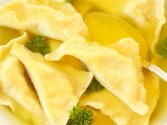

Made with noodle dough, rendered chicken fat or vegetable oil, ground veal, ground beef, onions, salt, black pepper, wonton wrappers
Serves/Makes: 24
- 1 tablespoon rendered chicken fat or vegetable oil, plus more for frying if desired
- 1/4 pound ground beef
- 1/4 pound ground veal
- 1/2 cup finely chopped onions
- 1 teaspoon salt
- 1/4 teaspoon black pepper
- 24 wonton wrappers
- OR
- 1 pound noodle dough
Heat the chicken fat or oil in a skillet over medium heat. Add the ground beef, ground veal, and chopped onions to the skillet. Cook, stirring frequently, for 10 minutes or until the meat is cooked. Season with salt and pepper, mix well, and let the mixture cool enough to handle.
If using noodle dough, roll the dough out and cut into 3-inch squares. Place the squares or wonton wrappers on a work surface. Place about one tablespoon of the meat mixture in the center of each square. Moisten the edges of the wrapper with water then fold the bottom point of the dough up over the filling to form a triangle. Press the edges together to seal the filling in. Let the filled kreplach dry for at least 15 minutes (or up to 1 hour).
Bring a pot of salt water to a boil. Add the kreplach, in batches as needed, and cook for 8-10 minutes or until they float to the top. Remove the kreplach with a slotted spoon and serve in hot, chicken soup.
If fried kreplach are desired, remove the boiled dumplings from the water and let drain on paper toweling. Heat 1/4 cup of chicken fat or vegetable oil in a skillet over medium-high heat. Add the kreplach and cook, turning as needed, until browned on all sides. Remove from the skillet with a slotted spoon and let drain on paper toweling before serving.

Made with cabbage, rendered chicken fat or vegetable oil, onions, crushed tomatoes, salt, black pepper, beef bones, ground beef, white rice, onion
Serves/Makes: 12
- 1 medium cabbage head
- 2 tablespoons rendered chicken fat or vegetable oil
- 2 small onions, sliced
- 1 can (28 ounce size) crushed tomatoes
- 1 tablespoon salt
- 1 teaspoon ground black pepper
- 1 pound beef bones
- 1 pound ground beef
- 1/4 cup uncooked white rice
- 1/4 cup grated onion
- 1 egg
- 3 tablespoons cold water
- 1/4 cup honey
- 1/4 cup fresh lemon juice
- 1/4 cup golden raisins
After cleaning the cabbage, core and place the head in a pot of boiling water. Cover and remove from heat. Let the cabbage soak for 15 minutes. Remove the cabbage from the pot and take 12 large, outer leaves. Set aside.
Heat the fat over medium heat in a deep, heavy pot or Dutch oven. Brown the sliced onions, then add the crushed tomatoes, half the salt and half the pepper. Add the bones and cook over a low heat for 30 minutes, uncovered.
Mix together the ground beef, rice, grated onion, egg, water, and remaining salt and pepper. Divide this mixture into 12 equal parts and place on each cabbage leaf. Tuck in the sides and roll up, sealing with wooden toothpicks where needed. Carefully add the cabbage rolls to the sauce.
Cover and cook over low heat for 1 1/2 hours. Then add the honey, lemon juice, and raisins, and cook for another 30 minutes covered.
Serve one piece per person as a first course, or two pieces per person as a main course.


related articles




Write a comment:
©2026 CDKitchen, Inc. No reproduction or distribution of any portion of this article is allowed without express permission from CDKitchen, Inc.
To share this article with others, you may link to this page:
https://www.cdkitchen.com/cooking-experts/lauren-braun-costello/171-sukkot-jewish-harvest/