

cdkitchen > cooking experts > josh gunn

Central Texas is already in a heat wave, y'all—for the past two weeks it's been in the triple digits, and there's no sign of these high temps coming to an end. These temps bring irony, as the second harvest of the patio garden commences. For the last two weeks my tomatoes have been popping; now, it's the hot peppers. So, it's deadly hot—and my garden is producing things that are hot in your mouth. Someone phone Alanis Morissette! I have a new lyrical idea for her "Ironic" song!
Because of the climate, I've discovered hot peppers seem to grow particularly well in central Texas. Even in 100-plus temps, as long as you water the plants and fertilize them once a week, hot peppers will start to emerge just at the moment everything else is dying of heat exhaustion.
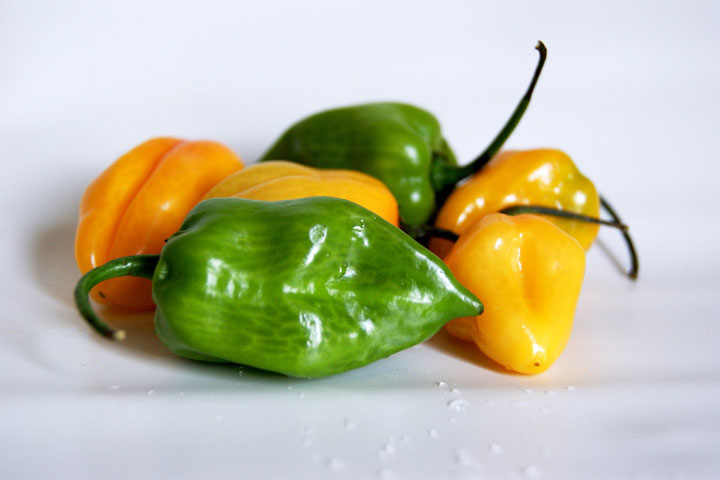
This summer I'm growing jalapeno, banana, Serrano, and Tabasco peppers. These are "milder" peppers (although the Serrano and Tabasco varieties are "hot" to most people). I've experimented over the years and discovered that, for reasons I've yet to discern, the habanero pepper grows best. There's only one problem with these bright orange, thumb-sized peppers: they're friggin' hotter than Hades!
Last summer my habanero pepper plant popped off dozens of peppers at a time. I chopped one up and made an omelet, only to have my mouth fall off. Worse, I didn't wash my hands after handling some, and unfortunately must have picked my nose or something because my right nostril stung for a whole darn day. Bigods!
I had piles of habaneros but they were practically useless because they were too hot. I ended up giving them away. I've learned my lesson: super hot is not for Josh. I love hot peppers—just not if they're too hot.
Now, technically hot peppers are fruits, or even more technically, they're berries! Did ya know that? From the genus capsicum, peppers originated in the north and south Americas, but have quickly become incorporated into diets across the world (yay! for ships). The hotness is from a bunch of chemicals called "capsaicinoids," which we can just call "capsaicin" to keep things simple.
I won't go into all the reasons why capsaicin is experienced as "hot," just trust me: it's complicated. Hotness is measured in something called "Scoville Heat Units" or SHU, which basically is the number of times one has to dilute a pepper's extract with water to experience no "heat."
The baseline SHU is the green bell pepper, which clocks in at a whopping zero SHU. Jalapeños top out at 6,000, the Serranos somewhere between 10,000 and 35,000, and those dang habaneros peak at 300,000 SHU. In general, I stick with Jalapeños and Serranos for my salsas, dips, and omelets. But if you're a masochist, knock yourself out with a habanero. Don't say I didn't warn ya.
Now, in addition to my recent pepper harvest, another reason I wanted to write about peppers this week is a dip that I love, made at one of my favorite restaurants here in Austin. It's a creamy Serrano dip, with just a nice balance of heat and cream. It's so flavorful and tasty I have been trying to get the recipe for years.
Recently a friend and I dined at this place, and I asked the waiter if I could have the recipe. In a typical Austin accent (somewhere between California "dude" drawl and southern twang) he said, "it's just olive oil and serranos, dude, with a little salt). So, I experimented and experimented and experimented with my trusty food processor. I could not produce this dip. I don't think it's just olive oil and peppers, because I've tried every combination. I cannot figure it out—yet. I will endeavor to figure it out.
Meanwhile, however, in the process I did invent what I think is a pretty tasty Serrano pepper cream sauce, which goes great on fish and chicken. Tonight I made this cream sauce and put it on a chicken fajita salad, and it was divine. It's a tad on the spicy side, but if you like a little kick, try it!
©2026 CDKitchen, Inc. No reproduction or distribution of any portion of this article is allowed without express permission from CDKitchen, Inc.
To share this article with others, you may link to this page:
https://www.cdkitchen.com/cooking-experts/josh-gunn/922-hot-peppers/
Hot Dang!
Central Texas is already in a heat wave, y'all—for the past two weeks it's been in the triple digits, and there's no sign of these high temps coming to an end. These temps bring irony, as the second harvest of the patio garden commences. For the last two weeks my tomatoes have been popping; now, it's the hot peppers. So, it's deadly hot—and my garden is producing things that are hot in your mouth. Someone phone Alanis Morissette! I have a new lyrical idea for her "Ironic" song!
Because of the climate, I've discovered hot peppers seem to grow particularly well in central Texas. Even in 100-plus temps, as long as you water the plants and fertilize them once a week, hot peppers will start to emerge just at the moment everything else is dying of heat exhaustion.
This summer I'm growing jalapeno, banana, Serrano, and Tabasco peppers. These are "milder" peppers (although the Serrano and Tabasco varieties are "hot" to most people). I've experimented over the years and discovered that, for reasons I've yet to discern, the habanero pepper grows best. There's only one problem with these bright orange, thumb-sized peppers: they're friggin' hotter than Hades!
Last summer my habanero pepper plant popped off dozens of peppers at a time. I chopped one up and made an omelet, only to have my mouth fall off. Worse, I didn't wash my hands after handling some, and unfortunately must have picked my nose or something because my right nostril stung for a whole darn day. Bigods!
I had piles of habaneros but they were practically useless because they were too hot. I ended up giving them away. I've learned my lesson: super hot is not for Josh. I love hot peppers—just not if they're too hot.
Now, technically hot peppers are fruits, or even more technically, they're berries! Did ya know that? From the genus capsicum, peppers originated in the north and south Americas, but have quickly become incorporated into diets across the world (yay! for ships). The hotness is from a bunch of chemicals called "capsaicinoids," which we can just call "capsaicin" to keep things simple.
I won't go into all the reasons why capsaicin is experienced as "hot," just trust me: it's complicated. Hotness is measured in something called "Scoville Heat Units" or SHU, which basically is the number of times one has to dilute a pepper's extract with water to experience no "heat."
The baseline SHU is the green bell pepper, which clocks in at a whopping zero SHU. Jalapeños top out at 6,000, the Serranos somewhere between 10,000 and 35,000, and those dang habaneros peak at 300,000 SHU. In general, I stick with Jalapeños and Serranos for my salsas, dips, and omelets. But if you're a masochist, knock yourself out with a habanero. Don't say I didn't warn ya.
Now, in addition to my recent pepper harvest, another reason I wanted to write about peppers this week is a dip that I love, made at one of my favorite restaurants here in Austin. It's a creamy Serrano dip, with just a nice balance of heat and cream. It's so flavorful and tasty I have been trying to get the recipe for years.
Recently a friend and I dined at this place, and I asked the waiter if I could have the recipe. In a typical Austin accent (somewhere between California "dude" drawl and southern twang) he said, "it's just olive oil and serranos, dude, with a little salt). So, I experimented and experimented and experimented with my trusty food processor. I could not produce this dip. I don't think it's just olive oil and peppers, because I've tried every combination. I cannot figure it out—yet. I will endeavor to figure it out.
Meanwhile, however, in the process I did invent what I think is a pretty tasty Serrano pepper cream sauce, which goes great on fish and chicken. Tonight I made this cream sauce and put it on a chicken fajita salad, and it was divine. It's a tad on the spicy side, but if you like a little kick, try it!
Creamy Cilantro-Serrano Pepper Sauce

Made with salt, cilantro, sour cream, Serrano chilies, olive oil, cream or half and half
Made with salt, cilantro, sour cream, Serrano chilies, olive oil, cream or half and half
Serves/Makes: 2.5 cups
- 10 long Serrano chilies, seeded, de-ribbed, and roughly chopped
- 3/4 cup olive oil
- 1/2 cup cream or half and half
- 1/2 cup sour cream
- 1/2 cup cilantro
- salt, to taste
In a food processor or blender (the latter works better, unless you have fancy blender), chop chilies. Slowly pour in oil and then add salt. Pour in half and half, then sour cream. Finally, blend-in your cilantro.
This is very easy to make, and the freshness of the ingredients is crucial. Use as a salad dressing, or stir into more sour cream as a dip.
share this article:


related articles


Write a comment:
©2026 CDKitchen, Inc. No reproduction or distribution of any portion of this article is allowed without express permission from CDKitchen, Inc.
To share this article with others, you may link to this page:
https://www.cdkitchen.com/cooking-experts/josh-gunn/922-hot-peppers/