

Now's the Time, Asparagus at Its Prime


You see it all the time in restaurants and it has a permanent place on the grocery shelf, but there is a reason why right now, like no other time during the year, is the time for asparagus. Although you would hardly know it by its prevalence today, there was a time when asparagus was a delicacy limited to the Mediterranean region. Now hothouses around the world from Peru to China to Michigan give us access to this nutritious green vegetable year-round.
However, depending on where you live, now is the time that asparagus grown in the great wide open is blossoming with the first great crop of the season. What came a month ago--slightly dried out, rubber band wrapped packages of asparagus as thick as the handle on a wooden spoon--have been replaced by the first real harvest of the season: bright green, tender, and thinner than a pencil.
The asparagus that we eat are the exposed stems of an underground bulb whose formal name is asparagus officinalis. Although it can be grown around the world year round, in the Northern Hemisphere the plant is at its prime from February to June. Depending on when they are harvested, the stems can range in size from as thin as a chopstick to as thick as the handle of a wooden spoon. The most common variety is the standard green asparagus, but can also be found wild, purple, or even white, a rarer form which gets its lack of color from light deprivation.
Two thousand years ago asparagus was considered a delicacy and was reserved for the elite. Today its mass cultivation makes it an inexpensive, highly nutritious food that can be enjoyed almost anywhere in the world. Asparagus is high in fiber, potassium, and folic acid; it contains no fat and is extremely low in calories. It is even a natural diuretic.
It is a true joy when something so good for you is both inexpensive and delicious. And with the tender new spring crop arriving in markets, it is a vegetable that can make one excited just by looking at it. No matter the size of the asparagus, preparation is just about the same. The ends of asparagus tend to be woody and filled with sand. These can either be cut off an inch or two above the base or snapped off by gently bending each spear until it breaks at the natural separation between the woody part and the tender part.
From there, asparagus is versatile in terms of preparation and the types of recipes it can work with. The vegetable is popular in China where it finds it ways into egg dishes, stir-fries, and soups. In France thicker asparagus is peeled of its outer layer, blanched in simmering salted water, and classically served with a Hollandaise. There are even special asparagus contraptions which allow the home cook to boil asparagus upright with the tips above the water so they don’t overcook.
This time of year the asparagus can stand on its own with little more than a couple minutes in salted boiling water, some salt and pepper and maybe a squeeze of lemon juice. For an easy brunch dish, I’ll top blanched asparagus with a vinaigrette consisting of shallots, garlic, red wine vinegar, Dijon mustard and olive oil. The marinated asparagus can be made ahead and served at room temperature or chilled.
When asparagus is at its peak, nothing gives that pure asparagus flavor quite like a creamy asparagus soup. Sautéed leek, celery, and the stalk of asparagus, marry together in vegetable broth then are sent through the blender for a quick puree. The tips are reserved and cooked separately to add as a garnish to the finished creamed soup. Perhaps a squeeze of lemon and a couple of tablespoons of cream at the end if you really need it and you have a wonderful first course for a crisp spring day. Omit the cream and top each bowl of soup with a poached egg and serve alongside crusty bread and you have a one bowl supper.
Asparagus may not hold the glamor of other rarified vegetables, but the new crop this time of year is a tender delight that holds a place as much on the fine china of a restaurant as it does in the more humble surroundings of the home cook. We are lucky that a healthful, delicious food like asparagus can be found at a reasonable price no matter the time of year, reason to enjoy it all the more.
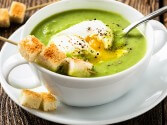

Made with lemon juice, white vinegar, eggs, olive oil, butter, vegetable stock, leek, celery, asparagus, basil
Serves/Makes: 4
- 2 tablespoons olive oil
- 2 tablespoons butter
- 4 cups vegetable stock
- 1 leek
- 1 celery stalk
- 2 bunches asparagus
- 8 large basil leaves
- 4 eggs
- 1 tablespoon white vinegar
- 1 1/2 tablespoon lemon juice
- black pepper
Heat oil and butter in a large soup pot over medium heat. In a separate, medium sized pot, bring vegetable stock to a boil.
Trim the end and all but one inch of the green off the leek. Cut down the middle and wash to remove all dirt. Slice leek thinly crosswise. Chop celery thinly crosswise as well. Add leek and celery to melted butter and oil. Stir and saute for about five minutes.
Prep asparagus by cutting or snapping the ends off each stock to remove the woodiness. Trim one inch of the tips off one bunch and set aside.
Cut remaining asparagus from both bunches into one inch pieces. Add all asparagus but the reserved tips to the onions and leeks. Add hot vegetable stock to asparagus, onions and leeks along with some pepper and a bit of salt. Stir to combine.
Cover with a lid and bring to a boil. When it comes to a boil, reduce to a simmer and cook for 10-15 minutes until asparagus is tender.
Bring a medium pot of water to a boil while soup is cooking. Bring a separate small pot of water to a boil and add salt. Add tips to the salt and cook for 2-3 minutes until tender. Remove from hot water and set aside. Add 2 cups of the asparagus liquid to the soup.
When the asparagus is tender, work in batches to puree soup in a blender, adding a bit of the torn basil to every batch. Transfer pureed soup back to the pot. Adjust seasoning with the lemon juice, additional salt and pepper if necessary.
When water is boiling, add vinegar and reduce heat to medium low. Add one cracked egg at a time, allowing each to come together slightly in the water before adding the next. Simmer for three minutes until whites are cooked but yolk is still runny.
To serve, ladle soup into bowls and top each with some of the cooked asparagus and a poached egg. Serve immediately.


related articles




Write a comment:
©2026 CDKitchen, Inc. No reproduction or distribution of any portion of this article is allowed without express permission from CDKitchen, Inc.
To share this article with others, you may link to this page:
https://www.cdkitchen.com/cooking-experts/amy-powell/864-asparagus-season/