

Taming of the Jumbo Asparagus


To peel or not to peel, that is sometimes the question with asparagus. Actually, in most American homes peeling almost never happens. It is an extra step, a fussy extravagance we are more likely to associate with fancy French restaurants than the sort of simple farm-to-table cooking we champion as American these days.
Why would you peel asparagus anyway? Aren’t the prized variety the kind that is thinner than a pencil and tender enough to be eaten raw?
Certainly those slim green sticks are delightful. They cook quickly in salted water and need little more prep than a trim or snap of their woody ends. But I’m here to make a case for the thick variety, the sturdy trunks bundled together and bound with rubber bands often overlooked by those home cooks with a prejudice for thin.
Do not fear these hearty green monsters! They can be tamed with that simple, tedious trick called peeling. For under that tough outer layer is a tender, pale interior that melts on the tongue like the most supple of vegetables.
What’s more, removing the tough outer layer rids asparagus of its sometimes overly “green” taste. Though most chefs go crazy over the first spring asparagus, that green flavor is difficult to pair with wine and can overwhelm other flavors in a dish. Peel away that tough outer layer, however, and though the “green” remains, it is definitely milder.
Peeling might be tedious, but, like with most kitchen tasks, it is infinitely easier with the proper tool. Here I recommend the sort of vegetable peeler sometimes called a Swiss peeler (when laid down flat the blade forms a T with the handle as opposed to the straight line of most traditional peelers). This particular peeler produces a thinner peel and is easier to hold when working with a vegetable on a flat work surface.
Which brings us to the task of just how to peel those pesky vegetables. Start by trimming off the woody ends as you would with any traditional asparagus. Working one at a time, lay one down on a cutting board, holding the tip gently to keep it from rolling. Place the blade of the peeler just below the asparagus tip and proceed to peel down and away along the stalk. Turn the spear slightly and repeat around the spear. You will be left with a peeled stalk and fully intact asparagus tip.
Cooking is simple. Once peeled, they will require no more time in salted boiling water than thinner, unpeeled asparagus.
Now you might be wondering how to serve these gentle behemoths. I would treat them as the star attraction of a simple starter at dinner or as a lunch unto themselves. You will need no more than 3-4 spears per person arranged side-by-side on a plate. If you were feeling fancier and traditional French, here is where you would top with Hollandaise. For the rest of us, a single poached egg makes a lovely instant sauce. To serve, top each asparagus plate with a single egg, sprinkle of chives, salt, and pepper.
When you have the right tools and a little direction, an extra step like peeling can pay off with a dish as elegant to behold as it was simple to prepare.
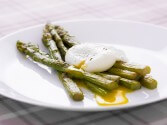

Made with sea salt, black pepper, asparagus, salt, eggs, vinegar, fresh chives
Serves/Makes: 4
- 16 jumbo asparagus spears
- salt
- 4 eggs
- 2 tablespoons white vinegar
- fresh chives, minced, optional
- black pepper
- sea salt
Bring a large pot of water to a boil. Trim or snap woody ends off the asparagus spears and discard. Working with one spear at a time, peel the outer layer off the asparagus beginning just under the asparagus tip and peeling down. Repeat with all spears.
When water comes to a boil, salt the water until it tastes like the sea. Add the asparagus. Simmer for 3-4 minutes until the asparagus are just tender. Transfer to an ice water bath.
Bring a separate medium sized pot to a boil. When it comes to a boil add the vinegar. Reduce heat to medium so the water is gently simmering. One at a time crack an egg into a small bowl then let it slide into the water. When the white comes together add the next egg. Keep track of the order each egg was put in the water. It should take about three minutes per egg. To check if each is cooked, gently lift from the water with a slotted spoon and press with an index finger. The white should be cooked but the yolk still runny.
When each egg is cooked transfer with a slotted spoon to a paper towel to briefly sop up the excess water.
To serve, place 3-4 spears of asparagus side-by-side on each plate. Top each bundle with a poached egg. Sprinkle each plate with freshly ground black pepper, sea salt, and minced chives.


related articles




Write a comment:
©2026 CDKitchen, Inc. No reproduction or distribution of any portion of this article is allowed without express permission from CDKitchen, Inc.
To share this article with others, you may link to this page:
https://www.cdkitchen.com/cooking-experts/amy-powell/1362-peeled-asparagus/