

Cooking Defined


In any profession where one is considered an expert, it is easy to forget our audience may not be as proficient in the lingo as we are. GRP, CPM, VPVH might sound like diseases to the average person but are common acronyms in the world of advertisers. Pallet, LFO, PO: all everyday terminology in the universe of distributors but gibberish to the rest of us. And just like every business that has its own dictionary of terms, the cooking world is full of all sorts of word that could very well sound like a foreign language to a novice cook.
No one expects the everyday cook to memorize the full language of Escoffier but there are certain words that are worth bringing into your own personal cooking world. Bain-marie, cartouche, hotel pan: words used constantly in the professional French kitchen, but not necessary in your home. Try not to get overwhelmed by the fancy wording in your French Laundry cookbook. But if you take this little vocabulary lesson to heart, the more basic recipes, be it online or in your favorite cooking magazine, will be a lot easier to decipher.
Dutch Oven: This large iron pot, usually cast iron, is an indispensible tool for many cooking techniques such as braising, roasting, or even deep frying. This pot has been made especially accessible and popular in the form of the enamel coated cast iron pots made by Le Creuset.
Braise: As opposed to a boil, where meat or veggies are completely submerged in a liquid, a braise requires liquid to come half way up the side of the meat. It keeps the meat moist, but allows the flavors in the braising liquid to reduce and concentrate. That liquid is then often used in the final dish, either as is, or strained and reduced to form a sauce.
Sauté vs. Sweat: Sautéing is what happens when food is subjected to a medium high heat. The heat causes the sugars to caramelize: onions, meat, garlic all brown and flavors are locked in. This is in contrast to sweating which occurs over a medium-low to low heat. Sweating causes no coloration and allows the various flavor components in a pan, say of diced onions, carrots and celery, to marry while the vegetables soften.
Sauté Pan: Yes, some people have told me they are confused by this word. Sauté pan is the same as a frying pan to the rest of us.
Emulsify: No, this is not a term from chemistry lab, but it is what happens when two liquids that don’t blend come together evenly. When making vinaigrette for example, oil is mixed with liquid until the oil particles are evenly distributed and suspended in the vinegar, lemon juice, or other acid. The emulsification, be it with a blender or a whisk is what keeps the elements from separating.
Blanch: Blanching is a way to partially cook vegetables. Bring a pot of salted water to a rolling boil. Drop vegetables in for a few seconds (julienned carrots) or a couple of minutes (asparagus) so veggies are partially cooked but still crisp. This can technique can be useful simply for having crisp crudite for an appetizer spread. This is also great for making sure your don’t under or overcook veggies that have different cooking times, adding almost cooked, blanched veggies back to the finished dish at the end bringing everything back together for the last couple minutes of cooking.
You don’t have to be a linguist to decipher the mysteries of kitchen code words. Nor do you have to have the vocabulary of a French chef to make sophisticated food. But if you can take this article and these few key words to heart, not only will reading the following recipe not be quite as puzzling, but you might just be able to start talking the kitchen talk, as well as you walk the walk.
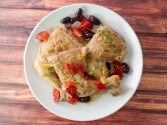

Made with vegetable oil, flour, salt, black pepper, chicken, onion, garlic, lemon, kalamata olives, roma tomatoes
Serves/Makes: 4
- 4 tablespoons vegetable oil
- 1/2 cup flour
- 1 teaspoon salt
- 1/2 teaspoon black pepper
- 1 whole chicken cut in pieces, with skin and bones
- 1/2 onion
- 2 cloves garlic
- 1 lemon
- 1/3 cup kalamata olives
- 2 roma tomatoes
- 2 sprigs fresh thyme
- 1/2 bottle (750 ml size) white wine
- additional salt and pepper
- bread
Heat the oil in a large Dutch oven or other large pot over medium high heat.
On a plate, mix the flour, salt and pepper. Pat the chicken pieces dry with paper towels. Dredge the skin side of the chicken in the flour mixture and then place flour side down in the preheated pan. Season the non-floured side of the chicken with additional salt and pepper. If the chicken does not all fit in one layer, work in two batches. Saute the chicken for 3-4 minutes until browned on one side.
Meanwhile, slice the onion into 1/4-inch pieces and crush garlic with the back of a chef's knife. Flip chicken over and add onion and garlic to pan, tucking down between the chicken pieces. Saute for about 3 minutes until onion starts to soften.
Peel 1/2 of the lemon with a vegetable peeler. Use a sharp knife to cut lemon into strips 1/8th inch thick. Cut tomatoes into a large dice.
Add the lemon strips, olives, tomatoes and thyme to the pot with the chicken, tucking ingredients in between the chicken pieces. Add the wine to the pot making sure it comes about half way up the chicken without submerging it completely.
Turn the heat to high to bring the wine to a boil. Season liquid with a bit of extra salt and pepper. Reduce heat to medium, cover pot with a lid and braise chicken for about 15-20 minutes, depending on the size of the chicken pieces, until cooked through.
Remove from heat. Taste liquid for seasoning and adjust with salt and pepper if necessary. Serve chicken with the braising liquid and bread to sop it up.


related articles



Write a comment:
©2026 CDKitchen, Inc. No reproduction or distribution of any portion of this article is allowed without express permission from CDKitchen, Inc.
To share this article with others, you may link to this page:
https://www.cdkitchen.com/cooking-experts/amy-powell/704-cooking-defined/