

cdkitchen > cooking experts > victoria wesseler

There are plenty of choices for summer meal desserts. Ice creams, sorbets, and sherbets seem to be popular as home cooks try to beat the heat with a cool treat. But yummy as those options are, they are generally lacking in nutrients and can add a lot of calories to a meal. Fortunately, the warmer weather brings us a great alternative to high calorie desserts. Try satisfying that sweet tooth with a bowl of chilled summer melon.
Brimming with juicy, sun-kissed sweetness, melons are also very nutritious. They are 90% water, low in calories, no fat, no cholesterol, low in sodium, and a good source of potassium and vitamins A and C. A half a cup of cantaloupe has a mere 27 calories, half a cup of honeydew melon has 30 calories, and a half cup of watermelon just 23 calories. Watermelon is also a source of lycopene (some recent studies say it actually has more lycopene pound for pound than tomatoes) which is reputed to prevent cancer and heart disease.
All melons are members of the Cucurbitaceae family which contains many other familiar plants including cucumbers, pumpkins and squashes. Melon varieties seem to be endless and during the months of June, July, and August, Farmer’s Markets and road stands are brimming with local varieties that are fun to try. Two of the most popular melons are the familiar watermelon and cantaloupe.
Although many sources will tell you that thumping a melon is not a good way to measure its ripeness, my husband swears by this method. I am not sure what he’s listening for, but he has never failed to bring home a ripe melon yet. For those of us who do not have this talent, here are some tips for finding that perfect melon.
• When selecting cantaloupes, look for a well defined netting/veining and a yellowish to orange cast on the underlying skin.
• Avoid cantaloupes which have stems attached to them. A ripe cantaloupe will separate itself naturally from the vine. A stem on the melon tells you it was picked too soon.
• When selecting watermelons, look for a dull sheen on the green skin and a yellow or white “belly” where the melon was on the ground during growing.
• Pick melons that seem heavy for their size. And look for ones that are free of cracks, bruises, or soft spots.
Once you get your melon home, store it, uncut, at room temperature for up to 7 days. You can also keep it in your refrigerator. Wash the melon before you cut it to remove any bacteria or debris that may be on the outer skin and could be transferred to the fruit’s interior by your knife. After cutting, store the melon in a storage bag or wrap it tightly in plastic wrap. It will keep in the refrigerator for 3-5 days.
Although there is nothing better than slicing a melon and enjoying its simple goodness, I do like to experiment with adding other flavors to the fruit. Sometimes I toss small chunks of cantaloupe with ribbons of thinly sliced prosciutto and serve it over arugula, baby lettuces, or watercress which have been tossed with a vinaigrette made with lemon, honey, and olive oil for a light summer lunch.
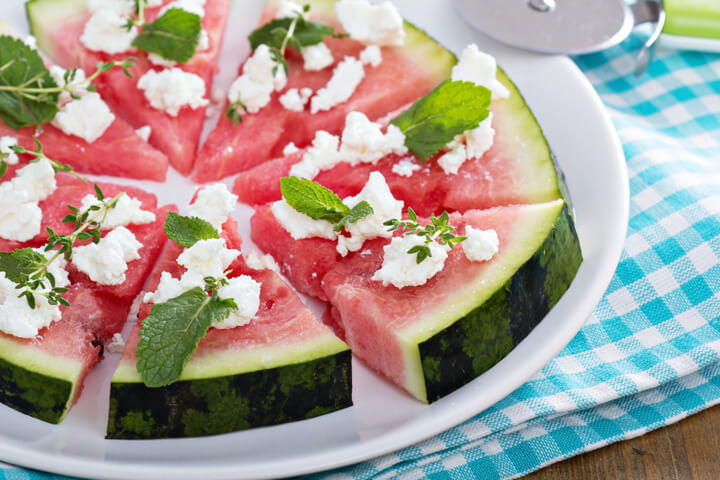
When I want a conversation starter at the beginning of a summer meal, I serve my Watermelon Pizza. It’s a fun salad combining feta, kalamata olives, red onion and watermelon. It’s a dish that certainly gets lots of comments and some surprised looks. And, after the initial curiosity and perhaps a bit of hesitation, there are many requests for seconds.
©2026 CDKitchen, Inc. No reproduction or distribution of any portion of this article is allowed without express permission from CDKitchen, Inc.
To share this article with others, you may link to this page:
https://www.cdkitchen.com/cooking-experts/victoria-wesseler/540-melons/
Summertime Melons
There are plenty of choices for summer meal desserts. Ice creams, sorbets, and sherbets seem to be popular as home cooks try to beat the heat with a cool treat. But yummy as those options are, they are generally lacking in nutrients and can add a lot of calories to a meal. Fortunately, the warmer weather brings us a great alternative to high calorie desserts. Try satisfying that sweet tooth with a bowl of chilled summer melon.
Brimming with juicy, sun-kissed sweetness, melons are also very nutritious. They are 90% water, low in calories, no fat, no cholesterol, low in sodium, and a good source of potassium and vitamins A and C. A half a cup of cantaloupe has a mere 27 calories, half a cup of honeydew melon has 30 calories, and a half cup of watermelon just 23 calories. Watermelon is also a source of lycopene (some recent studies say it actually has more lycopene pound for pound than tomatoes) which is reputed to prevent cancer and heart disease.
All melons are members of the Cucurbitaceae family which contains many other familiar plants including cucumbers, pumpkins and squashes. Melon varieties seem to be endless and during the months of June, July, and August, Farmer’s Markets and road stands are brimming with local varieties that are fun to try. Two of the most popular melons are the familiar watermelon and cantaloupe.
Although many sources will tell you that thumping a melon is not a good way to measure its ripeness, my husband swears by this method. I am not sure what he’s listening for, but he has never failed to bring home a ripe melon yet. For those of us who do not have this talent, here are some tips for finding that perfect melon.
• When selecting cantaloupes, look for a well defined netting/veining and a yellowish to orange cast on the underlying skin.
• Avoid cantaloupes which have stems attached to them. A ripe cantaloupe will separate itself naturally from the vine. A stem on the melon tells you it was picked too soon.
• When selecting watermelons, look for a dull sheen on the green skin and a yellow or white “belly” where the melon was on the ground during growing.
• Pick melons that seem heavy for their size. And look for ones that are free of cracks, bruises, or soft spots.
Once you get your melon home, store it, uncut, at room temperature for up to 7 days. You can also keep it in your refrigerator. Wash the melon before you cut it to remove any bacteria or debris that may be on the outer skin and could be transferred to the fruit’s interior by your knife. After cutting, store the melon in a storage bag or wrap it tightly in plastic wrap. It will keep in the refrigerator for 3-5 days.
Although there is nothing better than slicing a melon and enjoying its simple goodness, I do like to experiment with adding other flavors to the fruit. Sometimes I toss small chunks of cantaloupe with ribbons of thinly sliced prosciutto and serve it over arugula, baby lettuces, or watercress which have been tossed with a vinaigrette made with lemon, honey, and olive oil for a light summer lunch.
When I want a conversation starter at the beginning of a summer meal, I serve my Watermelon Pizza. It’s a fun salad combining feta, kalamata olives, red onion and watermelon. It’s a dish that certainly gets lots of comments and some surprised looks. And, after the initial curiosity and perhaps a bit of hesitation, there are many requests for seconds.
Watermelon Pizza
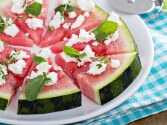

Made with fresh mint, olive oil, watermelon, feta cheese, Kalamata olives, lime juice
Made with fresh mint, olive oil, watermelon, feta cheese, Kalamata olives, lime juice
Serves/Makes: 12
- 1 large watermelon
- 1 cup crumbled feta cheese
- 1 cup Kalamata olives, drained and patted dry, optional
- 3 tablespoons freshly squeezed lime juice
- 3 tablespoons olive oil
- 12 sprigs fresh mint
Rinse and pat the watermelon dry. Cut three 3 inch thick rings from the center of the melon. Reserve the rest of the melon for another use.
Place each melon ring on a large plate and sprinkle each with one-third of the Feta and olives (if using). Drizzle each ring with 1 tablespoon each of the lime juice and olive oil.
Cut each ring into four wedges as you would a pizza. Garnish each slice with a sprig of mint. Serve immediately.
share this article:


related articles


Write a comment:
©2026 CDKitchen, Inc. No reproduction or distribution of any portion of this article is allowed without express permission from CDKitchen, Inc.
To share this article with others, you may link to this page:
https://www.cdkitchen.com/cooking-experts/victoria-wesseler/540-melons/