

When Life Hands You Meyer Lemons


If life handed you lemons and you made lemonade would anyone care if the lemon were already sweet? Would calling a clunker of a car a “lemon” have quite the impact if the thought of biting into a lemon wedge didn’t automatically make one’s eyes squint and mouth pucker? Good thing the clever folks who came up with these sayings and catchphrases weren’t thinking of Meyer lemons when they coined the terms.
Citrus limon is the garden variety lemon we think of when we are turning sour lemon juice into lemonade or making sweet and tart curd as the base of a lemon meringue pie. Although the exact origin of the lemon is unknown, it likely was first cultivated in China and South Asia, eventually making its way through the Middle East and into Europe. Along the way, lemons were used for their medicinal and antiseptic properties as well as for ornamental purposes and for flavoring when cooking.
Somewhere near the birthplace of the ordinary lemon (most likely in China), the Meyer lemon was born. The Meyer lemon, with a thin skin the color of an egg yolk, has a much sweeter taste than the standard lemon. Hence it is thought to be a hybrid of an ordinary lemon and a tangerine or mandarin orange. The Meyer lemon was named after the man who brought it to the States, Frank Meyer, who returned from a 1908 trip to China with the first samples to be planted in the US.
The Meyer lemon has since thrived in the hot climates of California, Florida and Texas, among other states. With the California cuisine movement of the '80s, chefs like Alice Waters of Chez Panisse were praising the edible wonder of this sweet-tart yellow fruit, one that once held little more than ornamental value in the Asian world.
Just this past week life handed me lemons, about thirty Meyer lemons to be exact. The Meyer lemon may be nearing the end of its growing season in most of the US, but all around me I see trees laden with ripe fruit. With that much citrus I had plenty of opportunities to figure out just what one does with the better looking, better tasting cousin of the ordinary lemon.
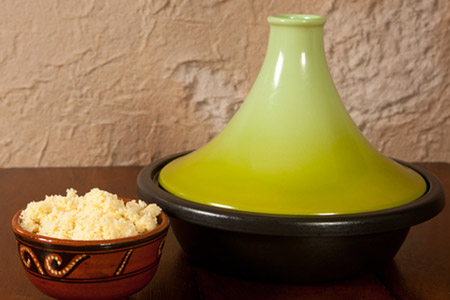
Moroccan cuisine is known for its use of preserved lemon. Meyer lemons, which can be cooked as is, skin and all, are particularly well suited to this technique whereby whole lemons are cured in a mixture of lemon juice, water, salt and sugar. Wedges of preserved lemons are then cooked with tagines, mixed in with lamb stews, or stirred into couscous.
If one lacks the time or patience to preserve the lemons, a similar flavor can be achieved with your standard Meyer lemon. I like to braise chicken breasts in white wine with onion, thinly sliced Meyer lemons, chopped green olives and seasonings like smoked paprika, cinnamon, and ginger for a Moroccan inspired take on the classic chicken dinner.
Meyer lemon makes a lovely substitute for just about anything you might use a normal lemon for, particularly the rind, as it lacks much of the bitterness of a standard lemon rind. I love Meyer lemon rind in parsley and garlic based gremolata to top the traditional osso bucco or even as an accompaniment to grilled fish. The mild rind can give just the right amount of tang to blueberry and lemon scones, lemon and poppy seed cookies, shallot and herb vinaigrette, or compound butter for grilled meats.
Last but not least, what would any lemon be if it could not be made into lemonade? Meyer lemons are fantastic for many drinks since their milder, sweeter flavor requires less sugar than the traditional lemon. On a recent visit to the Los Angeles spot Corkbar I tried a lovely combination of parsley and lemon juice for a unique twist on the traditional lemonade. I’ve been using Meyer lemon juice in place of lime juice along with simple syrup and gin for my own take on a gimlet.
Meyer lemons have such an appealing combination taste of sweet and tart it is hard to imagine anyone using them just for decoration. With so much low hanging fruit this year we should all be so lucky to have neighbors who gift us enough lemons to both cook with and decorate. With so many delicious ways to make use of them, if life handed me Meyer lemons, I know one thing for certain: I’d be making more than just lemonade.


Made with flour, smoked paprika, ground cinnamon, ginger, salt and pepper, chicken breast halves, vegetable oil, onion, Meyer lemons, green olives
Serves/Makes: 4
- 1/4 cup flour
- 1 tablespoon smoked paprika
- 1/2 teaspoon ground cinnamon
- 1/2 teaspoon ginger
- salt and pepper
- 4 boneless, skinless chicken breast halves
- 3 tablespoons vegetable oil
- 1 medium onion
- 2 Meyer lemons
- 8 large green olives, pitted
- 2 cloves garlic
- 1/2 bottle white wine
- cooked rice or couscous
On a shallow plate, mix flour with paprika, cinnamon, and ginger. Season both sides of the chicken breasts with salt and pepper. Dredge chicken breasts in the flour mixture to coat on both sides, shaking off excess.
In a heavy, deep skillet or saucepan, heat the oil over a medium high flame. Place chicken in pan and brown on both sides.
While chicken is cooking, thinly slice onions and lemons. Cut olives into larger slices and crush garlic.
When chicken is turned onto its second side, add sliced onion to the pan around the chicken. After about three minutes, add olives, garlic, and lemons to the pan underneath and around chicken. After another two minutes, add enough white wine to come up half way on the sides of the chicken breasts.
Bring the pot to a simmer then cover with a lid and reduce the heat to medium. Braise for another 10-15 minutes until chicken is cooked through.
Taste sauce and adjust seasoning if necessary with additional salt and pepper. Serve with rice or couscous.


related articles




Write a comment:
©2026 CDKitchen, Inc. No reproduction or distribution of any portion of this article is allowed without express permission from CDKitchen, Inc.
To share this article with others, you may link to this page:
https://www.cdkitchen.com/cooking-experts/amy-powell/1033-meyer-lemons/