

cdkitchen > cooking experts > lauren braun costello

March 25th is Greek Independence Day, so let's celebrate Greek food. So much more than feta cheese and phyllo (FEE-lo) dough, Greek cuisine is about fresh ingredients and vibrant, simple flavors. Although feta and phyllo are certainly in the culinary canon, there is so much more that pervades any Greek menu. First, let's clear up a few misconceptions.
Greek Mythology
Most of us associate certain things with Greek cuisine that actually have little to do with classic Greek cooking. Pita bread, for example, is not at all Greek. In fact, you would not see pita as we know it on any Greek table. You would see crusty bread – an essential component to an authentic Greek meal.
So, from where does that pita myth come? Pita is Turkish. The Ottoman Turks occupied Greece for more than 400 years (culminating in the War of Independence in 1829, hence Greek Independence Day). It is no surprise, then, that pita made its way into Greek cuisine. But it is not authentically Greek. There are, however, many Greek delicacies that end in the suffix "pita," such as spanokopita, the delectable savory spinach and feta pastry made with phyllo dough. Perhaps this linguistic similarity is where some of the confusion outside Greece was born.
Another myth of Greek cuisines is the use of balsamic vinegar. This is not an ingredient that is ever used in traditional Greek cuisine. Red wine vinegar and fresh lemon juice are the staple acids in Greek cooking.
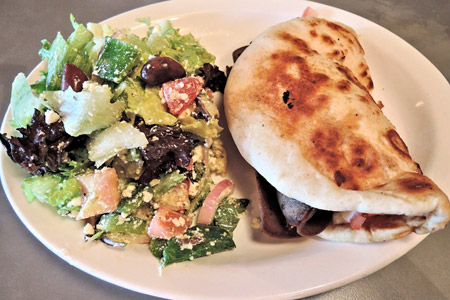
Greek salad as we know it – tomatoes, lettuce, feta and olives – is just one of the basic salads that grace an authentic Greek table daily. Of course, the Greeks do not refer to their own salad as "Greek Salad." Rather, it is called horiatiki, meaning "country" or "village" salad. Alongside a horiatiki salad would be a simple stewed salad of kale and lemon juice, called xorta, meaning "greens."
Finally, souvlaki and gyros (pronounced YEE-ro) are strictly street food. Much like an Indian samosa or German pretzel, you will not find these foods in the home. And yes, there is a difference between souvlaki and gyros: the former is shiskebab and the latter is sliced.
The Hellenistic Household
Any authentic Greek kitchen will have a healthy supply of fresh and simple ingredients. Salt, pepper, olive oil, lemons, oregano, paprika, onions and garlic are employed often and in concert. Since Greece is 90% island territory, seafood is easily available and essential to the cuisine.
Lamb is also a staple food, especially at the Easter celebration when the very cooking of the animal becomes a social event. Recently made famous in the film My Big Fat Greek Wedding, it is no myth that families will roast a whole lamb on a spit outdoors. Children will turn it as it roasts, and pieces will be carved off as people want to enjoy the succulent meat.
Feta is of course a classic and revered cheese in Greece. But just like Brie in France, it is certainly not the only cheese that is consumed. Kefalograviera and Kefalotiri are two other cheeses that are used for everything from accompaniments to a glass of ouzo, toppings for pasta (in place of parmesan or romano cheeses), or even fried and served as saganaki.
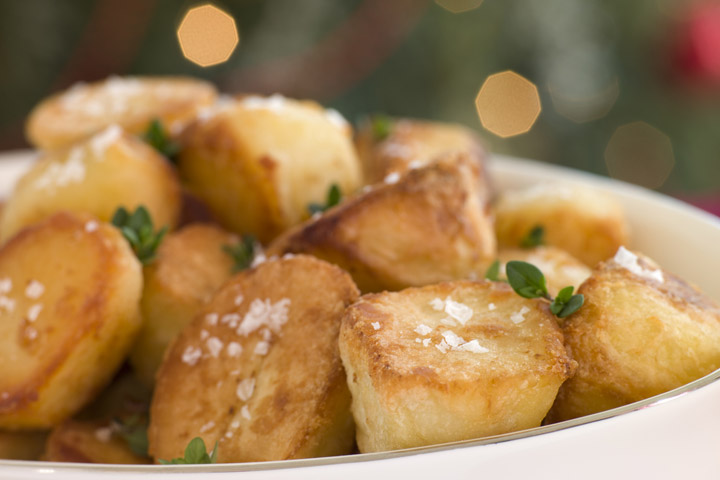
Greece has an ancient and rich culture. But its cuisine's appeal is rooted in its simplicity and honesty. Try the following recipe from my friend Paula. Her Patates Lemonates are the most delicious roasted potatoes you will ever taste. They are as easy to make as they are straightforward in flavor.
Zeeto ee Hellas! (Long Live Greece!)
1 comments
©2026 CDKitchen, Inc. No reproduction or distribution of any portion of this article is allowed without express permission from CDKitchen, Inc.
To share this article with others, you may link to this page:
https://www.cdkitchen.com/cooking-experts/lauren-braun-costello/238-greek-cuisine/
It's Greek To Me . . . And To You Too!
March 25th is Greek Independence Day, so let's celebrate Greek food. So much more than feta cheese and phyllo (FEE-lo) dough, Greek cuisine is about fresh ingredients and vibrant, simple flavors. Although feta and phyllo are certainly in the culinary canon, there is so much more that pervades any Greek menu. First, let's clear up a few misconceptions.
Greek Mythology
Most of us associate certain things with Greek cuisine that actually have little to do with classic Greek cooking. Pita bread, for example, is not at all Greek. In fact, you would not see pita as we know it on any Greek table. You would see crusty bread – an essential component to an authentic Greek meal.
So, from where does that pita myth come? Pita is Turkish. The Ottoman Turks occupied Greece for more than 400 years (culminating in the War of Independence in 1829, hence Greek Independence Day). It is no surprise, then, that pita made its way into Greek cuisine. But it is not authentically Greek. There are, however, many Greek delicacies that end in the suffix "pita," such as spanokopita, the delectable savory spinach and feta pastry made with phyllo dough. Perhaps this linguistic similarity is where some of the confusion outside Greece was born.
Another myth of Greek cuisines is the use of balsamic vinegar. This is not an ingredient that is ever used in traditional Greek cuisine. Red wine vinegar and fresh lemon juice are the staple acids in Greek cooking.
Greek salad as we know it – tomatoes, lettuce, feta and olives – is just one of the basic salads that grace an authentic Greek table daily. Of course, the Greeks do not refer to their own salad as "Greek Salad." Rather, it is called horiatiki, meaning "country" or "village" salad. Alongside a horiatiki salad would be a simple stewed salad of kale and lemon juice, called xorta, meaning "greens."
Finally, souvlaki and gyros (pronounced YEE-ro) are strictly street food. Much like an Indian samosa or German pretzel, you will not find these foods in the home. And yes, there is a difference between souvlaki and gyros: the former is shiskebab and the latter is sliced.
The Hellenistic Household
Any authentic Greek kitchen will have a healthy supply of fresh and simple ingredients. Salt, pepper, olive oil, lemons, oregano, paprika, onions and garlic are employed often and in concert. Since Greece is 90% island territory, seafood is easily available and essential to the cuisine.
Lamb is also a staple food, especially at the Easter celebration when the very cooking of the animal becomes a social event. Recently made famous in the film My Big Fat Greek Wedding, it is no myth that families will roast a whole lamb on a spit outdoors. Children will turn it as it roasts, and pieces will be carved off as people want to enjoy the succulent meat.
Feta is of course a classic and revered cheese in Greece. But just like Brie in France, it is certainly not the only cheese that is consumed. Kefalograviera and Kefalotiri are two other cheeses that are used for everything from accompaniments to a glass of ouzo, toppings for pasta (in place of parmesan or romano cheeses), or even fried and served as saganaki.
Greece has an ancient and rich culture. But its cuisine's appeal is rooted in its simplicity and honesty. Try the following recipe from my friend Paula. Her Patates Lemonates are the most delicious roasted potatoes you will ever taste. They are as easy to make as they are straightforward in flavor.
Zeeto ee Hellas! (Long Live Greece!)

Serves/Makes: 4
- 2 pounds waxy potatoes, peeled and cut into evenly sized chunks
- 2 tablespoons dried oregano
- olive oil for drizzling
- 2 lemons, juiced
- salt, to taste
- water
Preheat the oven to 400 degrees F.
Place potatoes in a single layer in a shallow roasting pan or baking dish. Sprinkle with the oregano, then drizzle with olive oil and lemon juice. Sprinkle the potatoes with salt, then pour enough water into the pan to almost cover the potatoes.
Bake, uncovered, at 400 degrees F for 30-40 minutes or until all the water has almost completely evaporated and the potatoes are tender and light golden brown on top.
share this article:


related articles




1 comments
As usual, another fantastic article from a stellar chef!
Comment posted by Paula
Write a comment:
©2026 CDKitchen, Inc. No reproduction or distribution of any portion of this article is allowed without express permission from CDKitchen, Inc.
To share this article with others, you may link to this page:
https://www.cdkitchen.com/cooking-experts/lauren-braun-costello/238-greek-cuisine/