

Interpretation and Tradition on Thanksgiving


There is this funny thing about Thanksgiving, or any holiday for that matter: it seems there is a constant battle between Tradition and Progression. There are two camps: one maintains the sanctity of green bean casseroles with canned onions, and the other argues for serving Seafood Newburg alongside the turkey. Both camps have valid points and are completely and totally right in their own way, but maybe, just maybe, there is room for compromise. Seeing as how I have spent many years away from home on the Thanksgiving holiday, I have had the opportunity to see “tradition” from many American points of view. From “traditional” to “progressive,” I can think of many stories that demonstrate the variety with which Thanksgiving is played out across the country.
A Thanksgiving spent with a cooking school friend resulted in one of the most bizarre “traditional” dinners I have ever attended. My dear and talented friend somewhat obsessively collects the menus of the parties her deceased mother had thrown over the years. At an intimate gathering in the Hamptons several years ago, I think all the guests were more than a little taken aback by the menu. . . which was circa the Late Disco Era. The menu was taken straight from my friends’ archive of her mother’s Thanksgiving menu in 1979. Our appetizers included a salmon mousse that was served in a fish mold and tasted suspiciously of, well, fish. Dinner consisted of what one typically would expect on Thanksgiving, but included a dish that is not much of a tradition anymore, oyster stuffing. Since, after the meal, neither that nor the mousse had more than a polite bit removed from each, I felt it argued for a move from the classic to the modern menu.
Last year I spent Thanksgiving in New England. Dinner ranged from the very classic (10 desserts were served just to make sure every guest got their holiday favorite), to the very different for the non-natives. Alongside the turkey was Seafood Newburg, a creamy casserole of fish and shellfish that, although a natural for Bostonians, would probably not appeal to most meat-and-mashed-potato Americans.
This year I have observed my friends as we enter the potential hazards of the holidays. One of my friends comes from a town not far from the sentimental cornerstone of our country, Plymouth Rock. She somewhat dreads the innovations of her South American boyfriend’s family, who mix their traditional flavoring and cooking techniques with our native turkey for a dish that is not crisp and savory, as we typically know it, but stewed and sweet. A friend who is a more experimental eater has lamented his own wife’s lack of adventure. Although he stands by the necessity of unadulterated mashed potatoes, he questions the canned green bean casserole and whether something so antithetical to a true foodie’s nature (note the excessive use of can openers and precooked items) should hold a legitimate place at the holiday table.
With so much debate over the mix of tradition and interpretation at Thanksgiving, I venture to suggest that there might be room for both at the Thanksgiving table. I almost hate to say it, but don’t mess with the turkey. And I almost agree with my friend who said to leave the mashed potatoes be. Those seem to be two dishes that are so central to the holiday they really are best left as is.
The room for interpretation can be found in your vegetable dish (sorry green bean casserole, you have stayed long past your welcome) and the “stuffing.” I say “stuffing” with quotation marks because whatever starch or grain you use for this side, it really doesn’t have to be bread based. This year I am doing quinoa, a grain that is truly native to this country. As for the vegetable, simple and seasonal works best, and even green beans are okay as long as they are fresh cooked to al dente not drained from a can. I am doing Brussels sprouts again, cooked quick and simply and tossed with pomegranate seeds for flavor, color and crunch.
With family in the kitchen, there is so much else to fight about during the holidays. So food should be the one thing we can all agree upon and that will quell the quarrelling no matter what the crazy in-laws are dishing out. If we stick to the roots with the basics and break out of the box with the extras there should be enough on the table that is both traditional and experimental to keep all guests happy on Thanksgiving. That is one tradition that is definitely worth keeping.
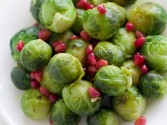

Made with salt and pepper, Brussels sprouts, butter, shallots, pomegranate
Serves/Makes: 8
- 2 pounds Brussels sprouts
- 3 tablespoons butter
- 2 shallots
- 1 pomegranate
- salt and pepper
Trim off the stems of the Brussels sprouts and remove any tough outer leaves.
Place the Brussels sprouts in a steamer basket in a pan over boiling water. Steam until tender, about 6-8 minutes.
Meanwhile, peel the pomegranate while submerged in a bowl of cold water. Discard the peel and white pith. Drain the seeds in a colander.
Peel the shallots and slice into very thin slices.
Melt the butter in a saucepan over medium heat. Add the shallots and cook for 4 minutes or until soft. Remove the pan from the heat.
Transfer the brussels sprouts to a bowl. Toss the sprouts with the buttery shallots and pomegranate seeds. Season to taste with salt and pepper. Serve hot.

Made with salt and pepper, thyme, fresh sage, quinoa, chicken or turkey stock, olive oil, sweet Italian sausage, oyster mushrooms, chestnuts
Serves/Makes: 8
- 2 cups quinoa
- chicken or turkey stock
- 2 tablespoons olive oil
- 2 links sweet Italian sausage
- 8 ounces oyster mushrooms, or mixed wild mushrooms
- 1 jar peeled whole chestnuts, rinsed and drained
- 8 fresh sage leaves
- 2 sprigs thyme
- salt and pepper
Cook quinoa according to package directions in chicken or turkey stock.
Meanwhile, heat oil in a large saute pan. Remove sausage from casing. Saute in oil breaking up with a wooden spoon while it browns. While sausage browns, wipe off mushrooms with a damp towel and roughly chop. Roughly chop drained chestnuts. Mince sage and remove thyme from stem.
With a slotted spoon, transfer sausage to a paper towel to drain. Drain off all but two tablespoons of the fat from the oil. Add mushrooms to sausage fat along with chestnuts and herbs. Season with salt and pepper.
Once nuts and mushrooms are browned, add mixture to quinoa and stir to combine.


related articles




Write a comment:
©2026 CDKitchen, Inc. No reproduction or distribution of any portion of this article is allowed without express permission from CDKitchen, Inc.
To share this article with others, you may link to this page:
https://www.cdkitchen.com/cooking-experts/amy-powell/410-thanksgiving-traditions/