

Virgin (Olive Oil) Territory


“Got eevooo?” My brother asked. What?, I responded. “Got eevooo? You know, E.V.O.O.?” Ummm… right. He was teasing me, of course, knowing how I feel about the subject of oil, particularly the olive variety. But his teasing could not have been worse than the horror of its inspiration. Apparently, Paul, having recently attended a wine and food festival in Washington DC, was witness to an act of foodie perversion. At a large booth representing a certain new cooking magazine were a gaggle of smiling, giddy booth workers wearing T-shirts asking one simple yet profound question: "Got E.V.O.O.?"
Well, I can tell you that I got it and I love it. That is not really the problem. But perhaps you are confused as to what E.V.O.O. stands for. If so, then you have yet to be brainwashed by today’s celebrity TV chefs and I congratulate you. E.V.O.O., or Extra Virgin Olive Oil, is so much more than an oil that is reached for at every flip of a sautee pan. The problem behind the question (that makes me cringe with displeasure) is the implicit over-use of “E.V.O.O.,” the implication that it is catch-all, everyday cooking oil.
Olive oil is the substance extracted from the fruit of the olive tree. It has been used for several thousand years in everything from medicine to fuel to cooking. Extra Virgin Olive Oil, or E.V.O.O., comes from the first cold pressing of olive oil. It is the highest quality grade available in the retail market. To be called E.V.O.O., an olive oil must be unrefined, contain less than 0.8% acidity, and be judged to be of superior quality. Not to mention, olive oil is now recommended by the FDA as being part of a heart healthy diet because of its concentration of monounsaturated fats.
All this sounds great, you say. So why am I so bothered by the over-use of E.V.O.O.?
It’s because in this world, there is a time and a place for everything. Extra Virgin Olive Oil has a place in many dishes that leave my everyday kitchen from a salad dressing to a drizzle to finish off a bowl of soup. However, when it comes to cooking, E.V.O.O. is not universal oil. With a relatively low-smoke point of 320 F, cooks must be careful what we are using it for. Smoke point refers to the temperature at which the oil begins to burn. Burnt oil will turn acrid and alter the flavor and, often, the desired color of a dish.
When cooking quickly, which often involves searing and sautéing over high heat, E.V.O.O. is really not appropriate. In these cases, one can use an olive oil with a more neutral flavor and higher smoke point such as pomace or light olive oil, or the more typical refined corn and canola oils. In addition, part of the reason we love E.V.O.O. is its distinct and strong flavor that lends it well to, say, sopping it with a slice of crusty bread. But there are times when we don’t want as strong an olive oil taste, when it will interfere with the other flavors in a dish and a neutral corn or vegetable oil would be more useful.
So yes, you-know-who-celebrity-TV-chef, I got E.V.O.O. I also got some sense in a kitchen enough to know when to use it, and when to put it aside. When it comes to cooking savvy, the oil might sometimes be virgin, but I certainly am not.
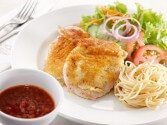

Made with fresh parsley, capers, boneless pork chops, flour, salt and pepper, olive oil, white wine, butter, lemon juice
Serves/Makes: 4
- 1 pound boneless pork chops
- 1/2 cup all-purpose flour
- salt and pepper, to taste
- 6 tablespoons olive oil (not extra-virgin)
- 12 ounces white wine
- 2 tablespoons butter
- 2 tablespoons lemon juice
- 4 tablespoons capers, rinsed
- 1/2 cup chopped fresh parsley
- extra-virgin olive oil
Slice the pork into thin medallions. Place the pork between sheets of waxed paper and pound thin using a meat mallet.
Combine the flour with generous amounts of salt and pepper and place in a shallow dish. Dredge the pork in the flour mixture, coating both sides and shaking off any excess. Set the pork aside.
Divide the oil between two saute pans (you want the pork to fit in a single layer) and heat over medium-high heat. Add the pork and cook until golden brown on each side, about 2-3 minutes per side. Remove the pork to a serving platter and keep warm.
Divide the wine between the pans and deglaze the pans, scraping the bottom of the pans to loosen any cooked on bits. Let the wine simmer until reduced by half. Divide the butter and lemon between the pans and reduce the heat to medium.
Add the pork back to the pans in a single layer. Add the capers and parsley. Cook for 1 minute, then turn the pork medallions over to coat in the sauce and cook for another minute. Return the pork and sauce from the pans to the serving platter. Drizzle lightly with the extra-virgin olive oil and serve immediately.


related articles



1 comments
Great article. I agree--There times when you should "just say no to EVOO"! I use grapeseed oil unless I want the distinctive flavor of olive oil in the finished dish. The grapeseed oil is flavorless and has a high smoke point. It allows me to saute at high temperatures and I find it lets the true flavors of the ingredients come through in my cooking. I even use it in salad dressings in place of olive oil especially if I am using a flavored vinegar (such as raspberry) and I don't want the delicate flavor of the vinegar compromised by the olive oil flavor. I love olive oil when it is used appropriately. But, as you so well point out,it is not the universal oil. The points you make about its limitations and uses are excellent.
Comment posted by victoria
Write a comment:
©2026 CDKitchen, Inc. No reproduction or distribution of any portion of this article is allowed without express permission from CDKitchen, Inc.
To share this article with others, you may link to this page:
https://www.cdkitchen.com/cooking-experts/amy-powell/326-olive-oil/