

cdkitchen > cooking experts > amy powell


I’m a sucker for an under-appreciated vegetable. Usually this inclination results in the dramatic rescue of a forlorn cabbage, celery root, or bunch of chard from a stand at a Farmer’s Market. I then coddle that forgotten, beautiful-in-its-own-special-way veggie and whisk it back to my kitchen, intent on transforming the ugly ducking into a beautiful swan worthy meal come dinnertime.
Kohlrabi, perhaps one of the saddest of the root vegetable bunch, was brought to my attention a bit differently than most. It came to me.
Several years ago in the kitchen of a family friend, the lady of the household approached me with several strange looking pale green orbs in her hands, each almost perfectly round and about the size of a baseball. “Do you know how to cook these?” she asked in her charming Franco-Belgian accent. “I think they are called kohlrabi?” Her neighbor, an excellent gardener, had bestowed on her some of his excess crop and despite being a talented cook, she had never made kohlrabi before.
Unfortunately, I wasn’t much help. I had seen some recipes, many involving boiling the peeled vegetable and pureeing it with potatoes for a mixed root veggie mash. But in fact, I had never cooked them before either.
Not too long after that, my mother called up with a similar dilemma. An avid gardener herself, she had successfully grown several kohlrabi that year and hadn’t the slightest clue how to prepare them. As I found myself giving her the same line about boiling and mashing, I thought it might be time to actually cook up some of this veg for myself and see what else, if anything, could be done with it.
Part of the cabbage family that also includes kale, Brussels sprouts, and cauliflower, the look and taste of kohlrabi could not be farther removed from its vegetal relatives. The edible orb, the part of the plant most frequently consumed, resembles a turnip. In fact, when eaten raw kohlrabi has a taste like a mild radish or daikon. Like turnips, kohlrabi takes well to cooking, but unlike starchier root vegetables, it will keep its taste and texture while absorbing the flavors of the cooking liquid.
I’ve tossed raw kohlrabi sliced paper-thin with lemony dressing and salad greens for a starter. Peeled and cubed, they’ve added bulk and texture to a pot of beef stew at the end of cooking.
Cooking, I realized that the texture of kohlrabi bears a striking similarity to daikon, the Japanese radish. So when kohlrabi came into season a few weeks back and my local grocer had slashed the price to an astounding 3 pounds for $1, I gathered up my new favorite overlooked vegetable and got to reimagining it as an Asian inspired side dish.
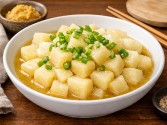
Like kohlrabi, daikon is served raw as well as cooked. I thought a simple daikon side dish involving miso as a braising liquid would work well with the kohlrabi. So as a pot of Vietnamese caramel pork simmered and rice steamed, I got to work on the kohlrabi. Peeled and cubed in bite-sized pieces, the kohlrabi went in the pot with miso paste I had dissolved in boiling water. Fifteen minutes later, the cubes were perfect- tender but not mushy. I removed them from the liquid, dusted them with pepper and gave them a generous sprinkling of green onions before serving.
Once strange, forgotten, and priced to move, kohlrabi proved once again that when it comes to the cooking potential of this particular overlooked vegetable, there is more than meets the eye.
©2026 CDKitchen, Inc. No reproduction or distribution of any portion of this article is allowed without express permission from CDKitchen, Inc.
To share this article with others, you may link to this page:
https://www.cdkitchen.com/cooking-experts/amy-powell/1230-kohlrabi/
The Hidden Potential of an Unloved Vegetable


I’m a sucker for an under-appreciated vegetable. Usually this inclination results in the dramatic rescue of a forlorn cabbage, celery root, or bunch of chard from a stand at a Farmer’s Market. I then coddle that forgotten, beautiful-in-its-own-special-way veggie and whisk it back to my kitchen, intent on transforming the ugly ducking into a beautiful swan worthy meal come dinnertime.
Kohlrabi, perhaps one of the saddest of the root vegetable bunch, was brought to my attention a bit differently than most. It came to me.
Several years ago in the kitchen of a family friend, the lady of the household approached me with several strange looking pale green orbs in her hands, each almost perfectly round and about the size of a baseball. “Do you know how to cook these?” she asked in her charming Franco-Belgian accent. “I think they are called kohlrabi?” Her neighbor, an excellent gardener, had bestowed on her some of his excess crop and despite being a talented cook, she had never made kohlrabi before.
Unfortunately, I wasn’t much help. I had seen some recipes, many involving boiling the peeled vegetable and pureeing it with potatoes for a mixed root veggie mash. But in fact, I had never cooked them before either.
Not too long after that, my mother called up with a similar dilemma. An avid gardener herself, she had successfully grown several kohlrabi that year and hadn’t the slightest clue how to prepare them. As I found myself giving her the same line about boiling and mashing, I thought it might be time to actually cook up some of this veg for myself and see what else, if anything, could be done with it.
Part of the cabbage family that also includes kale, Brussels sprouts, and cauliflower, the look and taste of kohlrabi could not be farther removed from its vegetal relatives. The edible orb, the part of the plant most frequently consumed, resembles a turnip. In fact, when eaten raw kohlrabi has a taste like a mild radish or daikon. Like turnips, kohlrabi takes well to cooking, but unlike starchier root vegetables, it will keep its taste and texture while absorbing the flavors of the cooking liquid.
I’ve tossed raw kohlrabi sliced paper-thin with lemony dressing and salad greens for a starter. Peeled and cubed, they’ve added bulk and texture to a pot of beef stew at the end of cooking.
Cooking, I realized that the texture of kohlrabi bears a striking similarity to daikon, the Japanese radish. So when kohlrabi came into season a few weeks back and my local grocer had slashed the price to an astounding 3 pounds for $1, I gathered up my new favorite overlooked vegetable and got to reimagining it as an Asian inspired side dish.
Like kohlrabi, daikon is served raw as well as cooked. I thought a simple daikon side dish involving miso as a braising liquid would work well with the kohlrabi. So as a pot of Vietnamese caramel pork simmered and rice steamed, I got to work on the kohlrabi. Peeled and cubed in bite-sized pieces, the kohlrabi went in the pot with miso paste I had dissolved in boiling water. Fifteen minutes later, the cubes were perfect- tender but not mushy. I removed them from the liquid, dusted them with pepper and gave them a generous sprinkling of green onions before serving.
Once strange, forgotten, and priced to move, kohlrabi proved once again that when it comes to the cooking potential of this particular overlooked vegetable, there is more than meets the eye.

Serves/Makes: 4
- 4 cups water
- 1/4 cup yellow miso paste
- 1/2 teaspoon ground white pepper
- 3 large kohlrabi
- 2 green onions
Bring water to a boil in a medium saucepan. Stir in miso paste and whisk till dissolved. Stir in white pepper.
While water is coming to a boil, peel kohlrabi. Cut kohlrabi into large cubes that are still bite sized. Add kohlrabi to miso. Bring back to a boil then reduce to a simmer. Cover with a lid and let simmer about 15 minutes, until a paring knife can easily pierce the kohlrabi.
Transfer kohlrabi to a serving dish with a slotted spoon. Thinly slice the green part of the onions. Sprinkle over the kohlrabi and serve.
share this article:


related articles


Write a comment:
©2026 CDKitchen, Inc. No reproduction or distribution of any portion of this article is allowed without express permission from CDKitchen, Inc.
To share this article with others, you may link to this page:
https://www.cdkitchen.com/cooking-experts/amy-powell/1230-kohlrabi/