

cdkitchen > cooking experts > sarah christine bolton

Everyone always makes lots of New Year’s resolutions. I used to. I recently went back to one my journals from age eleven, and read a list that I had written up the day before New Year’s Eve. A sample of the resolutions: “Walk gracefully. Hold your stomach in. Chew with your mouth closed. Wake up at 6:00 in the morning.”
I’m hoping that I’ve accomplished at least one of those resolutions, some twelve years later. Maybe not. Depends on who you ask. Since then, I have changed my philosophy and believe that making resolutions just once a year is an unrealistic idea. Resolutions should be made at any point in the year, whenever you feel like a change should be made.
Since I now walk (somewhat) gracefully and (attempt) to chew with my mouth closed, I decided my next resolution should be to be more adventurous when it comes to food. Since I’m a West Coast girl, a lot of southern cuisine baffles me. I never got fried okra or grits. Catfish just didn’t do it for me. But since I now live in the Bible Belt, I’m trying to open my mind and broaden my horizons…at least a bit.
I’m all about lentils and beans and legumes. Split pea soup with some carrots and turkey sausage is the perfect stick-to-your-ribs meal during the cold winter months. Black lentils served hot over rice with some curry and chili is another tasty option. But black-eyed peas were quite foreign to my kitchen and taste buds.
The black-eyed pea is thought to have originated in North Africa. It was a staple of both Greek and Roman diets, and brought to the New World by Spanish explorers and African slaves. At some point, the peas became part of Southern cuisine. One explanation goes like this:
During the Civil War, when the Federal soldiers pillaged and burned the southern farmlands, they often left the fields of corn and black-eyed peas intact, mainly because these crops were considered good only for animal consumption. In order to survive, people in the South had to eat whatever wasn’t destroyed, and black-eyed peas became an integral part of Southern soul food.
Even though I now live in the South, black-eyed peas were not an integral part of my kitchen. At least not until a few weeks ago, when my very Southern husband made a request: black-eyed peas. I threw a bag of dried peas into our cart and forgot about them. After not going grocery shopping for several days, the cupboard thinned down, and there they were: black-eyed peas.
Even though soul food has gotten a bad rap as being unhealthy, black-eyed peas don’t deserve to be lumped into the same list as say, fried chicken. The peas are low in fat, have zero cholesterol, and are low in sodium. They also have lots of potassium, iron and fiber. You can find them in virtually any form, including dried, fresh, canned and frozen. Black-eyed peas are traditionally cooked on New Year’s to bring good luck, but you can whip up a batch for good luck for the rest of the year, too.
©2026 CDKitchen, Inc. No reproduction or distribution of any portion of this article is allowed without express permission from CDKitchen, Inc.
To share this article with others, you may link to this page:
https://www.cdkitchen.com/cooking-experts/sarah-christine-bolton/624-black-eyed-peas/
Get Lucky With Black-Eyed Peas
Everyone always makes lots of New Year’s resolutions. I used to. I recently went back to one my journals from age eleven, and read a list that I had written up the day before New Year’s Eve. A sample of the resolutions: “Walk gracefully. Hold your stomach in. Chew with your mouth closed. Wake up at 6:00 in the morning.”
I’m hoping that I’ve accomplished at least one of those resolutions, some twelve years later. Maybe not. Depends on who you ask. Since then, I have changed my philosophy and believe that making resolutions just once a year is an unrealistic idea. Resolutions should be made at any point in the year, whenever you feel like a change should be made.
Since I now walk (somewhat) gracefully and (attempt) to chew with my mouth closed, I decided my next resolution should be to be more adventurous when it comes to food. Since I’m a West Coast girl, a lot of southern cuisine baffles me. I never got fried okra or grits. Catfish just didn’t do it for me. But since I now live in the Bible Belt, I’m trying to open my mind and broaden my horizons…at least a bit.
I’m all about lentils and beans and legumes. Split pea soup with some carrots and turkey sausage is the perfect stick-to-your-ribs meal during the cold winter months. Black lentils served hot over rice with some curry and chili is another tasty option. But black-eyed peas were quite foreign to my kitchen and taste buds.
The black-eyed pea is thought to have originated in North Africa. It was a staple of both Greek and Roman diets, and brought to the New World by Spanish explorers and African slaves. At some point, the peas became part of Southern cuisine. One explanation goes like this:
During the Civil War, when the Federal soldiers pillaged and burned the southern farmlands, they often left the fields of corn and black-eyed peas intact, mainly because these crops were considered good only for animal consumption. In order to survive, people in the South had to eat whatever wasn’t destroyed, and black-eyed peas became an integral part of Southern soul food.
Even though I now live in the South, black-eyed peas were not an integral part of my kitchen. At least not until a few weeks ago, when my very Southern husband made a request: black-eyed peas. I threw a bag of dried peas into our cart and forgot about them. After not going grocery shopping for several days, the cupboard thinned down, and there they were: black-eyed peas.
Even though soul food has gotten a bad rap as being unhealthy, black-eyed peas don’t deserve to be lumped into the same list as say, fried chicken. The peas are low in fat, have zero cholesterol, and are low in sodium. They also have lots of potassium, iron and fiber. You can find them in virtually any form, including dried, fresh, canned and frozen. Black-eyed peas are traditionally cooked on New Year’s to bring good luck, but you can whip up a batch for good luck for the rest of the year, too.
Slow Cooker Black Eyed Peas With Ham And Peppers

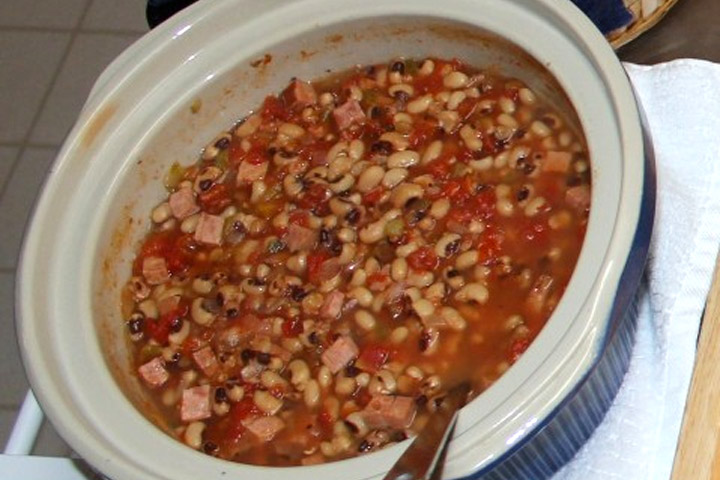
Made with salt and pepper, dried black-eyed peas, ham, tomatoes, green chiles, jalapeno pepper, chicken broth, celery
Made with salt and pepper, dried black-eyed peas, ham, tomatoes, green chiles, jalapeno pepper, chicken broth, celery
Serves/Makes: 6
- 16 ounces dried black-eyed peas
- 3/4 cup diced ham
- 30 ounces diced tomatoes
- 4 ounces diced green chiles
- 1 1/2 teaspoon minced jalapeno pepper
- 20 ounces chicken broth
- 1 stalk celery, chopped
- salt and pepper, to taste
Rinse peas in cold water, removing any debris or soiled peas. Place in a pot; cover with water. Bring to a boil and boil for 2 minutes. Turn off stove and let peas soak for 1 hour. Drain liquid and rinse peas under lukewarm water.
Place peas and all remaining ingredients in crockpot. Cook on LOW for 5-6 hours.
share this article:


related articles





Write a comment:
©2026 CDKitchen, Inc. No reproduction or distribution of any portion of this article is allowed without express permission from CDKitchen, Inc.
To share this article with others, you may link to this page:
https://www.cdkitchen.com/cooking-experts/sarah-christine-bolton/624-black-eyed-peas/