

cdkitchen > cooking experts > lauren braun costello

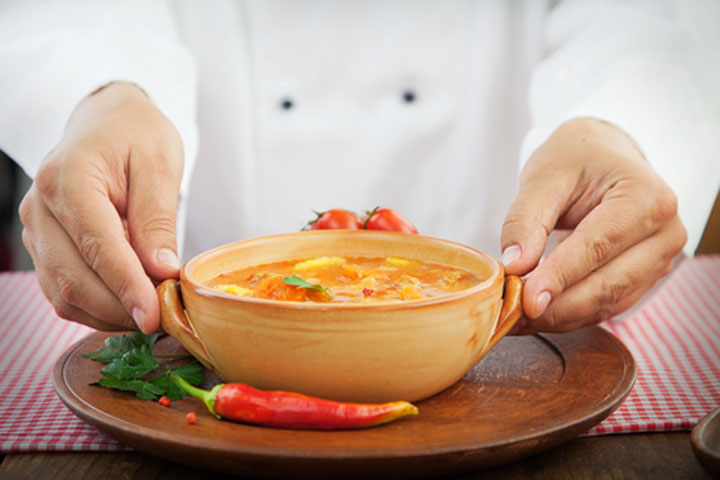
Food served in restaurants seems to taste better. There is nothing like the liberal use of salt and fat to elevate any ingredient. Freshly made stocks also make all the difference in the world, especially where sauces are concerned. But the presentation also has an impact. We do eat with our eyes as much as our taste buds. Restaurant chefs use a lot of tricks and tools to make art of what would otherwise be plain old sustenance.
Do Attempt This by Yourself at Home
A culinary degree gives a chef a comfort level, competence, speed and accuracy of technique. But it does not give a cook the exclusive rights to certain equipment and methods to make food look as beautiful as it tastes. There is no rule against using squeeze bottles, ring molds, pastry bags, and mandolines at home.
Squeeze bottles are such a boon to any attempt at garnishing a plate with sauces. It is not always appropriate to use one; there are instances where a loose, spooned approach is best. But if you want to have tight lines of sauce on your plate, straight or curved, a squeeze bottle is the way to go. I have about half a dozen bottles with different tops, some with wider openings than others. I use them for both savory and sweet sauces, such as flavored mayonnaises and fruit purees. I highly recommend picking up a squeeze bottle. It is a $2 investment that will pack a huge, impressive punch on the plate.
Rings molds are also as effective as they are inexpensive. Whether round, square or triangular, a ring mold will allow you to give height, shape and positioning to your food. Imagine how stunning it would be to serve chicken salad at home for a luncheon if it were spooned into a ring mold. You could even make layers in the ring mold. Try a little salad, a few slices of tomato and then some sliced avocado on top. When you remove the mold, an elegant and colorful packed stack will appear that will impress any guest.
Pastry bags are perhaps more limited in use than squeeze bottles and ring molds, but they are equally as valuable. If you want to make dips more formal, fill a pastry bag with a stiffer version of your favorite dip (fold in cream cheese to do this, for instance) and pipe the filling into miniature pastry cups. Whipped cream is good whether it is piped or spooned, but it can take your food styling to a new level by using the pastry bag. Even mashed potatoes can be much prettier twice baked when passed through a star tip (a tip with almost a Phillips head screwdriver shape).
I have written it before and I will write it again: a mandoline will do all the fancy cutting for you without the fuss. Julienne, waffle cuts and paper thin slices are easy when you slide vegetables across this rectangular surface fit with a tilting blade. Carrot and daikon matchsticks look so pretty in salads. They can be cut by hand, but even chefs use the shortcut of the mandoline. Thin slices of radishes or cucumbers make refined garnishes, and are achieved most easily on the mandoline. Food styling at home or in a restaurant without this tool would be a challenge.
Functional v. Nonfunctional Garnishes
A functional garnish is one that is used or eaten. A lemon wedge on a plate of fried calamari, or wasabi and ginger on a sushi plate are both examples of functional garnishes. Nonfunctional garnishes are there for decoration alone, such as the large bird carved from a carrot on a platter of sesame chicken, or the proverbial sprig of curly parsley on top of broiled fish. There is a school of thought that one should use only functional garnishes. I do not necessarily agree, since there is a time and place for almost everything. But I would urge anyone who wants to style food in the fashion of contemporary eateries to make use of some key functional garnishes.
Micro greens like kohlrabi, radish greens, baby arugula and baby mizuna are all wonderful garnishes to almost any savory dish. Bright in color, rich in flavor and vitamins, micro greens are used in every professional kitchen these days. Nature makes them miniature, so there is no cutting or preparation, just placement. The same goes for herbs. Try frying a sage leaf in hot oil for a shiny, crisp and tasty functional garnish. Never use an herb for a garnish that is not in fact an ingredient in the dish, unless it is something basic like parsley or chervil. A rosemary sprig is a lovely nonfunctional garnish, but only if rosemary is used in the food.
With these tools and tips, you can bring food styling home any time you want.
1 comments
©2026 CDKitchen, Inc. No reproduction or distribution of any portion of this article is allowed without express permission from CDKitchen, Inc.
To share this article with others, you may link to this page:
https://www.cdkitchen.com/cooking-experts/lauren-braun-costello/320-home-food-styling/
Food Styling For The Home Cook
Food served in restaurants seems to taste better. There is nothing like the liberal use of salt and fat to elevate any ingredient. Freshly made stocks also make all the difference in the world, especially where sauces are concerned. But the presentation also has an impact. We do eat with our eyes as much as our taste buds. Restaurant chefs use a lot of tricks and tools to make art of what would otherwise be plain old sustenance.
Do Attempt This by Yourself at Home
A culinary degree gives a chef a comfort level, competence, speed and accuracy of technique. But it does not give a cook the exclusive rights to certain equipment and methods to make food look as beautiful as it tastes. There is no rule against using squeeze bottles, ring molds, pastry bags, and mandolines at home.
Squeeze bottles are such a boon to any attempt at garnishing a plate with sauces. It is not always appropriate to use one; there are instances where a loose, spooned approach is best. But if you want to have tight lines of sauce on your plate, straight or curved, a squeeze bottle is the way to go. I have about half a dozen bottles with different tops, some with wider openings than others. I use them for both savory and sweet sauces, such as flavored mayonnaises and fruit purees. I highly recommend picking up a squeeze bottle. It is a $2 investment that will pack a huge, impressive punch on the plate.
Rings molds are also as effective as they are inexpensive. Whether round, square or triangular, a ring mold will allow you to give height, shape and positioning to your food. Imagine how stunning it would be to serve chicken salad at home for a luncheon if it were spooned into a ring mold. You could even make layers in the ring mold. Try a little salad, a few slices of tomato and then some sliced avocado on top. When you remove the mold, an elegant and colorful packed stack will appear that will impress any guest.
Pastry bags are perhaps more limited in use than squeeze bottles and ring molds, but they are equally as valuable. If you want to make dips more formal, fill a pastry bag with a stiffer version of your favorite dip (fold in cream cheese to do this, for instance) and pipe the filling into miniature pastry cups. Whipped cream is good whether it is piped or spooned, but it can take your food styling to a new level by using the pastry bag. Even mashed potatoes can be much prettier twice baked when passed through a star tip (a tip with almost a Phillips head screwdriver shape).
I have written it before and I will write it again: a mandoline will do all the fancy cutting for you without the fuss. Julienne, waffle cuts and paper thin slices are easy when you slide vegetables across this rectangular surface fit with a tilting blade. Carrot and daikon matchsticks look so pretty in salads. They can be cut by hand, but even chefs use the shortcut of the mandoline. Thin slices of radishes or cucumbers make refined garnishes, and are achieved most easily on the mandoline. Food styling at home or in a restaurant without this tool would be a challenge.
Functional v. Nonfunctional Garnishes
A functional garnish is one that is used or eaten. A lemon wedge on a plate of fried calamari, or wasabi and ginger on a sushi plate are both examples of functional garnishes. Nonfunctional garnishes are there for decoration alone, such as the large bird carved from a carrot on a platter of sesame chicken, or the proverbial sprig of curly parsley on top of broiled fish. There is a school of thought that one should use only functional garnishes. I do not necessarily agree, since there is a time and place for almost everything. But I would urge anyone who wants to style food in the fashion of contemporary eateries to make use of some key functional garnishes.
Micro greens like kohlrabi, radish greens, baby arugula and baby mizuna are all wonderful garnishes to almost any savory dish. Bright in color, rich in flavor and vitamins, micro greens are used in every professional kitchen these days. Nature makes them miniature, so there is no cutting or preparation, just placement. The same goes for herbs. Try frying a sage leaf in hot oil for a shiny, crisp and tasty functional garnish. Never use an herb for a garnish that is not in fact an ingredient in the dish, unless it is something basic like parsley or chervil. A rosemary sprig is a lovely nonfunctional garnish, but only if rosemary is used in the food.
With these tools and tips, you can bring food styling home any time you want.
share this article:


related articles


1 comments
Great ideas! I just started blogging about food and my photos have needed some extra oomph. I'll be using some of your tips from now on!
Comment posted by Rebecca
Write a comment:
©2026 CDKitchen, Inc. No reproduction or distribution of any portion of this article is allowed without express permission from CDKitchen, Inc.
To share this article with others, you may link to this page:
https://www.cdkitchen.com/cooking-experts/lauren-braun-costello/320-home-food-styling/