

To Brine or Not To Brine


The Thanksgiving turkey is perhaps the greatest source of insecurity and anxiety for America's home cooks. The competition, it seems, is not for the moistest turkey, but unfortunately for being able to make the bird moist in the first place. Every year, people ask me whether they should brine their holiday bird. "I hear that if you don't brine it, the turkey will be dry. Is that true?" I am thrilled to set the record straight, and hopefully to make you a more competent--and confident--Thanksgiving Day cook.
No! It is not at all true that you must brine to have a moist turkey. That being said, brining is an excellent technique that helps to produce a moist and tasty turkey. But it is not a requisite. Personally, I do not brine my turkey. I have alternative techniques to moisten and flavor my bird (see below) without adding this additional step. But that is an individual choice, and there are literally hundreds of delicious and technically sound ways to roast a turkey. Before you decide whether you want to brine, learn more about the technique and all your options.
What is Brining?
Brining is placing food in a strong solution of water and salt (a brine) in order to pickle or preserve it. Other ingredients can be added to this solution for flavor or color, such as sugar or molasses. Specifically, brining a turkey helps the bird to retain moisture and impart flavor throughout the meat.
Brining can take anywhere from 4 hours to overnight, depending on your schedule and needs. The longer you plan on brining the turkey, however, the less salt you should use. For example, if you have a 15 pound turkey and you plan to brine it in 2 gallons of water for 4-6 hours, use up to 4 cups of kosher salt. If you will eat an early dinner Thanksgiving day and wish to begin brining the night before, use only 2 cups of kosher salt. You may use table salt, but you will need to use even more of it since it is less potent in flavor. To that end, kosher salt is ideal.
When the bird is removed from the brine to be put in the oven, it first must be rinsed thoroughly inside and out, and then pat dry inside and out. These are two critical steps to ensure that the turkey is neither unpleasantly salty nor damp before being cooked.
That is the Question. . .
So, to brine or not to brine. At this point you may be wondering what your other options are, if not to brine. One way to achieve moisture and impart a salty, seasoned flavor is to wrap the turkey in bacon. This is undoubtedly my favorite roast turkey preparation. The bacon is cured and fatty, so it can impart lots of flavor and moisture from salt and fat. Coating the turkey breast and legs with bacon literally acts as a shield, creating a layer between the turkey and direct heat. The bacon itself tastes like no other bacon you have ever had.
Another useful method is to rub the outside of the bird with lots of butter, in the same manner as Julia Child's legendary roast chicken. Butter is pure fat and flavor, so it certainly can provide moisture and taste. Roasting the turkey breast-side down is also a fool-proof method for retaining, at the very least, moisture. At the last stage of cooking, the turkey is turned breast-side up to brown and crisp.
There are other ways to keep a turkey moist, such a cooking it in one of those large plastic bags or tenting it with foil (both serve as protective shields from direct heat). People swear by deep fried turkey, and I imagine a bird cooked in a cauldron of hot grease could not possibly lack flavor or moisture. You do have many options after all, brine or not.
Top Turkey Tips
Whether you decide to brine your bird or not, there are a few additional things to keep in mind. Many people overcook their birds, I think, because when they check the legs for the juice to run clear, they see that the leg flesh looks pink, and they consider that color to be unsafe for consumption. Remember that turkey legs are dark meat and the color is most definitely pinkish. If the juices have run clear and the internal temperature has reached 180F in the thigh or 170F in the breast, your turkey is ready to be served. Along those lines, let the turkey rest. If the turkey is carved right away without having rested, the juices will simply run from the bird, leaving the meat potentially dry. Allow the turkey time to redistribute its own internal moisture. Not only will the bird hold onto all those juices that it produced during the cooking process, but you will have an easier and safer experience carving the turkey.
There are a few other common mistakes that people tend to make. We all focus on seasoning the outside of the turkey, but often neglect the cavity. The inside of the bird must be seasoned just as much as the outside, if not more so. The flavors can infuse from within during cooking. Rub the cavity with lots of salt and pepper, then fill part of it with onions, apples, carrots, celery or any other aromatics that appeal to you.
What about the stuffing? Even though a stuffed turkey is the visual representation of our national day of thanks, it is not really a safe or particularly good preparation. There is the potential for the stuffing to fail to reach a food-safe temperature, which is problematic when stuffing is made with raw meats and eggs. Also, the stuffing stays wet, absorbing moisture from the bird, since very little of it is exposed to the heat directly to become browned and develop a crust. More to the point of this article, the stuffing prolongs the cooking of the turkey, since air and heat cannot get to the cavity and circulate within the bird. The part of the turkey that suffers the most is, of course, the breast.
If you are used to stuffing your bird and have had dry results, consider "undressing" the turkey this year (stuffing, when cooked in a casserole on its own, is called dressing). Try one of my three recipes for a moist, tasty turkey.
Happy Thanksgiving, Competent Cooks!
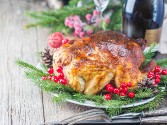

Made with salt and freshly ground black pepper, onion, whole turkey, unsalted butter, fresh sage, fresh thyme, fresh savory, carrot, celery
Serves/Makes: 8
- 14 pounds whole turkey
- 1/2 cup unsalted butter, melted
- 1 bunch fresh sage
- 1 bunch fresh thyme
- 1 bunch fresh savory
- 1 medium carrot, cut in chunks
- 1 medium celery stalk, cut in chunks
- 1 small onion, cut in chunks
- salt and freshly ground black pepper
Preheat oven to 325 degrees F. Wash turkey well under cold running water. Pat dry. Remove excess fat from cavity. Tuck wings underneath body.
Mix melted butter, plus 2 tablespoons each chopped sage, thyme, and savory. Stuff turkey cavity with carrot, onion, celery and a few sprigs each of sage, thyme and savory.
Place turkey, breast side up, on a V-shaped rack in a large roasting pan. Brush about half the herb butter mixture over top and sides of turkey. Sprinkle both the cavity and outside with salt and pepper.
Roast turkey, uncovered, for one hour. Brush with herb butter mixture and continue roasting for approximately 2 1/2 hours, basting occasionally with pan juices, until the internal temperature in the thickest part of the thigh measures 180 degrees F or the breast measures 170 degrees F.
Remove pan from oven and allow the turkey to rest for 15 minutes before slicing.
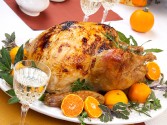
Made with oil, fresh marjoram, fresh thyme, whole turkey, lemons, limes, orange, brown sugar, white wine or apple juice, fresh sage
Serves/Makes: 8
- 14 pounds whole turkey
- 2 large lemons
- 2 large limes
- 1 large juicing orange
- 1/4 cup brown sugar (dark or light)
- 1/4 cup dry white wine or apple juice
- 2 tablespoons chopped fresh sage
- 2 tablespoons chopped fresh thyme
- 2 tablespoons chopped fresh marjoram
- 1/4 cup oil
- salt and freshly ground black pepper
Preheat the oven to 325 degrees F.
Pat the turkey dry with paper toweling. Remove any excess fat from the cavity and tuck the wings under the body.
Cut the citrus fruits in half then squeeze the juice from them. Combine the lemon juice, lime juice, and orange juice. Add the wine and brown sugar and mix well. Set aside.
Season the inside of the turkey cavity with salt and then add the halved fruits.
Combine the sage, thyme, and marjoram. Slide the herb mixture under the skin of the turkey. Rub the outside of the turkey with the oil and season well with salt and pepper.
Place the turkey breast side up on a rack in a shallow roasting pan. Secure the neck skin with skewers. Place the roasting pan in the oven and roast at 325 degrees F for 3 1/2 hours. During the last hour of cooking time, baste the turkey with the pan drippings and citrus glaze. If the turkey begins to brown too quickly, cover it lightly with foil. Cook until the turkey registers 170 degrees F in the breast or 180 degrees in the thigh when tested with a meat thermometer.
Remove the turkey from the oven and let it rest, covered lightly with foil, for 15 minutes before carving.
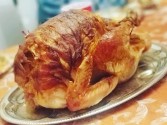
Made with salt and freshly ground black pepper, turkey, bacon, maple syrup, tart apple, onion
Serves/Makes: 12
- 14 pounds whole turkey
- 2 pounds sliced bacon
- 1 cup maple syrup
- 1 large tart apple, quartered
- 1 medium onion, quartered
- salt and freshly ground black pepper
Preheat oven to 400 degrees F. Wash turkey well under cold running water. Pat dry. Remove excess fat from the cavity. Tuck wings underneath body.
Season the skin and cavity of the turkey generously with salt and pepper, including the backside. Place the quartered apple and onion in the seasoned cavity. Using a brush, paint the turkey breast, thighs and legs with some of the maple syrup. Then wrap the turkey with bacon, covering the entire breast, thighs and legs so that no skin shows through.
Position the turkey, on a rack, in a roasting pan with 1/2 cup of water, uncovered and place in the preheated 400 degree F oven. Immediately lower the oven temperature to 325 degrees F and roast for about 3 1/2 hours, basting the turkey with pan drippings and maple syrup every 30 minutes. If the bacon begins to get too brown, cover loosely with aluminum foil.
In the last half hour, remove the crisp bacon (save for gravy or enjoy as a snack of the best bacon you have ever had). Baste the turkey one more time with maple syrup. Continue to roast until the internal temperature reaches 180 degrees in the thigh or 170 degrees in the breast.
Remove pan from oven and allow the turkey to rest for 15 minutes before slicing.


related articles


5 comments
This really isn't a comment:it's a question. How does the bacon fat drippings which mingle with the other juices from the turkey affect the taste of the Gravy? That's my real concern here.
Comment posted by Pastor Keith
Thanks for a great article. I decided to brine the turkey this year. Big success! Diane Watkins
Comment posted by Diane
This is an EXCELLENT question. The bacon drippings blend, in my opinion, so well with the fat of the turkey. The salty smokey flavor makes the a gravy with a lot of depth of flavor that needs very little added to it. If you have serious concerns about salt for either health or flavor issues, just blanch the bacon first before wrapping the turkey.
Comment posted by Chef Lauren Braun Costello
How about apple juice and a sage brine.Does that sound like it would work?.
Comment posted by brodie
what about brining a butterball injected turkey
Comment posted by rsharp
Write a comment:
©2026 CDKitchen, Inc. No reproduction or distribution of any portion of this article is allowed without express permission from CDKitchen, Inc.
To share this article with others, you may link to this page:
https://www.cdkitchen.com/cooking-experts/lauren-braun-costello/187-how-to-brine-a-turkey/