

cdkitchen > cooking experts > lauren braun costello

The Jewish New Year, Rosh Hashanah, begins on the first day of the month of Tishri and lasts for 10 days, culminating in the conclusion of Yom Kippur. These are known as the Days of Awe, the holiest of days in the Jewish Year. Food plays a major role, both ritually and culturally, during this time. Sweet flavors are to be savored and bitter tastes to be avoided. There are several fascinating traditions to discover.
Apples and Honey
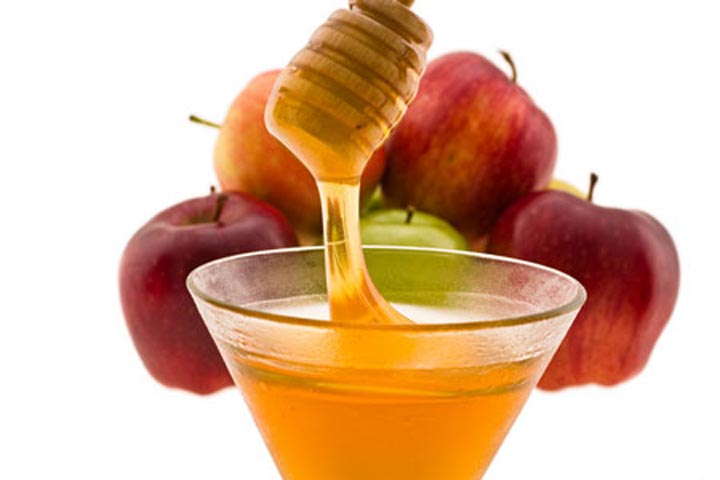
Apples dipped in honey are the most well known symbols of Rosh Hashanah. They represent the wish of sweetness for the new year. There is in fact a ritual for this celebratory food pairing: the apple is dipped in honey, the blessing for eating tree fruits is recited, the apple is then tasted, and finally a special "apples and honey" prayer is recited.
I can remember dipping a slice of a juicy red apple into a bowl of golden honey for the first time. It was such a thrill to grab so much of the bee's nectar on a crisp slice of apple. As a young girl, I would look forward to the family meal because I knew this annual treat would be my first bite of the holiday feast. Apples and honey should be enjoyed by all this time of year. Apple picking season is in full gear, so everyone grab apples and enjoy this healthy snack.
Bread with a Special Twist
Bread is a significant symbol throughout the Jewish year, representing prosperity and plenty. The typical shape of challah, Jewish egg bread similar to French brioche, is a long braid. During Rosh Hashanah, however, the challah is shaped differently and studded with raisins for sweetness. To keep the "sweet" theme going, the challah is dipped in honey or sugar instead of salt, as is the usual custom on the weekly Sabbath.
There are many ways to shape challah during Rosh Hashanah, the most common of which is a round loaf to symbolize the circle of life, and perhaps also to represent a crown as a reminder of God's kingship. There are two other traditional new year challah shapes, but they are not known to me through experience. One such tradition is to shape the challah like a ladder to help our prayers reach heaven, and to remind us that God decides who ascends the ladder of life. Another even more rare tradition is to adorn the challah with birds, or to shape the entire bread like a bird. This recalls the phrase of Isaiah: 31:5, "As hovering birds, so will the Lord protect Jerusalem."
A "Head" Start
Rosh Hashanah literally means "head of the year." There is obvious symbolism then in serving a fish head or roasted lamb's head at the holiday table. However, fish and meat are also often served whole to represent the wish of wholeness for the coming year.
Food can be used to pray for a good edict for the new year. Connections can be made between the foods we eat and their roots in Aramaic or Hebrew. These declarations are called “simmonim” or “simon” (singular). For example, in eating tongue we ask for two decrees. Since tongue comes from the cow's head, we first request from God that we be the head and not the tail. In Hebrew, "tongue" is "lashon" so we ask God secondly that we do not speak "lashon haraah", evil speech.
New Fruits
Rosh Hashanah is a time of sweetness, contemplation, and discovery, too. It is tradition to taste the new fruits of the season for the first time on the second night of Rosh Hashanah. These fruits include fresh dates, figs, and pomegranates, all of which are biblical foodstuffs. The pomegranate has particular significance. Some suggest that its many seeds represent the 613 good deeds, or mitzvot, mentioned in the Torah that a Jew has to perform during the year. Others assert that pomegranate seeds number 365 and represent the days of the year. In general, the new fruits symbolize a fresh start and the beginning of another year's cycle.
There are dozens more Rosh Hashanah customs marked by food, whether it be what is eaten or what is avoided, such as bitter vinegar. Shape, taste, appearance, preparation and linguistic roots all play a role in these rituals within local cultures. These traditions are as intriguing as they are broad. I wish all those who celebrate this joyous and reflective festival L’Shana Tova. May your new year be sweet!
1 comments
©2026 CDKitchen, Inc. No reproduction or distribution of any portion of this article is allowed without express permission from CDKitchen, Inc.
To share this article with others, you may link to this page:
https://www.cdkitchen.com/cooking-experts/lauren-braun-costello/165-rosh-hashana-new-year/
Rosh Hashana: A New Year of Food
The Jewish New Year, Rosh Hashanah, begins on the first day of the month of Tishri and lasts for 10 days, culminating in the conclusion of Yom Kippur. These are known as the Days of Awe, the holiest of days in the Jewish Year. Food plays a major role, both ritually and culturally, during this time. Sweet flavors are to be savored and bitter tastes to be avoided. There are several fascinating traditions to discover.
Apples and Honey
Apples dipped in honey are the most well known symbols of Rosh Hashanah. They represent the wish of sweetness for the new year. There is in fact a ritual for this celebratory food pairing: the apple is dipped in honey, the blessing for eating tree fruits is recited, the apple is then tasted, and finally a special "apples and honey" prayer is recited.
I can remember dipping a slice of a juicy red apple into a bowl of golden honey for the first time. It was such a thrill to grab so much of the bee's nectar on a crisp slice of apple. As a young girl, I would look forward to the family meal because I knew this annual treat would be my first bite of the holiday feast. Apples and honey should be enjoyed by all this time of year. Apple picking season is in full gear, so everyone grab apples and enjoy this healthy snack.
Bread with a Special Twist
Bread is a significant symbol throughout the Jewish year, representing prosperity and plenty. The typical shape of challah, Jewish egg bread similar to French brioche, is a long braid. During Rosh Hashanah, however, the challah is shaped differently and studded with raisins for sweetness. To keep the "sweet" theme going, the challah is dipped in honey or sugar instead of salt, as is the usual custom on the weekly Sabbath.
There are many ways to shape challah during Rosh Hashanah, the most common of which is a round loaf to symbolize the circle of life, and perhaps also to represent a crown as a reminder of God's kingship. There are two other traditional new year challah shapes, but they are not known to me through experience. One such tradition is to shape the challah like a ladder to help our prayers reach heaven, and to remind us that God decides who ascends the ladder of life. Another even more rare tradition is to adorn the challah with birds, or to shape the entire bread like a bird. This recalls the phrase of Isaiah: 31:5, "As hovering birds, so will the Lord protect Jerusalem."
A "Head" Start
Rosh Hashanah literally means "head of the year." There is obvious symbolism then in serving a fish head or roasted lamb's head at the holiday table. However, fish and meat are also often served whole to represent the wish of wholeness for the coming year.
Food can be used to pray for a good edict for the new year. Connections can be made between the foods we eat and their roots in Aramaic or Hebrew. These declarations are called “simmonim” or “simon” (singular). For example, in eating tongue we ask for two decrees. Since tongue comes from the cow's head, we first request from God that we be the head and not the tail. In Hebrew, "tongue" is "lashon" so we ask God secondly that we do not speak "lashon haraah", evil speech.
New Fruits
Rosh Hashanah is a time of sweetness, contemplation, and discovery, too. It is tradition to taste the new fruits of the season for the first time on the second night of Rosh Hashanah. These fruits include fresh dates, figs, and pomegranates, all of which are biblical foodstuffs. The pomegranate has particular significance. Some suggest that its many seeds represent the 613 good deeds, or mitzvot, mentioned in the Torah that a Jew has to perform during the year. Others assert that pomegranate seeds number 365 and represent the days of the year. In general, the new fruits symbolize a fresh start and the beginning of another year's cycle.
There are dozens more Rosh Hashanah customs marked by food, whether it be what is eaten or what is avoided, such as bitter vinegar. Shape, taste, appearance, preparation and linguistic roots all play a role in these rituals within local cultures. These traditions are as intriguing as they are broad. I wish all those who celebrate this joyous and reflective festival L’Shana Tova. May your new year be sweet!
share this article:


related articles


1 comments
i am doing a prodject on josh hashanah and i have found this article very, very useful. i think that a lot of good resurch has gone in to this article. so thankyou!!!!!!!
Comment posted by kits
Write a comment:
©2026 CDKitchen, Inc. No reproduction or distribution of any portion of this article is allowed without express permission from CDKitchen, Inc.
To share this article with others, you may link to this page:
https://www.cdkitchen.com/cooking-experts/lauren-braun-costello/165-rosh-hashana-new-year/