

cdkitchen > cooking experts > christine gable

Daughter recently had a friend over to play who stayed to eat dinner with us. A spunky, enthusiastic girl, she began to regale us with tales of leftover food funnies from their house. You know, the green, the forgotten, the “what’s that growing in there?” stories that kids love. And then she took it a step further:
“Wouldn’t it be funny if when you went over to buy tomato sauce there would be cans of leftovers there too? There would be cans with labels: a picture of some food with bad smells coming off and it would have green smoke rising from it. Imagine that … no one would want buy that, for sure.”
Ha! Well, we all certainly had a good laugh about that vision.
Leftovers in a can. Ugh. Just the thought of that makes most of us a bit queasy, eh?
And can’t we all relate to a memory of some too-long-kept leftovers with green smoke emanating? Makes you want to get rid of all those Rubbermaid keeper containers and think only fresh for each mealtime.
Yet daughter said next exactly what I was thinking: “I like leftovers, and they’re usually pretty good.”
“Yeah,” I agreed. “Sometimes they’re even better than the dish was the first time-around.
Thankfully we don’t have to dole out unknown contents of cans bearing “leftover labels.” But what if there was a good way to make leftovers more appealing? Perhaps even appetizing?
Well, that has been one of my goals over the past several years. While not an official New Year’s resolution, it was something that I wanted to get straight on. That’s because there was usually some food left from our meals, and the containers seemed to end up hither and yonder and scattered amongst and between the sour cream container, milk jugs, juice cartons and spaghetti sauce jars. With other multiples thrown in daily.
Where exactly were the leftovers, first of all? And why did they always get shoved to the back of the shelves?
There had to be a better way. Oh, what to do?
Our solution presented itself when I was cleaning out the refrig one Saturday morning. Why not keep all the containers on one shelf, all together? That way the eye (and the cook) can see what’s available at a glance—without having to hunt and search and wonder. And why hadn’t we thought of that sooner?
We managed to clean out the storage container drawer and get rid of all those mismatched lids and containers. And it was an awesome sight: stacks of small, medium and large containers with the matching lids waited at attention. I even splurged on a new set of clear Rubbermaid with fabulous sealing lids—there’s nothing like having clean, see-through attractive containers to get leftovers going in the right direction.
It worked. We began designating one special shelf in our refrig just for containers of leftovers and an amazing thing happened. We hardly ever threw out any food anymore. The cup of buttered noodles was eaten as a snack. The half-cup of soup was used in a casserole. Dad paired up some meatloaf with three-quarters of a baked potato and a half-cup of peas and made a dandy microwaveable lunch for work. The oatmeal was used in a batch of muffins and the vegetables were tossed into a rice and tofu stir-fry. Amazingly enough, we began finding uses for all the odds and ends that often get scraped into the garbage—either sooner or later.
Hopefully leftovers in a can aren’t something that we’ll ever have to deal with—but if you can successfully manage your own household’s contribution to the unnecessarily thrown-out food in the trash stream, you’ll be helping the planet and stretching your own leftover-chef creativity at the same time.
So, do tell—do you have a favorite recipe to use up those leftovers at your house?
©2026 CDKitchen, Inc. No reproduction or distribution of any portion of this article is allowed without express permission from CDKitchen, Inc.
To share this article with others, you may link to this page:
https://www.cdkitchen.com/cooking-experts/christine-gable/833-leftover-tips/
Leftovers In A Can?
Daughter recently had a friend over to play who stayed to eat dinner with us. A spunky, enthusiastic girl, she began to regale us with tales of leftover food funnies from their house. You know, the green, the forgotten, the “what’s that growing in there?” stories that kids love. And then she took it a step further:
“Wouldn’t it be funny if when you went over to buy tomato sauce there would be cans of leftovers there too? There would be cans with labels: a picture of some food with bad smells coming off and it would have green smoke rising from it. Imagine that … no one would want buy that, for sure.”
Ha! Well, we all certainly had a good laugh about that vision.
Leftovers in a can. Ugh. Just the thought of that makes most of us a bit queasy, eh?
And can’t we all relate to a memory of some too-long-kept leftovers with green smoke emanating? Makes you want to get rid of all those Rubbermaid keeper containers and think only fresh for each mealtime.
Yet daughter said next exactly what I was thinking: “I like leftovers, and they’re usually pretty good.”
“Yeah,” I agreed. “Sometimes they’re even better than the dish was the first time-around.
Thankfully we don’t have to dole out unknown contents of cans bearing “leftover labels.” But what if there was a good way to make leftovers more appealing? Perhaps even appetizing?
Well, that has been one of my goals over the past several years. While not an official New Year’s resolution, it was something that I wanted to get straight on. That’s because there was usually some food left from our meals, and the containers seemed to end up hither and yonder and scattered amongst and between the sour cream container, milk jugs, juice cartons and spaghetti sauce jars. With other multiples thrown in daily.
Where exactly were the leftovers, first of all? And why did they always get shoved to the back of the shelves?
There had to be a better way. Oh, what to do?
Our solution presented itself when I was cleaning out the refrig one Saturday morning. Why not keep all the containers on one shelf, all together? That way the eye (and the cook) can see what’s available at a glance—without having to hunt and search and wonder. And why hadn’t we thought of that sooner?
We managed to clean out the storage container drawer and get rid of all those mismatched lids and containers. And it was an awesome sight: stacks of small, medium and large containers with the matching lids waited at attention. I even splurged on a new set of clear Rubbermaid with fabulous sealing lids—there’s nothing like having clean, see-through attractive containers to get leftovers going in the right direction.
It worked. We began designating one special shelf in our refrig just for containers of leftovers and an amazing thing happened. We hardly ever threw out any food anymore. The cup of buttered noodles was eaten as a snack. The half-cup of soup was used in a casserole. Dad paired up some meatloaf with three-quarters of a baked potato and a half-cup of peas and made a dandy microwaveable lunch for work. The oatmeal was used in a batch of muffins and the vegetables were tossed into a rice and tofu stir-fry. Amazingly enough, we began finding uses for all the odds and ends that often get scraped into the garbage—either sooner or later.
Hopefully leftovers in a can aren’t something that we’ll ever have to deal with—but if you can successfully manage your own household’s contribution to the unnecessarily thrown-out food in the trash stream, you’ll be helping the planet and stretching your own leftover-chef creativity at the same time.
So, do tell—do you have a favorite recipe to use up those leftovers at your house?
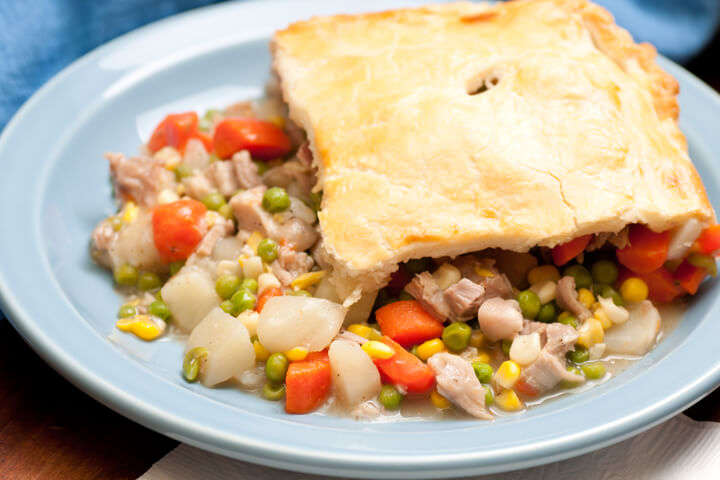
Leftover Pie


Made with gravy, leftover grain, black pepper, pie crust, vegetable oil, onion, leftover vegetables, leftover protein, onion salt
Made with gravy, leftover grain, black pepper, pie crust, vegetable oil, onion, leftover vegetables, leftover protein, onion salt
Serves/Makes: 4
- 1 prepared double pie crust
- 2 tablespoons vegetable oil
- 1 small onion, minced
- 2 cups leftover vegetables (carrots, peas, corn, etc.), or amount as desired
- 1 cup leftover protein (lentils, tofu, chicken, etc.)
- 1/2 teaspoon onion salt
- 1/4 teaspoon black pepper
- 2 cups leftover grain (rice, millet, noodles)
- gravy, optional
Preheat oven to 375F.
Place bottom crust in a 9-inch pie pan. Set aside.
In large heavy skillet over medium heat, saute onion in vegetable oil for 1-2 minutes. Add leftover vegetables and protein, and saute another 2 minutes; add salt and pepper. Stir in leftover grain and scoop whole mixture into prepared crust.
Top with second crust; trim and pinch edges together. Cut 5-6 steam slits in top. Bake for 30-35 minutes until golden. Remove from oven, slice and serve with gravy.
share this article:


related articles


Write a comment:
©2026 CDKitchen, Inc. No reproduction or distribution of any portion of this article is allowed without express permission from CDKitchen, Inc.
To share this article with others, you may link to this page:
https://www.cdkitchen.com/cooking-experts/christine-gable/833-leftover-tips/