

Hominy: The Story of a Canned Culinary Secret


Once upon a time in the Land of Earthquakes (California), young children were asked to bring canned goods to school to put in a classroom kit for earthquake preparedness. From across this small town, children asked their mothers for cans of tuna fish, corn, and pinto beans. One child (me), asked her mother for a jumbo sized can of her favorite canned food at the time, hominy.
On the great can collection day, as kids are apt to do, there was much comparison and hushed judgment of each canned contribution. The winner by far, as determined by the fast flow of gossip, was the boy with the large, brightly colored can of some strange looking meat called SPAM. The loser by verdict of similar but derisive classroom gossip and suffering a punishment of a whole day’s worth of childish harassment was the girl who brought that jumbo-sized can of weird looking stuff called hominy.
If they only knew what they were missing. Perhaps because of that incident, or maybe because hominy fell out of favor with the home menu planning, I didn’t see much more of that delicious vegetable. Hominy, as weird as it sounds and strange as it looks, is nothing more than dried corn kernels that have been soaked in a water and lye mixture. This mixture removes the outer hull, making the corn easier to digest.
The act of making corn into hominy is an ancient practice that dates back to the native people of North and South America. The earliest evidence of hominy making was found in Guatemala in 1500-1200 BC. Hominy has since been used in everything from soups and stews, cornbread, fried with bacon, or ground and made into something like hominy grits.
Luckily, with the invention of modern technology, if you want to try hominy yourself, the processing is already done for you, and this is one time where it is certainly acceptable to get an item in the canned food aisle. Like corn, hominy can be white or yellow. It is dime-sized and roundish, just like you would imagine a swollen corn kernel would look like. The taste is mild, earthy, and slightly sweet. Altogether, the taste is not unlike corn itself, but the processing with the lye lends a unique texture which can then add a different dimension to the soup and stews it finds its way into.
A classic Mexican use of hominy is the potent stew called menudo. Like many of the world’s great foods, this was a recipe born of poverty, a way to make use of all the least desirable bits of food. In this case, the stomach of a cow (tripe) is boiled with chilies, seasoning, and hominy. It has become a classic dish for Mexican and Mexican Americans, often served in Mexican restaurants in the US only on the weekends, known in some parts as a cure for hangovers.
The dish that most takes me back to my childhood, and the taste that had me hooked on this canned good in the first place, is another Mexican stew called pozole. This too is a poor man’s food. A true poor man’s pozole can be made up of little more than a stewed cheap cut of pork like ribs or butt, with hominy, onions, garlic, and chilies. Beyond the basics, the variations are endless. A rich man’s pozole can include a more expensive cut of pork or even chicken. I like a lot of cilantro, a combination of dried and fresh chili, and a little lime juice at the end.
In the Land of Earthquakes, amidst the harsh judgment of children, it is reasonable that an odd looking food like hominy would be misunderstood. But in the event of an actual emergency, I am pretty sure that that can of hominy would have been a stand-out among the tins of tuna and green beans. A can of hominy, some SPAM, and a can of diced green chilies and what do you have but disaster-relief pozole! Given the many cultures that have come before us and made memorable dishes like menudo and pozole in needy times, those kids should have known that that can of hominy was nothing less than a earthquake-ready culinary masterpiece in the making.
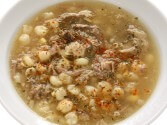

Made with pasilla peppers, vegetable oil, onion, garlic, chicken stock, cilantro, boneless pork chops, hominy, bay leaf, chili powder
Serves/Makes: 4
- 2 pasilla peppers
- 3 tablespoons vegetable oil
- 1 medium onion, diced
- 3 cloves garlic, crushed
- 1/2 bunch cilantro, roughly chopped
- 1 1/2 pound boneless pork chops, cut in 1/2-inch cubes
- 2 cans (12 ounce size) hominy, rinsed and drained
- 1/2 teaspoon chili powder
- 1 bay leaf
- 8 cups chicken stock
- 2 tablespoons water
- salt and pepper, to taste
- limes, cut in wedges
- other toppings such as avocado slices, diced onion, sliced radish, cilantro, shredded cabbage
Preheat the oven broiler.
Place the pasilla peppers on a rimmed baking sheet and place under the broiler. Let cook for 20 minutes, turning occasionally, until the skin is charred. Remove the peppers from the oven and let cool on a cutting board.
Heat the oil in a large pan over medium heat. Add the onion and cook, stirring occasionally, for 3 minutes. Add the garlic and cook, stirring constantly, for 1 minute. Stir in the cilantro and let cook for 1 minute or until the cilantro has wilted slightly.
Place half of the onion mixture in a blender. Add the pork, hominy, chili powder, bay leaf and chicken stock to the onion in the pan. Bring the liquid to a boil then cover the pan and reduce the heat to a simmer.
Remove the skin, stems, and seeds from the roasted peppers. Add the peppers to the blender along with the water. Puree until smooth.
Turn the heat to medium-high and add the pepper puree to the pan with the pork. Cook for 5 minutes or until the pork is cooked through. Season to taste with salt and pepper. Remove the bay leaf. Serve the pozole with lime wedges on the side and any desired toppings.


related articles


Write a comment:
©2026 CDKitchen, Inc. No reproduction or distribution of any portion of this article is allowed without express permission from CDKitchen, Inc.
To share this article with others, you may link to this page:
https://www.cdkitchen.com/cooking-experts/amy-powell/838-hominy/