

A Simple Scoop of Rice


This is a dispatch from Southeast Asia. For the last 12 days I have been eating chicken with green curry and rice, seafood soup with coconut milk and rice noodles, and stir-fried beef with holy basil, chilies, and lemongrass. And of course, a side of rice, among other things. This part of the world is a land of many diverse people and cultures, but when it comes to food, it is most certainly the land of rice.
Most species of rice are native to South Asia (where I am currently, writing to you from under the sunny skies of Phuket, Thailand) or certain parts of Africa. However, rice has an ability to be grown almost anywhere in the world that receives a significant amount of rainfall. It's that diverse agricultural capability along with the modern world of fusing cuisines that makes rice show up in dishes across the world from Poland to Italy to Mexico to Brazil and back to to the many Asian countries that consider rice a staple food. Rice is so widely consumed, in fact, that it accounts for approximately 1/5th of the calories that are consumed by humans.
Although mostly consumed in its basic form, plain rice, rice also forms the base for a number of other dishes. Rice flour can be used as a substitute for wheat flour in some cases, a savior for those who are gluten intolerant. Rice flour can then be used to make noodles or casings for spring rolls or dumplings. Rice is used to make a sort of porridge called congee often eaten as a breakfast food in China. Cooked rice can be a binding agent in meatballs or a filler in cabbage rolls. It serves a base for the entree known as paella in Spain, and is staple of the Northern Italian dish, risotto.
No matter what its intended use, there are many methods for cooking rice from the parboiled Minute Rice from Uncle Ben's, to the 45 minutes of boiling required for brown rice. Electric rice cookers which require the addition of rice and water up to certain lines have made basic white rice almost dummy-proof. In dishes such as pilafs and risotto, the rice is toasted first in oil and sometimes with onions or spices before the addition of liquid. However, when you're unwilling to compromise quality (Minute Rice) but you do not have the time for long cooking (brown and wild rice), a basic white rice, with its simple preparation, is the dream side dish for most kitchens.
Cooking white rice the old fashioned way on a stove top takes a basic 2 parts liquid (water, stock, etc) to 1 part rice ratio. It does not get any simpler than that. Add liquid and rice to pot with pinch of salt and a splash of oil, bring to a boil, stir, reduce heat to low, cover with a lid, and walk away. Fifteen minutes later, turn off the heat, let the rice sit for 5 minutes. Remove lid and fluff with fork. Voila! Perfect rice.
Almost. It might depend on what your definition of "perfect rice" is. Parts of Asia consider the crisp rice that sticks to the bottom of a pan the best part of the pot. When it comes to the Spanish, they so love the rice sticking to the bottom of the paella pan that they even gave that sticking rice its own name, soccarrat. But if you are like me, and you like your plain white rice as fluffy and stick-free as possible, all I can say is what a difference a pan makes. I recently invested in a high quality stainless steel saucepan for the purpose of cooking better rice, among other things. In the last 2 months and about 5 times of making rice, not once has it come away with more than a handful of grains attached to the bottom of the pan.
And although it is easy to "boil down" the recipe to 2 parts liquid to 1 part rice, there are subtle differences in the type of rice you are cooking that might require some variation. For instance, short grain sticky rice often served with Japanese cuisine should be rinsed first before adding to the cooking liquid. A pilaf is already partially cooking and absorbing some liquid by means of the oil it is toasting in, so reducing the total liquid by about 1/8 from the 2 to 1 ratio usually leads to a more perfectly timed cooked rice.
In the land of rice, one might occasionally pine for a nice baguette after a while. But whether you travel to the land of baguettes, or tortillas, or potatoes, rice can still be found. Nearly two weeks after my trip began and several shades of tan darker than I started out, it is a great comfort to know that no matter where I am in the world, home is no closer or further away than that scoop of rice on my plate.
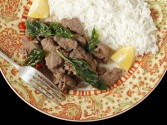

Made with soy sauce, fish sauce, lemongrass, vegetable oil, basil, shallots, garlic, Thai chile
Serves/Makes: 6
- 1/4 cup dried lemongrass
- OR
- 1 stalk fresh lemongrass
- 3 tablespoons vegetable oil
- 1 cup holy basil (Thai basil) or regular basil leaves
- 2 shallots, peeled and thinly sliced
- 3 cloves garlic, peeled and thinly sliced
- 1 Thai chile, minced
- 2 tablespoons fish sauce
- 1 tablespoon soy sauce
- 1 teaspoon sugar
- 1 1/2 pound beef sirloin, sliced very thin
If using dried lemongrass, bring a small saucepan of water to a boil over medium-high heat. Add the dried lemongrass and let simmer for 20 minutes. Drain well.
If using fresh lemongrass, trim the woody ends and then gently crush the stalk with the back of a chef's knife. Slice into 1-inch pieces.
Heat the oil in a wok over medium-high heat. Add the basil and cook, stirring constantly, for 30 seconds. Remove the basil with a slotted spoon and place on paper toweling to drain.
Add the shallots, garlic, chile, and lemongrass. Cook for 2 minutes, stirring constantly. Remove the mixture from the wok with a slotted spoon and set aside in a small bowl. If desired, pick out and discard the fresh lemon grass (the flavor may be overpowering to some).
Combine the fish sauce, soy sauce, and sugar in a small bowl and mix to dissolve the sugar.
Add half of the beef to the wok and cook, stirring constantly, for 30 seconds. Remove the meat with a slotted spoon and set aside. Cook the other half of the beef the same way.
Add the meat back to the wok along with the cooked shallot mixture, fish sauce mixture, and fried basil. Cook, stirring constantly, for one minute.
Serve immediately with cooked white rice.
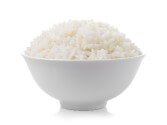
Serves/Makes: 6
- 1 1/2 cup white rice, Jasmine or other Asian long grain rice
- 3 cups water
- 1/4 teaspoon salt
- 1 tablespoon vegetable oil
Place all ingredients in a medium saucepan and stir to combine. Bring to a boil and stir again. Reduce heat to low and cover. Cook for 15 minutes.
Remove from heat without removing the lid. Let sit 5 minutes. Remove lid and fluff with fork.


related articles



Write a comment:
©2026 CDKitchen, Inc. No reproduction or distribution of any portion of this article is allowed without express permission from CDKitchen, Inc.
To share this article with others, you may link to this page:
https://www.cdkitchen.com/cooking-experts/amy-powell/653-versatile-rice/