

A Salmon A Day . . .


Eat fish! It is good for your heart, fights depression, improves your vision and will help you live a long and healthier life! Then again, maybe don’t eat fish. These days we are being warned that the fish that is supposed to be good for us is high in nitrates, PCBs, mercury… all those mysterious names that ultimately spell out the worst word of all: cancer. With so much conflicting information, what is a health-conscious home cook to do?
Of all the fish out there, salmon seems to be the most confounding. As one of the fattiest fish on the market, it is an excellent source of heart healthy Omega-3 fatty acids. According to two separate government sponsored studies whose findings were released last fall, those who eat fish twice a week, particularly fattier fish, have a 36% less chance of dying of heart disease and a 17% lower mortality rate, period. With doctors recommending ¼ gram of omega-3s per day, it certainly seems it would be a good idea to make salmon a regular part of one’s diet.
But just when you are ready to start a salmon and soybean diet on your way to living forever, you remember those Environmental Protection Agency recommendations that came out a few years back warning against eating that very same fish. Cancer causing agents such as PCBs and mercury were found in higher concentration in farmed fish versus those caught in the wild. And, if memory serves you right, it seems that the pretty pink-fleshed salmon you’d been picking up at the grocery store on special was, you guessed it, farm-raised. Now the Food and Drug Administration has deemed these levels acceptable, but wouldn’t you rather err on the safe-side? To be safe for sure then, the EPA says not to eat farm-raised salmon more than one to two times per month. The really good news is that you are in the clear to eat wild salmon as much as twice per week!
In all this shuffle of eating salmon for a healthy heart but worrying about picking up cancer along the way, perhaps you forgot that you actually really like to eat the fish. Out for dinner as sushi it comes raw, marbled and glistening in Nigiri form laid out across a small mound of sushi rice. You eat it poached in a fragrant broth with spring vegetables for the most healthful of meals. Sautéed in vegetable oil, the skin turns a perfect crackling crispiness that serves as a foil for the medium-rare, soft and fatty flesh. And let us not forget that canned salmon makes an excellent substitute for the standard tuna fish salad and mixed with breadcrumbs and a bit of egg can even stand in for the ubiquitous crab cake. The best part is there are not many ways to prepare salmon that take more than a few minutes to make the journey from the pan to the plate.
It is no wonder that salmon is so popular and the source of such hot debate over its various health benefits and detriments. It is widely available and can be consumed in an array of preparations. As consumers there is one small thing we need to do to be sure what we are eating is safe and not just delicious: buy wild. So in a restaurant, I always ask. And at home, since I am doing the shopping, I know for sure my fish has all come from the nets or lines of a real fisherman’s boat. I save my allotment of farm raised salmon for those times it is more difficult to regulate where it came from: when the salmon is raw at a sushi restaurant or out of a can at home. Aside from that, if I were preparing it fresh, if the label does not say wild, I would rather not risk it.
Confounded no more by the conflicting scientific reports on the benefits of my favorite fish, I am back on the “live forever” diet of salmon twice a week… so long as it's wild that is.
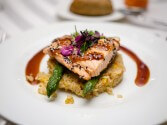

Made with olive oil, vegetable oil, black pepper, blood oranges, red wine vinegar, shallots, black peppercorns, whole star anise, wild salmon, kosher salt
Serves/Makes: 6
- 4 blood oranges
- 6 tablespoons red wine vinegar
- 2 shallots
- 1/2 teaspoon whole black peppercorns
- 2 whole star anise
- 2 pounds wild salmon, skin-on
- kosher salt
- black pepper
- vegetable oil
- 1/4 cup extra virgin olive oil
Juice oranges and pass through a strainer to remove pulp. Press down on pulp in strainer to remove all possible juice. Add juice to small saucepan along with red wine vinegar.
Peel and mince shallots. Add to juice along with peppercorns and star anise. Bring mixture to a boil, reduce to medium heat and continue to simmer until mixture has reduced by two-thirds.
Meanwhile, if not already cut up, portion salmon into equal weight serving pieces. Ensure pin bones have all been removed.
Heat a large skillet or two medium ones over medium high heat. Cover bottom of skillet with enough vegetable oil to generously coat the surface. Crack black pepper onto the skin side only of the fish. Place in pan skin side down. Cook on medium high heat until fat begins to melt on the sides. Sprinkle flesh side with salt and pepper.
Reduce heat to medium. Continue cooking until fillets are nearly cooked through with just a small strip of raw fish on top.
Towards end of cooking, use a thin spatula to loosen fillets from bottom of pan, being careful not to tear the flesh (different thicknesses will require different cooking times). Turn fillets over for one-minute flesh side down to remove pink.
To finish sauce, strain juice reduction and discard solids. Whisk in olive oil with salt and pepper to taste.
Serve sauteed fish warm, skin side up, with a couple tablespoons of the blood orange vinaigrette. Serve steamed vegetables and rice alongside.


related articles


Write a comment:
©2026 CDKitchen, Inc. No reproduction or distribution of any portion of this article is allowed without express permission from CDKitchen, Inc.
To share this article with others, you may link to this page:
https://www.cdkitchen.com/cooking-experts/amy-powell/486-healthy-wild-salmon/