

A Bundle of Mussel Joy


So here I am, carrying one 5 lb., 3 oz bundle of pure heaven all wrapped up tight and ready to take home. Inside the bundle it glistens, all black and shiny… with a beard. No, this bundle of joy is not a super small baby but an extra large sack of mussels recently purchased and bound for my stove and stomach.
These mussels weren’t all intended for me. Still, I eventually downed about half of them myself at a recent dinner party. Sadly, although I have a great affection for this inexpensive and delicious bivalve, I believe it is mostly misunderstood. Which is how I ended up eating a majority of those 5 lbs. of mussels while the other guests seemed wary. I did not want a single mouth-watering mollusk to go to waste.
I can understand why the mussel can be a bit scary to both prepare and consume. Any food that one buys still alive (for there are not many that come that way), and that one is not really able to see the edible portion thereof until it is cooked, can seem like a leap of faith indeed. Luckily, there are some standard rules of preparation and consumption that virtually ensure that that little mollusk will be alive going into the pot and quite the opposite coming out, making it safe for your dining pleasure.
First step when bringing that sack of mussels home is to rinse and sort them in a colander. Pick through the mussels and discard any that are open--that probably means they are dead already. Only tightly closed mussels should be destined for the pot. You can also pick off any noticeable beards at this point; those are the hair-like fibers coming out of a few. These beards are totally harmless but perhaps not so aesthetically pleasing. To make the most of this sorting time, it is now appropriate to be sweating leeks in butter, sautéing chorizo, or generally preparing whatever you will serve as the liquid base in a large pot in which the mussels will be steamed.
Once cooked, the other rule is if it isn’t all the way open, throw it out. Those mussels are probably bad too. They may not have been all the way cooked, and it's better not to risk it.
Around the world, mussels have their place as parts of larger dishes such as bouillabaisse or are smoked and mixed in with salads. But my favorite way to prepare these little guys is like the Belgians: served as the focal point of the meal, steamed in large quantities in a flavorful base alongside a healthy portion of French fries.
Eating mussels as a meal can be another daunting process, as you're faced with a huge bowl of shells that must be at least partially pried open to get to the treasure inside. The best plan of attack is to toss the silverware aside and dig right in… yes, with your hands! Find a good shell with the joint still intact and use it like something of a mollusk chopstick, pinching the shell to dig into the next shell and sort of tweeze out the sweet meat inside. Beyond that the mussels are cooked in a most delicious broth that should not go to waste and is best appreciated with a good chunk of crusty bread to soak it up.
That little bundle of mussel joy may be destined for my dinner table but I can assure you that the love I feel for it is pure and real. I hope others can begin to look past their misgivings and learn to appreciate--if not adore--these yummy creatures like I do. But if not, it’s just more for me!
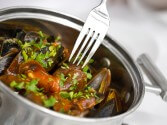

Made with parsley, salt and pepper, mussels, butter, olive oil, leeks, garlic, chorizo, bay leaf, cava
Serves/Makes: 4
- 4 pounds mussels
- 1 tablespoon butter
- 1 tablespoon olive oil
- 2 leeks, white part only
- 2 cloves garlic
- 8 ounces raw chorizo sausage
- 1 bay leaf
- 1/2 bottle cava, or other sparkling wine
- salt and pepper
- 1/2 bunch flat leaf parsley
- French bread
Place mussels in a colander and rinse under cold water. Discard any mussels that are already open. Pick off any noticeable hair-like "beards".
Meanwhile heat butter and oil in a large pot or Dutch oven over medium heat. Cut leeks lengthwise almost through to the root. Rinse under cold water spreading leaves to remove all dirt. Cut the rest of the way through root and slice in 1/4 inch half circles. Peel garlic and thinly slice lengthwise.
Add garlic and leeks to butter and oil. Sweat along for about five minutes until leeks soften. If necessary, remove sausage from casing and add to leeks. Raise heat to medium high and saute breaking up sausage with a spoon until cooked through.
Add cleaned mussels, bay leaf, and cava to pot along with a couple cracks of black pepper and just a pinch of salt (mussels are naturally very salty). Stir gently a couple of times to mix ingredients. Turn heat to high, cover with a lid and let steam. Rinse parsley and roughly chop.
After two or three minutes remove lid and give mussels another stir or two. Return lid and continue to steam until almost all mussels are open.
To serve, ladle mussels into individual bowls along with some broth and chopped parsley. Serve with bread and a large communal bowl for discarding empty mussel shells.


related articles




1 comments
Thank you for the article about my favourite food. I used to pick mussels off rocks at low tide in Nova Scotia years ago. Even then, I made sure I was harvesting in a clean area, free of gasoline,etc. Today one can buy farmed mussels that are grown on racks in the sea. These are barnacle-free and have less luxuriant 'beards', bysall threads so prep is easier. Mussels make a relatively quick meal but a special one. I have substituted cider or apple juice instead of wine and the result is a different but tasty dish. I heartily agree that crusty bread is essential for mopping up juices. My children, when little and harvesters with me, particularly liked mussels because they were 'fun food' - no cutlery was needed. Mussels conjure up happy family times at the beach during halycon summer days long ago.
Comment posted by becfin
Write a comment:
©2026 CDKitchen, Inc. No reproduction or distribution of any portion of this article is allowed without express permission from CDKitchen, Inc.
To share this article with others, you may link to this page:
https://www.cdkitchen.com/cooking-experts/amy-powell/474-cooking-eating-mussels/