

Risotto: Love at First Bite


My love affair with risotto began as a teenager. And I dare say it was love at first bite. It is hard to pin down any single feature that did me in; rather it was the divine combination of the whole. Short, plump grains of rice surrounded by an opaque, starchy sauce of their own creation mounded high on an earthen dish. Aromas of toast, onion, and wine titillated my olfactory glands luring me in for the first taste.
In the mouth the slightly chewy grains of rice with their unctuous binding reminded me more of sauced pasta cooked al dente than any rice dish I had eaten. The flavors of wine and toasted grain bound by just the right amount of salty Parmigiano-Reggiano formed a union deep enough to be complex while still retaining the individual notes of taste. It was a dish perfect in itself and exciting in its possibilities.
As I grew older and my time for cooking became more compressed, I still managed to make risotto on a regular basis. I did it for relaxation: the half hour spent caring for a dish of slowly cooking rice had certain Zen-like qualities. I did it for the versatility: once I had mastered the art of a basic risotto, the options for modification were endless. I did it for the sake of frugality: rice is fairly cheap, and if I could make it stretch through a couple of meals, then for a poor student, this dish was a winner! I did it because it was quick: although it took some devotion to stirring, total cooking time was nominal and the rice was in fact at its best and ready to eat the moment it was finished. At the end of the day, risotto was the perfect 30 minute meal.
Risotto originated in Northern Italy and is to that region what pasta is to the South. It is made with short grain rice cooked in an open pot over a medium flame with the gradual addition of liquid, usually stock, stirred frequently until the grain is soft but chewy and a starchy sauce has formed. There are three basic types of high-starch rice used for risottos: Arborio, Carnaroli, and Vialone nano, although Arborio is most widely used and most easily found at the supermarket.
For a basic risotto, we begin by sweating chopped onion in oil until soft then adding the rice to absorb the excess oil, sautéing until lightly toasted. At this point, if using, wine is added and cooked until almost absorbed. The heat is turned down and we begin adding hot stock a little at a time, adding more once the last batch is absorbed.
It is important to keep the rice well hydrated for to neglect that detail may result in a sticky final product devoid of the luscious natural sauce (A professor of mine once reprimanded me on my too-sticky risotto, admonishing me for not adding enough liquid during cooking. He told me to always keep enough liquid around the rice that the final dish should almost have to be eaten with a spoon). The rice receives a quick shower of Parmigiano-Reggiano and either a pat of butter or a splash of cream at the end along with salt and pepper to taste.
Risotto is generally loved by all. It is often the default vegetarian course at restaurants where vegetable stock is swapped for chicken and additional ingredients are limited to vegetables. But it is also a dish enjoyed by carnivores, either with the addition of meat and seafood to the rice itself, or as an accompaniment to a meat course such as with its classic coupling with the supremely rich osso bucco.
For me, risotto has been a wonderland for my culinary imagination. Shrimp, saffron and fish stock make for a simpler paella. A puree of roasted red peppers added just before the rice finishes cooking is brilliant when the peppers are at their sweetest. The resulting dish is as vibrantly colored as it is flavored.
Like any of life's great loves, the novelty of the dish may have come and gone for me, but for others out there it is a love still worth discovering. As time has passed so has my love evolved, in as many ways as I can dream. So my risotto never ceases to delight me.
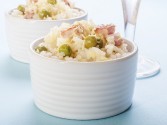

Made with salt and pepper, butter or cream, chicken broth, olive oil, onion, arborio rice, white wine, frozen peas, prosciutto, Parmesan cheese
Serves/Makes: 4
- 4 cups chicken broth
- 3 tablespoons olive oil
- 1/2 large onion, finely chopped
- 1 1/3 cup arborio rice
- 1/2 cup white wine
- 1/2 cup frozen peas
- 1/4 pound prosciutto, sliced in half inch strips
- 1/2 cup grated Parmesan cheese
- 1 tablespoon butter or cream
- salt and pepper, to taste
Heat the chicken broth in a saucepan over high heat. Bring to a boil then reduce the heat to low to keep the broth warm.
In a large skillet, heat the olive oil over medium-high heat. Add the onions and cook, stirring frequently, until soft, about 3 minutes.
Add the rice and cook, stirring frequently, until the rice begins to toast and is coated in the oil, about 2 minutes.
Add the wine to the rice and let cook, stirring constantly, until the wine is almost completely absorbed.
Reduce the heat to medium. While stirring, add the chicken broth in 1/3 cup increments, and cooking until the rice has absorbed each increment of broth. Repeat the process of adding the broth while stirring constantly until the rice is al dente, about 20 minutes.
During the last few minutes of cooking time, add the peas and prosciutto to the rice. When the rice has absorbed the last of the liquid, turn off the heat and stir in the Parmesan and butter. Season to taste with salt and pepper and serve immediately.


related articles




2 comments
I know when cooking regular rice you have your standard liquid-to-rice ratio. Does a similiar ratio exist when cooking risotto? I'd love to experiment with my own flavors/ingredients but I'm afraid of messing up the liquid/rice balance. Now, don't laugh, I know I could just continue to add liquid until it's absorbed, but I like to measure out all my ingredients ahead of time and make sure I have everything I need. Also, do different liquids absorb differently? I've seen some recipes that call for milk or cream to be added while cooking and I always felt like they wouldn't be absorbed as much?
Comment posted by Darcie
The general ratio of 2 parts liquid to 1 part rice approximately works for risotto. It is fine to have that amount of liquid measured out in advance, just be aware you may need a little more, you may need a little less depending on the temp. you are cooking at, the rate at which you are adding liquid, all of which will result in slight differences in the rate of absorption. (Generally, I would err on the side of having more liquid hot and ready for use than you need, just in case)Mostly, and this is one of the best parts of cooking anything, you need to taste as you go. Keep tasting the rice, checking for doneness until you have the perfect slightly chewy al dente. If you are using cream, I would wait to add it until the end, at that point you are not really looking so much for absorption, but for a rich and creamy finish to the rice. The problem with adding milk or cream earlier is that you risk curdling the liquid. Hope this helps!
Comment posted by Amy
Write a comment:
©2026 CDKitchen, Inc. No reproduction or distribution of any portion of this article is allowed without express permission from CDKitchen, Inc.
To share this article with others, you may link to this page:
https://www.cdkitchen.com/cooking-experts/amy-powell/149-risotto/