

The Fish Who Came to Dinner


Too often at the fish counter I find myself going back to the same old choices. It is too bad, because I am blessed with a particularly nice fish market with a selection of imported and local specialties that puts everything but the big waterfront operations to shame.
This market has it all. Multiple varieties of tuna like albacore, ahi, and yellowfin. Salmon from Alaska and the Atlantic, cut into steaks and fillets, smoked and cured into gravlax. There’s Hawaiian Opah, mid-Atlantic grouper, and Mediterranean branzino. On a bed of crushed ice sits stone crab from Florida next to blue crab from Maryland and king crab legs from Arctic waters.
Not to mention, this being New York, there is an abundance of local fish I could never find during my years in California. Bottom dwelling skate, hake, haddock, and fluke to name a few, line up in row upon row of neatly cleaned fillets.
Yet time and again I bypass those local specialties opting to spend more money on salmon fillets, yellowtail, and tuna that has been shipped halfway around the world. There is nothing wrong with salmon and tuna. It is just that, well, you could eat those anywhere. It’s a bit like moving to a new city and only socializing with your friends who come to visit from out of town rather than trying to make new acquaintances with the locals.
Enough is enough, I decided. I had to start making friends with the local fish.
Of course, there were compelling reasons to eat local fish aside from just expanding my palate. Eating fish supports local fisherman, a vanishing breed. By eating what was coming from the closest waters to me, the fish need only travel a short distance by truck to get to my plate rather than the planes, boats, and maybe even trains that some of the more exotic offerings require. In this case my “making friends with the locals” supports jobs and is better for the environment, all while shaking up my dinner menu with some new and different choices.
Next was deciding which friend to take home first. I had eaten skate many times at area restaurants, and haddock is a staple of the eastern seaboard fish restaurants. But hake, now there was a fish with which I did not have much experience.
The fishmonger told me the flesh of hake was firm but sweet. A bit like cod perhaps? It might be just the thing to fill in as protein for a planned fish Thai red curry. Lemongrass, onion, garlic, red peppers, and Japanese eggplant caramelized first before I mixed in red curry paste, coconut milk, and finally the hake cut into bite-sized chunks. The sweet white fish was a perfect vehicle for the spicy sauce and the ideal texture to hold up to a gentle simmer without dissolving into nothingness.
Next I took it down a notch. If I was going to really experience this local I needed to taste it in a somewhat pure form. For this I decided on a quick marinade in olive oil and herbs. I dredged the fillets in Wondra flour and pan-fried it gently in a mixture of olive oil and butter. A squeeze of lemon later, the fish was perfect: tender and moist with a golden crust and just the right amount of seasoning.
What took me so long to get to know hake? I’m to blame for pushing it aside in favor of its better known brethren. No more. Hake is one friend I plan on having over to dinner as often as I can.
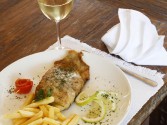

Made with flour, salt, hake, dried thyme, fennel seeds, bay leaf, dried parsley, black pepper, olive oil
Serves/Makes: 4
- 1 1/4 pound hake, cut into even sized fillets (cod, grouper, catfish, tilapia, all good alternatives)
- 1/2 teaspoon dried thyme
- 1/2 teaspoon fennel seeds
- 1/2 teaspoon crushed, dried bay leaf
- 1/2 teaspoon dried parsley
- 1/4 teaspoon black pepper
- 1/4 cup olive oil PLUS
- 2 tablespoons olive oil
- salt
- 1/2 cup Wondra flour (or regular white flour)
- 2 tablespoons butter
- lemon wedges
Rinse fish under cold water and pat dry with paper towels. In a small bowl whisk together all dried herbs, black pepper, and 1/4 cup olive oil. Place hake in a large resealable plastic bag along with the herb-oil mixture. Seal bag and squish around to make sure fish is evenly coated. Place in the refrigerator for 15 minute to marinate. After fish is done marinating, remove from bag and shake off excess oil.
Season fillets on both sides with salt. Spread flour on a large plate and dredge fish on both sides shaking off excess. Working in two non-stick pans (or in two batches) heat 1 T. olive oil and 1 T. butter per two fillets over medium high heat.
When butter is melted, place fillets in pan. Brown for 3-4 minutes per side until just cooked through. Remove to plates and serve with a squeeze of lemon.


related articles



Write a comment:
©2026 CDKitchen, Inc. No reproduction or distribution of any portion of this article is allowed without express permission from CDKitchen, Inc.
To share this article with others, you may link to this page:
https://www.cdkitchen.com/cooking-experts/amy-powell/1301-fish-varieties/