

Walkin' the Hog


As I was picking beans a few weeks ago, I looked up and saw my neighbors walking with three hogs down the center of our gravel road. Their little jiggly butts (point of clarification--the hogs’ butts, not my neighbors’) slowly swaggered down the street. I was more than curious. Why would anyone take a hog for a walk?
According to my neighbor Elizabeth who was getting the hogs ready for competition at our county 4-H fair, walking the hogs helps prepare them for showing and firms them up a bit. Judging from the junk in those piggies’ trunks, it looked like they needed to at least break into a jog for a few miles to reach that second goal!
The next morning, I was up bright and early. I just had to walk those hogs. I was given a “guide stick” and told to tap the hogs on their sides to control them as we walked. Might as well have given me a hammer and nails and asked me to secure Jell-O to a tree trunk! The minute they were let out of their pen, sensing my novice skills at guiding them, those hogs scattered. The two males went one way and the third, a female, headed directly in the opposite direction. I think we got more exercise chasing them than they got on that walk.
According to Elizabeth, pigs are among the most intelligent animals. During our walk she helped me confirm and dispel a few commonly held myths about them. It is absolutely true that you can be “happy as a pig in mud” but there is no truth to the notion that you can “sweat like a pig.” Pigs are happy in mud because they have no sweat glands and rolling in mud (or the neighbor’s kiddie pool—a very unwise decision made by some of Elizabeth’s pigs a few years back) helps cool them down. When a pig is not happy, his tail is straight as it was when we were walking them and nudging them along the road with the guide sticks. When a pig is happy, his tail curls into a cute little ringlet. And, right on cue, the minute those hogs slid into their mud hole at the end of our walk, those tails curled. Yes, you can “eat like a pig.” They are by nature hearty and curious eaters. Pigs have a reputation for biting, but Elizabeth said what they are really trying to do is nibble on you a bit to see if you are tasty enough to eat. I kept my distance after hearing that one.
When I watched the pigs rolling in the mud, I thought about how the image of pork has changed over the past several years. Pork used to be avoided in many healthy eating plans because of the concern over its high fat content. But that image is changing because the facts are changing.
According to a June 26, 2006 press release from the Pork Information Bureau, today’s common cuts of pork are 16% leaner than they were 15 years ago and the saturated fat content has dropped by 27%. Based on an extensive analysis done by the United States Department of Agriculture (USDA), pigs have slimmed down and the results are great news for the healthy eater. In the most recent USDA analysis, pork tenderloin was found to have 2.98 grams of fat per 3 ounce serving while a skinless chicken breast has 3.03 grams of fat. Pork tenderloin now meets the government guidelines for “extra lean” which requires less than 5 grams of fat, 2 grams of saturated fat and less than 95 mg cholesterol per 4 oz. uncooked serving.
Besides being a flavorful meat, pork tenderloin is nutritious and versatile. It takes a variety of seasonings well and is quick and easy to prepare. A three ounce serving of pork tenderloin is an excellent source of protein, thiamin, vitamin B6, niacin and a good source of zinc, riboflavin and potassium. It has 120 calories, no carbohydrates, and 17 grams of protein. So, healthy eaters can feel confident giving this delicious cut of pork, and many others, a place on their menu.
For those of you who love food history and lore as I do, I discovered that pigs hold an interesting place in US history. When they were first introduced to America, the uncontrolled, semi-wild pigs freely traveled around the area that is now known as Manhattan. To control their roaming, a long, solid wall was built. Today that area is known as Wall Street.
Walking the hogs must have done some good. Elizabeth came home with a top prize for her female hog. All scrubbed to pink perfection, she regally pranced around the show ring, head held high and was praised by the judges for her nice hind end (point of clarification—the hog, not Elizabeth).
Now you may be wondering what became of the three hogs when the fair was over. Well, as the story goes, those little piggies went to market.
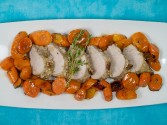

Made with fresh thyme, bread crumbs, pecans, pork tenderloin, honey, salt and pepper, grapeseed oil, honey mustard, carrots, butter
Serves/Makes: 4
- 6 tablespoons fresh white bread crumbs
- 3 tablespoons coarsely chopped pecans
- 1 (16-18 ounce size) pork tenderloin
- salt and pepper
- 3 tablespoons grapeseed oil, divided
- 2 tablespoons prepared honey mustard
- 1 pound carrots, peeled and cut diagonally into 1 inch thick slices
- 1 tablespoon melted unsalted butter
- 1 tablespoon honey
- 1 tablespoon chopped fresh thyme leaves
- fresh thyme sprigs for garnish
Preheat the oven to 450 degrees F. Line a baking sheet with non-stick foil.
In a small bowl, mix the breadcrumbs and pecans and set aside.
Pat the pork tenderloin dry with paper towels and season on all sides lightly with salt and pepper.
Heat 2 tablespoons of the oil over medium-high heat in a large ovenproof skillet.
Sear the pork in the skillet until all sides are well browned, about 5-7 minutes total.
Remove the skillet from the heat and transfer the pork to a plate to cool for about 5 minutes.
Spread the top and sides of the pork with the honey mustard, and press the breadcrumb-pecan mixture on top of the mustard coating. Place the pork back in the skillet.
In a large bowl or zipper bag, toss the carrots with the remaining grape seed oil and place them in a single layer on the baking sheet.
Place the pork and carrots in the oven. Roast the pork for 15-20 minutes or until a meat thermometer registers 155 degrees F.
Remove the pork from the oven and let it rest for 5 minutes before slicing.
While the pork is resting, blend the butter and honey thoroughly in a large heatproof bowl.
Remove the carrots from the oven after 20 minutes and place in the bowl with the butter-honey mixture and add the thyme. Toss gently to coat the carrots with the honey-butter mixture.
Slice the pork on the diagonal and fan the slices on a serving platter. Surround the pork with the glazed carrots. Garnish with the thyme sprigs.


related articles




4 comments
I look forward to Victoria's article every week and every week I am more intrigued with her real-life stories and wonderful recipes. I've tried many of the recipes and they are so simple to follow and soooo delicious! She certainly puts the "joy" back into cooking!
Comment posted by Joanie
I read Vic's articles knowing I'm going to enjoy her experiences and learn something in addition. I am an avid collector of all things having to do with pigs including a pair of 'piggy' pj's & slippers. I will try the tenderloin receipe & forward it to a friend who is an excellent cook, especially pork.
Comment posted by Kathy
What a great incorporation of 4-H and your article! The kids learn so much from the 4-H program, enough to teach another person about their experience with their pig. For those who are interested in joining the program, contact your local Extension Agent through your County's Extension Office!
Comment posted by Katelyn
My exposure to 4-H has shown me such a wonderful side of today's young people. I continue to be impressed with the many things taught through the program whether it's sewing, cooking, agriculture, writing, or the opportunity to gain leadership and interpersonal skills. Whenever I am around 4-H kids, I am inspired by them. And I would like to give a big THANK YOU to the adult leaders who tirelessly give of their time so that organizations like this can thrive.
Comment posted by victoria wesseler
Write a comment:
©2026 CDKitchen, Inc. No reproduction or distribution of any portion of this article is allowed without express permission from CDKitchen, Inc.
To share this article with others, you may link to this page:
https://www.cdkitchen.com/cooking-experts/victoria-wesseler/368-pork-tenderloin/