

A Bite of the Apple


What’s your apple eating style? Are you an “Equator Eater?” You are if you take a big bite out of the center of the apple and eat a band around the middle before consuming the top and bottom. Or maybe you employ the “Top to Bottom” strategy of starting at the stem end; eating in a vertical line down to the bottom of the apple and then returning to the top again, munching in side by side vertical strips until the apple is finished. Or are you a “Compulsive Wedger” who cuts his/her apple into eight, same sized, perfect core-free wedges which you then neatly arrange on a plate before you eat them? If none of these describe your own unique apple eating strategy, perhaps you’ll find it listed on the U.S. Apple Association’s website (www.usapple.org) along with the Splitter, Circle Stickler, The Streak, Core-Free Cruncher and Stem Plucker.
My style is “Top to Bottom” and my husband is an “Equator Eater.” I’m not certain what psychological attributes (or dysfunctions) are associated with these categories and I’m not sure that I really want to know. But it is fun to observe the unique ways that people approach eating this healthy fruit.
Because apples are commercially available year-round, we tend to forget that, like all fruits and vegetables, they are a seasonal crop. In the United States, September 1 begins apple season which runs through November. This is when apples are at their peak of freshness and flavor.
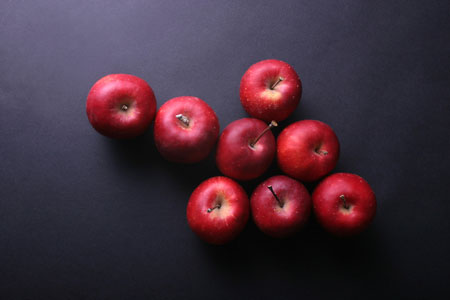
The apple is a member of the rose family. Some estimate that there are over 7,500 varieties of apples grown globally. Local supermarkets generally have 7-10 of those varieties available to the consumer. Red Delicious, Yellow Delicious and Granny Smith are the most popular commercial varieties. The Gala, a cross between Kidd's Orange Red and Golden Delicious, and Fuji, a cross between Rall's Genet and Red Delicious, are rapidly gaining popularity in the commercial markets and can easily be purchased in most supermarkets.
Apples from your local grocery store can be several months old and, thanks to controlled atmosphere storage methods, still remain crisp and tasty. But nothing beats the flavor and texture of a freshly picked apple on a fall day. I would encourage you to explore your local orchards in search of less commercially viable apple varieties such as Northern Spy (a wonderful choice for apple pies) or Newtown Pippin, the classic American apple, which is the oldest commercially grown native variety in the United States and said to be George Washington’s favorite.
When picking or purchasing apples, look for ones that are firm to the touch, have smooth unwrinkled skin and are free of soft spots. Apples continue to ripen after they have been picked and can spoil quickly. Once you bring your apples home, store them unwashed in your refrigerator or a cool, dark basement area. Don't store them in the same place with other fruits and vegetables. Apples give off ethylene gas that speeds the ripening process and may cause your other produce to quickly deteriorate. And be sure to wash the apples thoroughly before you eat them to remove any pesticides and/or chemicals that may have been used in the commercial growing process.
Apples are a great choice for a quick snack, dessert or ingredient in recipes. They’re low calorie, thirst quenching and contain both soluble and insoluble fiber. A medium unpeeled apple (five ounces) contains 80 calories, 20 grams of carbohydrates, 5 grams of fiber and ½ cup of water. Nutritionists advise not to peel the apple prior to eating it since the peel is fiber rich and almost half of the vitamin C content of the fruit lies just beneath the peel. Countless medical studies have shown that the fiber in apples may help to reduce the risk of heart disease and cancer.
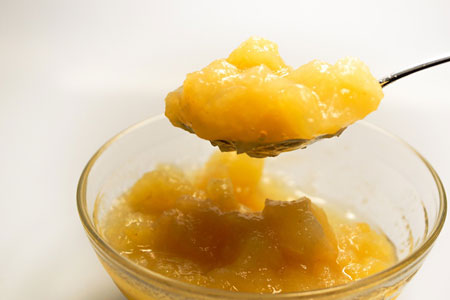
I like to make applesauce with the apples from our orchard. It’s a great way to preserve and enjoy the flavor of our fresh apples year round. I’ve found that the secret to a great tasting applesauce is to use the freshest apples possible, add very little, if any, sugar and to use bottled spring water instead of tap water when cooking the apples. Because I like to get as much nutrient value out of the apples as possible, I cook the apples with the skins on and use a food mill to process the cooked fruit.
Once you discover how easy it is to make your own applesauce and how delicious it is, you’ll be hooked. You can store the applesauce in a covered glass casserole dish or glass jar with a non-corrosive lid in your refrigerator for up to 5 days. If you want to preserve the applesauce for longer storage, refer to the USDA food preservation guidelines in the Ball Blue Book: Guide to Home Canning, Freezing and Dehydration or contact your local Cooperative Extension Service office for more information regarding the proper procedures for safe food preservation methods.
In Norse mythology, golden apples granted immortal life to the gods. None of the research I’ve read promises that outcome to us mere mortals. But unless you’re Adam or Snow White, there are lots of good reasons for taking a bite of the apple!


Serves/Makes: 4 cups
- 3 pounds MacIntosh or Braeburn apples (approximate amount)
- 1 small bottle spring water
- 1/4 cup extra fine white sugar (or more to taste)
Wash the apples and remove the stems.
Cut the apples into quarters and remove/discard the core and seeds. (Do not remove the peels.)
Put 1 inch of spring water in a large heavy saucepan and add the apples.
Cook the apples on medium heat until they are soft, stirring frequently to prevent sticking. (You may have to add some additional water to the bottom of the pan while you cook the apples to prevent them from sticking to the bottom of the pan.)
Force the cooked apple mixture through a food mill fitted with the medium disk to remove the peels.
Return the apple pulp to the pot and add sugar, a tablespoon at a time, to taste.
Bring the applesauce to a boil, stirring constantly to prevent sticking.
Reduce the heat to low and simmer gently for 5 minutes, stirring constantly to prevent sticking.
Remove the pot from the heat and ladle the hot applesauce, using a wide-mouth plastic funnel, into a quart size heatproof glass jar with a non corrosive lid or ladle into a quart size glass casserole dish.
Let it cool completely and serve.
FROM SIDE DISH TO DESSERT: For a quick dessert, top a scoop of vanilla frozen yogurt or ice cream with a few tablespoons of warm applesauce, sprinkle on a tiny bit of cinnamon sugar and add a pinch of freshly grated nutmeg. Garnish with a cinnamon stick and a few walnut pieces.
Cook's Note: I find it helpful to use a 'flame tamer' on my gas stove's burner to prevent burning the applesauce.


related articles


Write a comment:
©2026 CDKitchen, Inc. No reproduction or distribution of any portion of this article is allowed without express permission from CDKitchen, Inc.
To share this article with others, you may link to this page:
https://www.cdkitchen.com/cooking-experts/victoria-wesseler/361-eating-apples/