

cdkitchen > cooking experts > rebecca michaels

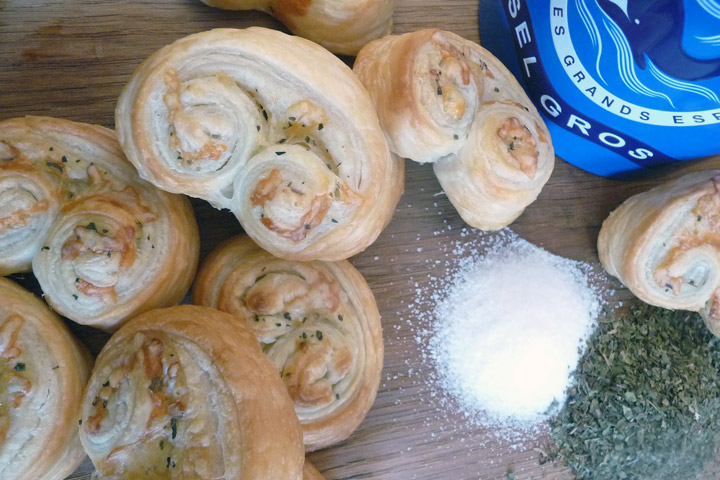
Puff pastry is a wonderful invention. It's rich and buttery yet its delicately light texture makes it an extremely versatile ingredient in the kitchen. It can be made into myriad different things for your party table or can even turn a humdrum Tuesday evening dinner into something a little extra special.
Puff pastry is a pastry dough that puffs up when baked. No kidding, you say! It is made by creating extremely thin separate layers of butter and flour (as opposed to pastry dough, or pate sucree, in which the butter and flour are incorporated together). Theoretically, the 'perfect puff pastry' should have 1,000 layers of flour and butter.
Making it by hand is a laborious process that requires folding the dough over itself over the course of a few hours. The puff is created by the steam coming from the hot butter, which creates pockets of air between the layers. Making puff pastry properly is a skill that requires precision, optimum working temperatures and a whole lot of practice in handling (Note: Puff pastry found in the frozen food section of your grocery store is a pretty good substitute if you don't have the patience to teach yourself the nuances of making puff pastry that will actually puff).
The single most important thing to remember when handling puff pastry is that you must roll it out thin. But not too thin. Roll it to about 1/8 of an inch thick. Try not to work the dough too much or you'll smush the layers together and won't get great rise. After you’ve rolled it out, prick the pastry with a fork liberally. This will allow the pastry to rise more evenly.
From here, there are two ways you can use your puff pastry. The first way is puffy and light, for use as vol au vents or fruit tarts. The second is flat and crispy, for when you want to create those thin and crispy layers, such as in a Napoleon or mille feuille. We'll discuss the latter in another article, so hang tight!
For your puffy puff, cut out your pastry in the desired shape. For vol au vents that you will stuff later, cut out small bite-sized circles of dough and then cut out 'O's (think of a linzer cookie, with the top part of the cookie as an open 'O'). Use a little egg wash to glue the O on top of the circle (Be careful not to get egg wash on any other part of the puff pastry or it won't rise correctly). Now bake your vol au vents at the temperature recommended on the box and let them rise up! Once cool, you can fill them with all things sweet or savory. Here are some ideas:
* Sautee chopped up garlic, onion and wild mushrooms with salt, pepper and butter. Stir in some cream cheese. Fill vol au vents and let them bake in the oven for another 5 to 7 minutes.
* Fill with diced antipasti--roasted red pepper, marinated artichokes, and/or bocconcini.
* Fill them with lemon curd and top with meringue. Use your chef's torch to give the meringue a lightly browned top.
* Dice up your favorite combination of fruit, toss with a little sugar and a corresponding liqueur and top with a little whipped cream.
* Sautee some apples and pears with some butter, sugar and vanilla until soft. Little puff pastry pies!
* Coat the inside of the vol au vent with chocolate. Let set. Fill with chocolate mousse or pastry cream.
It's best to fill your vol au vents as close to serving as possible so they don't sog out. But to save time, you can prebake them and freeze them ahead of time without any filling.
2 comments
©2026 CDKitchen, Inc. No reproduction or distribution of any portion of this article is allowed without express permission from CDKitchen, Inc.
To share this article with others, you may link to this page:
https://www.cdkitchen.com/cooking-experts/rebecca-michaels/202-puff-pastry-1/
Puff the Magic Pastry, Part I
Puff pastry is a wonderful invention. It's rich and buttery yet its delicately light texture makes it an extremely versatile ingredient in the kitchen. It can be made into myriad different things for your party table or can even turn a humdrum Tuesday evening dinner into something a little extra special.
Puff pastry is a pastry dough that puffs up when baked. No kidding, you say! It is made by creating extremely thin separate layers of butter and flour (as opposed to pastry dough, or pate sucree, in which the butter and flour are incorporated together). Theoretically, the 'perfect puff pastry' should have 1,000 layers of flour and butter.
Making it by hand is a laborious process that requires folding the dough over itself over the course of a few hours. The puff is created by the steam coming from the hot butter, which creates pockets of air between the layers. Making puff pastry properly is a skill that requires precision, optimum working temperatures and a whole lot of practice in handling (Note: Puff pastry found in the frozen food section of your grocery store is a pretty good substitute if you don't have the patience to teach yourself the nuances of making puff pastry that will actually puff).
The single most important thing to remember when handling puff pastry is that you must roll it out thin. But not too thin. Roll it to about 1/8 of an inch thick. Try not to work the dough too much or you'll smush the layers together and won't get great rise. After you’ve rolled it out, prick the pastry with a fork liberally. This will allow the pastry to rise more evenly.
From here, there are two ways you can use your puff pastry. The first way is puffy and light, for use as vol au vents or fruit tarts. The second is flat and crispy, for when you want to create those thin and crispy layers, such as in a Napoleon or mille feuille. We'll discuss the latter in another article, so hang tight!
For your puffy puff, cut out your pastry in the desired shape. For vol au vents that you will stuff later, cut out small bite-sized circles of dough and then cut out 'O's (think of a linzer cookie, with the top part of the cookie as an open 'O'). Use a little egg wash to glue the O on top of the circle (Be careful not to get egg wash on any other part of the puff pastry or it won't rise correctly). Now bake your vol au vents at the temperature recommended on the box and let them rise up! Once cool, you can fill them with all things sweet or savory. Here are some ideas:
* Sautee chopped up garlic, onion and wild mushrooms with salt, pepper and butter. Stir in some cream cheese. Fill vol au vents and let them bake in the oven for another 5 to 7 minutes.
* Fill with diced antipasti--roasted red pepper, marinated artichokes, and/or bocconcini.
* Fill them with lemon curd and top with meringue. Use your chef's torch to give the meringue a lightly browned top.
* Dice up your favorite combination of fruit, toss with a little sugar and a corresponding liqueur and top with a little whipped cream.
* Sautee some apples and pears with some butter, sugar and vanilla until soft. Little puff pastry pies!
* Coat the inside of the vol au vent with chocolate. Let set. Fill with chocolate mousse or pastry cream.
It's best to fill your vol au vents as close to serving as possible so they don't sog out. But to save time, you can prebake them and freeze them ahead of time without any filling.
share this article:


related articles


2 comments
what can i make from puff pastry in skool i only have 1 hr 40 mins though
Comment posted by Kat
Please can I have the quantities and ingredients as well as the method to make this perfect puff pastry.
Comment posted by Camy
Write a comment:
©2026 CDKitchen, Inc. No reproduction or distribution of any portion of this article is allowed without express permission from CDKitchen, Inc.
To share this article with others, you may link to this page:
https://www.cdkitchen.com/cooking-experts/rebecca-michaels/202-puff-pastry-1/