

Making Recipes Your Own


Last month I was treated to a rare and thrilling evening: someone else cooked for me! My dear friend, Limor, made the most delicious lasagna I have ever tasted. The other elements of the meal--roasted butternut squash, sautéed zucchini, fresh fruit and chantilly cream, and frighteningly perfect peanut butter cookies--were delectable, as well. But her lasagna was utterly outstanding.
When I emailed Limor to tell her how incredible it was and to ask her to share the recipe, she informed me that it was not her recipe, but that of Ina Garten, a.k.a. the Barefoot Contessa. I was curious to know whether Limor followed the recipe with precision, or if she per chance made adjustments here and there to make it her own. She said, "I use sweet Italian pork sausage instead of sweet Italian turkey sausage, and I use two pounds of sausage instead of 1.5 pounds. Sometimes, I use 1.5 sweet Italian, and 0.5 hot Italian. I leave out the goat cheese (I use extra ricotta instead), and I use more parmesan than is called for. Not too different."
Not too different? Oh, yes it is! And that is what creating recipes is all about. Ina Garten, a great cook, did not invent lasagna, nor would she ever make a claim to have done so. In both ingredients and method, Ina Garten’s recipe, as a general concept, has been made before and will be reinvented again and again. But it is the selection of ingredients (parmesan instead of pecorino), the proportion of those ingredients (28 ounces of crushed tomatoes to 6 ounces of tomato paste), and the nuance of the method (soaking noodles instead of adding them dry) that makes a recipe unique.
Limor's description above is exactly how a person should make a recipe their own. After all, a recipe is merely a road map or set of guidelines. When a recipe calls for ½ teaspoon salt and ¼ teaspoon pepper, it is just a suggestion, not a command. I do not know one professional chef who actually measures salt and pepper when they season. When writing recipes, however, some amount has to be assigned. So, the somewhat arbitrary teaspoon measurements are given. Frankly, a dish should be tasted first and then seasonings should be adjusted accordingly. Perhaps the salt was absorbed in the cooking process, or your individual taste just calls for more salt.
In fact, many recipes are written to bring flavor to the lowest common denominator, not the highest. When a popular food magazine or cookbook publishes recipes, many of the stronger or more exotic flavors are pared down to become more palatable to a wider audience. When I see a recipe, for example, that calls for 1 teaspoon of freshly minced ginger I invariably know that this will not cut it for my taste buds. I prefer a more forward ginger flavor, and therefore almost always double or triple the amount.
When reading a recipe, do not regard it as gospel. Instead, look at a recipe as a concept--an idea--for a combination of flavors and a method of preparing ingredients. With this attitude, you will find that you will be more willing to experiment. After all, you know what you like to eat and you have spent a lifetime doing it. You know what flavors you like paired together, and what ingredients you like to avoid. This makes you more than competent to trust your instincts when working with a recipe.
There is one exception to all this creativity and experimentation. Baking is much more of a science than savory cooking. I urge you always to follow a baking recipe, especially where the chemistry of the recipe is concerned. For example, never tamper with the baking soda, salt, egg and flour ratios of a cake batter, but feel free to add a pinch of ginger, or some toasted nuts to add a new dimension. In other words, it is generally safe to adjust the flavor of a baked good, but not the basics of the batter.
As you discover recipes on CDKitchen.com, read them as road maps. Remember there is more than one way to get from Point A to Point B. Trust your instincts and your palate. Try Limor's Luscious Lasagna below, and make it your own!
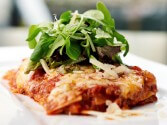

Made with yellow onion, garlic, sweet Italian sausage, crushed tomatoes, tomato paste, fresh parsley, fresh basil, lasagna noodles, ricotta cheese, Parmesan cheese
Serves/Makes: 8
- 2 tablespoons olive oil
- 1 large yellow onion, chopped
- 3 cloves garlic, minced
- 2 pounds bulk sweet Italian sausage, (or a combination of sweet and hot Italian sausage)
- 1 can (28 ounce size) crushed tomatoes in tomato puree
- 1 can (6 ounce size) tomato paste
- 4 tablespoons chopped fresh parsley
- 1/2 cup chopped fresh basil
- 10 lasagna noodles
- 22 ounces ricotta cheese
- 1 1/2 cup freshly grated Parmesan cheese
- 1 egg, lightly beaten
- 1 pound fresh mozzarella cheese, thinly sliced
- kosher salt
- freshly ground black pepper
Preheat the oven to 400 degrees F.
Heat the olive oil in a large saucepan over medium-low heat. Add the onion and cook, stirring occasionally, until translucent, about 15 minutes. Add the garlic and cook for one more minute.
Add the sausage and cook, breaking it up with a fork, for 10-15 minutes, or until no longer pink.
Add the crushed tomatoes, tomato paste, half of the parsley, the basil, 1 1/2 teaspoons salt and 1/2 teaspoon pepper. Simmer, uncovered, over medium-low heat, for 20 minutes or until thickened, stirring occasionally.
Meanwhile, fill a large bowl or pan with very hot tap water. Add the noodles and allow them to sit in the water for 20 minutes. Drain well.
In a medium bowl, combine the ricotta, 1 cup of the Parmesan cheese, the egg, the remaining parsley, 1/2 teaspoon salt, and 1/4 teaspoon pepper. Mix well and set aside.
Ladle 1/3 of the sauce into a 9x12-inch rectangular baking dish, spreading the sauce over the bottom of the dish. Then add the layers as follows: half the pasta, half the mozzarella, half the ricotta, and one third of the sauce. Add the rest of the pasta, mozzarella, ricotta, and sauce.
Sprinkle with 1/4 to 1/2 cup of the Parmesan cheese. Bake for 30 minutes, until the sauce is bubbling. Let the lasagna cool for 5-10 minutes before slicing and serving.
This dish can also be made up to one day in advance. Just assemble the lasagna, cover it and refrigerate it unbaked. When ready to serve, bake for 40 minutes uncovered until bubbly.
Recipe Source: adapted from "Barefoot Contessa: Family Style" by Ina Garten.


related articles


Write a comment:
©2026 CDKitchen, Inc. No reproduction or distribution of any portion of this article is allowed without express permission from CDKitchen, Inc.
To share this article with others, you may link to this page:
https://www.cdkitchen.com/cooking-experts/lauren-braun-costello/276-creating-recipes/