

Jenny's Caesar Salad


It all started with a book of 50 salads. And at the dentist’s office, no less. My daughter had been perusing the book while waiting for me to finish. And after a winning no-cavity visit, who could say no to a kid who was actually requesting salad for lunch?
Plus, since I already had to make a run into the grocery store for some laundry detergent, it was no biggie to swing by the produce department and grab a large head of Romaine lettuce (too bad our garden variety isn’t yet large enough to harvest) and real Parmesan cheese. The recipe also listed anchovies and egg yolk dressing, noted daughter. Well, being a chip right off the old block, she didn’t miss a beat in saying that we didn’t need to use the anchovies, and that she bet the raw egg yolks weren’t necessary either. And since the head note mentioned replacing the raw egg with hard-cooked ones sliced or diced atop the salad, that was our option of choice.
So, on our way home, we picked up some Romaine and a triangular wedge of real Parmesan (“Oh, Mommy – it’s $7 for this piece … do you think that’s OK?”). Aware and armed—especially with all the talk about the economy, she was vigilant in double-checking our ability to cover this expenditure.
I said it was A-OK. I told her that I had heard many times that it only takes a little bit of this fine quality cheese to create powerful flavor. Oh, sure I’ve seen Lydia and Giada singing the praises of the tried-and-true real Italian cheese: Parmigiano-Reggiano. But just between you and me: I usually cheaped out on the pre-grated variety. It never seemed imperative—until now.
It’s this hard, dry cheese’s aging process that offers that distinctive, sharp tang. Parmesan cheese is made in Argentina, Australia and the United States, but it is said that none can compare with the famous Italian Parmigiano-Reggiano. And apparently that has to do with the aging: while most U.S. varieties are aged a minimum of 10 months, the true blue Italian is aged at least 2 years. And if you see a label that says stravecchio, it’s been aged 3 years while stravecchiones are over 4 years old. To know if you have the real thing, look for stenciling on the rind: Parmigiano-Reggiano. Otherwise it’ll probably say just Parmigiano if the protected designation of origin requirements aren’t met (production area, cattle diet and aging, etc.).
No matter what type you find, Parmesan cheeses are used primarily for grating—and it’s quite satisfying to use the vegetable peeler to grate off long, thin slices. Try it—it’s fun. And I bet your kids will like doing it too.
So now we would have a chance to taste-test the difference between our standard Kraft or 4C and the 10-month aged wedge we found.
Hungry as ever by the time we were back in our own kitchen, I mixed up a dressing (sans the egg yolks)—with a dash or two of our own spice, and she peeled some hard-boiled eggs (thanks to recent Easter dye fun). Then it was time to cut some bread to make the homemade croutons (absolutely divine) and assemble it all on two plates.
Conclusion: This real Parmesan is definitely worth it. The pungent flavor added a richness that the sprinkle variety just couldn’t match. Where those shake-on granules are too flat and stick-to-the-roof of your mouth, this real Parmigiano was a delightfully rich and tangy accent to a delicious salad. With a slight yet satisfying chew. Now this is a lunch I would gladly repeat time and again.
See if you don’t think so too.
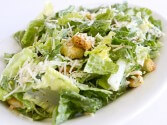

Made with dry mustard, Parmesan cheese, garlic, French or Italian bread, romaine lettuce, lemon juice, egg, olive oil, Worcestershire sauce, anchovies
Serves/Makes: 4
- 1 clove garlic
- 4 slices French or Italian bread
- 6 cups torn romaine lettuce
- 2 tablespoons lemon juice
- 1 egg
- 1 tablespoon olive oil
- 1/2 teaspoon Worcestershire sauce
- 2 anchovies, drained and finely chopped
- 2 tablespoons freshly grated Parmesan cheese
- 1/8 teaspoon dry mustard
- 1 dash hot pepper sauce
- freshly ground black pepper, to taste
Preheat the oven to 425 degrees F.
Cut the garlic clove in half. Rub both sides of the bread slices with the cut side of the garlic cloves. Cut the bread into cubes and place in a single layer on a jelly roll pan. Place the pan in the oven and toast the croutons for 5 minutes, stirring the croutons once or twice during the cooking time.
Place the lettuce in a bowl. Finely mince the garlic cloves and combine with the lemon juice, egg, olive oil, Worcestershire sauces, anchovies, Parmesan, dry mustard, and hot sauce in a bowl. Whisk until emulsified.
Pour the Caesar dressing over the lettuce and toss to coat the lettuce. Season as desired with freshly ground black pepper, add the croutons to the salad, and gently toss again.
Serve the classic Caesar salad immediately.


related articles




Write a comment:
©2026 CDKitchen, Inc. No reproduction or distribution of any portion of this article is allowed without express permission from CDKitchen, Inc.
To share this article with others, you may link to this page:
https://www.cdkitchen.com/cooking-experts/christine-gable/891-caesar-salad/