

Slow Food For a Fast World


Your dinner tonight is going to be really “slow,” but you will have it on the table from start to finish in under half an hour. Sounds crazy, right?
Normally “slow” is not a word people want associated with their dinner recipes. But when you are talking about Slow Food, as in the Slow Food Movement, it is a word that you just might consider using for your next meal.
Slow Food is an international non-profit organization with a mission of connecting producers of traditional foods and the consumer to fight the prevalence of fast food in the modern world. Founded in Italy over 20 years ago, the group is now over 80,000 members strong worldwide. These members work together to put into practice their philosophy that food taste good, be environmentally friendly, and that producers be paid fairly.
At this point the Slow Food philosophy may conjure images of Birkenstock clad feet in a steamy kitchen stirring a pot of beans for a whole Saturday afternoon. Not so. It is possible to adopt some of the Slow Food philosophies into your weekday life and still get dinner on the table in a reasonable amount of time.
Fish is one food that no matter how “Slow” you cook it, it is nearly impossible for it to take a long time to go from kitchen to table. So the slow part of cooking fish relates more to where it is coming from to make sure your choices are both safe for the environment (fish is coming from sustainable and renewable sources) and safe for you (levels of mercury and PCBs are low). The Environmental Defense Fund has made it a little easier for us to navigate the murky waters of seafood selection with a pocket guide that you can download or have sent to your phone.
Wild Alaskan Salmon is on the Best Choices list in the pocket guide and this particular fish variety lends itself to another Slow, and that is slow roasting. Slow roasting salmon in a moderately low temperature oven does not take more than 25 minutes from start to finish, which is plenty fast by most people’s standards. Unlike pan sautéing the fish or roasting in a high heat oven which produces a crisp skin with a tender center, slow roasting not only leaves the flesh an orangey pink color, but creates a finished dish that is rich and silken all the way through.
Brown rice used to be the sort of food you would expect a Birkenstock clad, Slow Food loving, vegetarian to be the sole consumer of. These days the former red-headed stepchild of the rice family is enjoying a bit of a comeback. White rice is simply brown rice minus the bran layer, plus a polishing. Removing the bran layer results in a loss of some of the nutritional value as well as flavor. Brown rice has also been the nemesis of a quick kitchen as its cooking time varies from 45 minutes to an hour, versus the 15 minutes it takes to make a pot of white rice.
However, the process of parboiling (partially precooking) the brown rice dramatically reduces the cooking time. These days most stores sell par-boiled brown rice or you can do it yourself by cooking 1 cup of brown rice in 2-3 cups of boiling water for 15 minutes then draining. You can store the parboiled rice in the refrigerator for a couple of days. When you are ready to cook that final meal, just cook rice in 2 parts liquid to 1 part rice for about 30 minutes.
It is unlikely that most of us have time in a week, let alone many given days, to take up the Slow Food movement in its entirety. But adopting elements of it into the kitchen is a good reminder to take a minute in the kitchen to stop and smell the radicchio, or roses, or whatever. Making sure your food is as environmentally friendly as possible, maybe even going out of your way to get to know the producer by shopping at your local farmer’s market, and most of all embracing the pleasure of eating itself are easy ways to bring a little slow into this fast world.
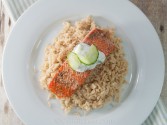

Made with rice wine vinegar, chicken stock, brown rice, salmon fillets, olive oil, salt and pepper, Greek yogurt, English cucumber, dill, garlic
Serves/Makes: 4
- 3 1/2 cups chicken stock
- 2 cups parboiled brown rice
- 4 salmon fillets (4 ounce size)
- 2 tablespoons olive oil
- salt and pepper
- 1 cup Greek yogurt
- 1/2 English cucumber
- 2 tablespoons minced dill
- 1 clove garlic, finely chopped
- 1 tablespoon rice wine vinegar
- 1 teaspoon sugar
Preheat the oven to 375 degrees F.
Bring the chicken stock to a boil in a saucepan over medium-high heat. Add the brown rice, cover the pan and reduce the heat to a simmer. Let simmer for 25-30 minutes, or as directed on the package.
Remove any skin from the salmon fillets. Drizzle the olive oil in the bottom of a shallow baking dish. Season the salmon on all sides with salt and pepper. Place the salmon in the baking dish and put the dish in the oven. Bake at 375 degrees F for 10 minutes, then turn the fish over. Continue baking for another 10-15 minutes or until the fish flakes when tested with a fork.
Meanwhile, slice the cucumber paper-thin using a mandolin or knife. Combine the cucumber, yogurt, dill, garlic, vinegar, and sugar in a bowl and mix well. Season to taste with salt and pepper.
When the rice is cooked, fluff it gently with a fork. Place a serving of rice on each individual dinner plate. Top each serving of rice with a salmon fillet. Garnish the salmon with 1/4 cup of the cucumber yogurt sauce.
Serve immediately.


related articles


Write a comment:
©2026 CDKitchen, Inc. No reproduction or distribution of any portion of this article is allowed without express permission from CDKitchen, Inc.
To share this article with others, you may link to this page:
https://www.cdkitchen.com/cooking-experts/amy-powell/672-slow-food/