

To Be Worth Your Salt


It drove the growth of civilization. It created roads that paved the way for caravans in search of it. It has raised cities and destroyed empires. Today, doctors condemn its role in high blood pressure and gourmet markets stock it in myriad artisanal varieties to satisfy gourmet desires. It seems that even today salt continues to be both the hero and the villain in our culinary development.
I may have grown up with a mother firmly rooted in the modern doctor’s camp, but I have learned a great appreciation for the seasoning as the years have passed. Specifically at culinary school, if I learned anything that was “worth its salt,” it was how to season a dish properly. To learn the proper balance of salt and pepper in a dish and how those elements enhance ingredients is a skill that is worth its weight in gold.
When you are in school, tasting dishes that you create for five hours every day, you have a chance to develop a taste for the subtle difference that a little too much salt, or not enough salt, can make. The problem is that most of us haven’t taken the time to examine those subtleties in our own home. Instead, we become the type that automatically reaches for the salt shaker at a meal before even tasting the food, or conversely, the type that omits the salt from a muffin because the recipes says “optional.”
Unless you have a serious health concern, salt should not be an option. However, it is almost a crime to automatically salt a finished product at your home table, or at a restaurant, before you have tasted the dish. Ideally, the cook or chef has seasoned it perfectly already and no additional salt should be required. That being said, there are some things you can do in your own home to get you closer to seasoned perfection.
First, when boiling pasta or blanching vegetables in water, make sure to salt the water beforehand. Add a generous amount of salt to the water and stir. Dip your finger in. The water should taste like the sea. When the water has the taste of the ocean it is ready to cook with. This is the only way to get seasoning into the pasta and vegetable itself so salting the water is extremely important.
Second, wait until just before searing to sprinkle fish and meat headed to the sauté pan with salt and pepper. But make sure the seasoning is there before it hits the pan. Putting salt on meat too early before you cook it draws out moisture. The moisture will prevent proper browning in the pan. So doing a generously sprinkling of salt and pepper right before the meat or fish hits the hot sauté pan ensures that all that seasoning will be sealed in with the meat’s flavor in the beautiful brown crust.
Third, when working with sauces, it is best to wait to the end to salt. This is the case because when reducing components of sauces, like wine and stock, the flavors concentrate. Adding salt at the beginning runs the risk of having an overly salty sauce. However, adding salt is extremely important to a well-balanced sauce. This is difficult using commercial stock as most of that is over-salted to start with. So better to get a stock that says “low-sodium” on the label. But a bit of salt at the end can brighten the various parts of a well-layered sauce. Salt will mellow out the tannins of a reduced wine, or tone down an acidic bite from lemon juice or vinegar.
Fourth, treat each piece of a dish like its own finished product. Be it sautéed peppers going into a ratatouille, or caramelized onions to top a burger, salt and pepper for each part means that the assembled final product will need little adjustment to the overall seasoning of the dish.
Fifth, pastry needs salt. If it says optional in the recipe, always opt for adding it. Be it butter in a pastry crust or sugar in a cupcake, salt’s role is to balance those flavors creating contrast and balance so that every bite is round and complete.
If you are a lover of food, no matter what the health books say, you are worth your salt. Just use it with respect and a gentle touch, pushing that salt shaker aside at the table until after you have had a taste. Learning to taste for seasoning is a skill, and good taste really is the salt of life.


Made with chicken stock, red wine, butter, vegetable oil, crimini mushrooms, onion, rosemary, lamb tenderloin, salt and pepper
Serves/Makes: 4
- 2 cups chicken stock
- 2 cups red wine
- 2 tablespoons butter
- 1 tablespoon vegetable oil
- 8 ounces crimini mushrooms
- 1/2 medium onion
- 2 tablespoons minced rosemary
- salt and pepper
- 1 1/3 pound lamb tenderloin
- salt and pepper
- 1 1/2 cup orzo pasta
- 1 large zucchini
- 1 tablespoon olive oil
- salt and pepper
Preheat broiler. Bring medium pot of water to a boil.
In a medium saucepan, bring chicken stock to a boil. Continue to boil until reduced by half. Add red wine and return to a boil. Continue to boil until reduced by half again.
Meanwhile prepare other parts of dish. Wipe down mushroom and slice into 1/4 inch thick pieces. Mince onion and rosemary. Heat 1 Tb. butter and 1 Tb. vegetable oil in a saute pan over medium heat. Add mushrooms. Leave until beginning to brown on one side.
Add onions and rosemary with a bit of salt and pepper. Saute to combine. Continue to cook until onions are soft. Set aside.
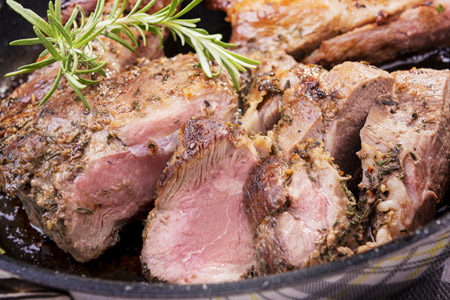
Season lamb tenderloins with salt and pepper on all sides. Place in oven. Cook for about 8 minutes, turning once during cooking. Meat should be medium to medium rare at this point. Cook longer for more well done. Remove from oven and let rest before slicing.
Meanwhile, generously salt boiling water. Add orzo and cook according to package directions.
Grate zucchini on a box grater. When orzo is done, drain in colander then return to pan. Add zucchini, olive oil, and pepper to taste. Stir to combine.
While meat is resting, finish sauce. Add mushrooms to reduced wine mixture and bring to a simmer. Add remaining 1 Tb. butter along with salt and pepper to taste. Slice meat.
To serve, arrange several thick slices of lamb on a bed of orzo. Top with a generous ladle of mushroom-wine sauce.


related articles




Write a comment:
©2026 CDKitchen, Inc. No reproduction or distribution of any portion of this article is allowed without express permission from CDKitchen, Inc.
To share this article with others, you may link to this page:
https://www.cdkitchen.com/cooking-experts/amy-powell/580-salt/