

Mexican Melting Pot


Mexico City has just made my Top Ten List of favorite cities in the world. When I told people I was going to Mexico for a few days, they instantly thought of me and some crazy friends in Cancun making our own version of Girls Gone Wild. When I told them I was going to Mexico City to attend an Orthodox Jewish Mexican wedding, the reaction was confusion, then mild disappointment, followed by the question, “Jewish people live in Mexico?” But once you understand a bit about the history of the city, the existence of a thriving Jewish population seems perfectly in line with the melding of cultures and peoples over the centuries that has given us the vibrant culture, architecture, art, and food that the country produces today.
Mexico City is a city of contrasts. It sprawls across just under 2,000 square miles. Packed into this area, shoulder to shoulder, are about 19 million people, according to my guidebook (although a tour guide said the actual number is more like 25 million due to the constant influx of migrants and the difficulty of tracking their movements). The city is filled with both the extremely wealthy and the utterly impoverished. You can spend whole days strolling through lush green parks and beautifully maintained historic squares under the haze of one of the world’s most polluted skies. While climbing the ruins of Teotihuacan, one can sense the spirit of the Aztecs who founded Mexico City and their predecessors who built the original pyramids still alive in a city that today breathes the life of Indian, Spanish, and yes, Jewish, ancestors.
One cannot really escape Mexico without being indoctrinated in their tequila drinking rituals. Our first lunch in town, in the seafood restaurant Puntarena, began with a toast to the blushing bride with a shot glass of reposado alongside a small glass of sangrita, the Bloody Mary-like concoction traditionally used as a chaser. On our way to tour the pyramids, our bus stopped at an artisan shop where our group was given a demo of the importance of the agave plant. From juicing the plant, they made cactus water. Consumed by itself it is a healthy alternative to sugar, and it is also said to improve ones, um, sexual prowess. Of course, by distilling the cactus water, one gets tequila.
As for the food, the variety was immense, to the pleasure of my taste buds and the distress of my digestive system. The breakfast of choice, whether formal as part of a wedding brunch or casual at a taco shop, were chilaquiles: stale tortilla chips smothered in red or green sauce and topped with cheese. This was served with meat or egg or even once with napoles, or prickly pear cactus. And so we searched side streets for taquerias and a lunch of tacos pastor, and ate homemade raviolis filled with spinach and Oaxaca cheese at an Italian restaurant in our hotel.
The Jewish Orthodox Mexican wedding itself could not have been a better example of the melding of cultures in traditions and food. We danced the Hora to a Hebrew band, salsa-ed to a Latin band, and jumped around to modern day DJ. Dinner was salad, cream of coriander soup with grapes, sea bass with poblano chili risotto and pickled cabbage, and cake, of course. But while we danced to the Hora and ended the night with mariachis, we finished our fine-dining with something suited to soak up the late night tequila toasts: yes, more chilaquiles.
Just as the guests came from all over the world to celebrate our friend’s joyful marriage, so do the cultures of centuries of immigrants weave in and out of the everyday customs of Mexico City. So we ate the ravioli and risotto, but they were made with the flavors of Mexico. We ate Kosher some of the time, but again, it was the food of the country combined with the customs of its Jewish people. So as my American friend marries her Mexican husband, she carries on a tradition of joining the old and the new with customs of all those that have come before her in a strange but beautiful harmony. It's not unlike the strangely beautiful city itself. Mazal Tov!


Made with flour, vegetable oil, onion, garlic, white wine, chicken stock, cilantro, heavy cream, green seedless grapes, salt and pepper
Serves/Makes: 4
- 1 pound turkey tenderloins, boneless, skinless
- salt and pepper
- 1/2 cup flour
- 3 tablespoons vegetable oil
- 1/2 onion
- 2 cloves garlic
- 6 ounces white wine
- 2 cups chicken stock
- 1 bunch cilantro
- 3 tablespoons heavy cream
- 1 cup green seedless grapes
- salt and pepper
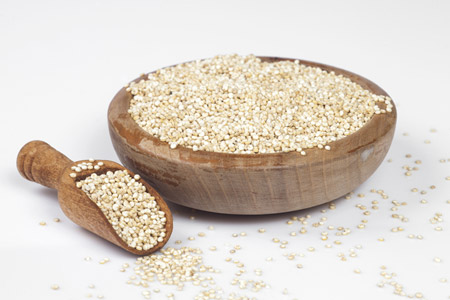
- 1 cup quinoa, preferably Incan red
- 1 cup water
- 1 cup chicken stock
- salt and pepper
Season turkey on both sides with salt and pepper. Place flour on a plate and dredge tenderloins, coating on both sides, shaking off excess.
Preheat deep saute pan with vegetable oil over medium high heat. Place tenderloins in saute pan. Leave to brown.
Meanwhile, cut onion in 1/4 inch slices. Crush garlic. Rinse cilantro thoroughly. Roughly chop leaves, reserving 1/4 chopped leaves for garnish.
Once one side of turkey has browned, turn to other side and add onion and garlic to pan, adding more oil if necessary. Saute for about two minutes until garlic has softened.
Add white wine. Bring to simmer and reduce by half. Add chicken stock and cilantro. Bring to simmer, top with lid, and reduce heat to medium. Let simmer for about 15 minutes until turkey has cooked through.
Meanwhile, bring quinoa, water and stock to a boil in a medium saucepan with salt and pepper. Reduce heat to medium, and cover with lid to cook for about 15 minutes until all the liquid has been absorbed. Taste and adjust seasoning if necessary.
Slice grapes in half lengthwise. When turkey has cooked through, add cream and grapes. Bring to simmer and reduce liquid to desired consistency.
Serve over quinoa with a sprinkling of reserved chopped cilantro.


related articles




1 comments
If it has cilantro, it simply has to be good. Going to purchase the turkey and make this for dinner tonight. I especially like that the ingredients are usually on hand. Thanks for the recipe. There is so much more to Mexican cuisine than tacos, burritos, and enchiladas.
Comment posted by NOPALITO
Write a comment:
©2026 CDKitchen, Inc. No reproduction or distribution of any portion of this article is allowed without express permission from CDKitchen, Inc.
To share this article with others, you may link to this page:
https://www.cdkitchen.com/cooking-experts/amy-powell/375-mexican-cuisine/