

Relief For The Pressure Cooker


I am a human pressure cooker. I mean literally, when I am under pressure or stress, what do I do? I cook. Some people do yoga, others golf, I cook. I do other forms of stress relief, for sure: run, road rage, drink a bottle of Cabernet by myself, but at the end of the day, as I am tearing my hair out, I usually ask myself, what would I rather be doing? The answer is always that I would rather be, well, cooking.
Summer is supposed to be carefree. It is the time of year when we are almost expected to be reckless and thoughtless: carefree with work, reckless with love, and thoughtless with sunblock. And because of it we usually emerge, come September, happier, healthier, and with a hell of a great tan.
This summer hasn’t been so carefree for me in certain ways. In fact, many people I know are unable to even take advantage of such encouraging perks as “Summer Fridays” simply because even designated vacation days do not provide escape from emergency conference calls with clients. My poor brother, for instance, had to book a trip to the Amazon just to escape his Blackberry for nine whole days.
I may have been careless with my sunblock on occasion this summer. But that is about as far as I have allowed the sun to warp my feelings of responsibility. Outside of working, my main form of release lies at the tip of a 7-inch Henckel and above the flame that lights my 10-inch stainless steel All-Clad sauté pan.
There are several cooking methods that lend themselves naturally to relieving stress. Personally, while other yuppies are cruising the Happy Hour scene on a Friday night, I find that preparing a five course dinner--for one--is not only totally distracting from my work week, but provides better company than I could hope to find at any bar. Then there is bread making: there is really nothing like beating down a yeasty balloon of dough to relieve a little pent-up aggression.
But as this is a column on quick cooking, it would be logical to talk about the meditative cooking method I apply more frequently: that is the 30 minutes of non-stop, hands-on, multi-burner, multi-tasking that leaves not even a moment to think about anything but the task at hand.
There are several types of dishes that require such all-consuming attentiveness. Risotto immediately comes to mind, as one must employ, at a minimum, two pots. One sauté holds the rice that must be stirred frequently with the addition of hot stock coming from the other pot at intervals. This all needs to be managed while preparing the other vegetables, grated cheese, and so on that will be added to the finished dish.
But even more consuming than risotto, I believe, is the pasta of Northern Italy, otherwise known as polenta. Polenta is a kind of cornmeal porridge that bears a strong similarity to the grits of the American South. Although there are many pre-fab polentas and quick cooking varieties available at the supermarket today for outlandish prices, the real deal is simple and inexpensive. This is why it is a staple food in so many parts of the world.
The reason we shy away from cooking polenta the old fashioned way is the very reason I turn to it in times of stress. Polenta needs constant attention. Although tradition dictates that polenta be stirred sans interruption with a wooden spoon to prevent clumping and burning, I prefer mine a little on the runnier side and so I whisk with more liquid. Regardless of how you stir it, polenta requires boiling liquid, cornmeal, and a little salt at the very basic level. Beyond that you are free to experiment (try stock instead of water for the liquid, or add marscapone cheese at the very end for a richer version), or simply lose yourself in the swirling of the golden grain.
The real test of your multi-tasking abilities is preparing the topping for your polenta while not allowing the polenta itself to scorch. This, too, might require multiple burners and a cutting board for slicing and dicing. Needless to say, there really exists not even a moment in this process where your mind could wander to that project you need to work on over the weekend. It is you, the burners, and thirty minutes of beating the hell out of some yellow grain.
While other people might find stress in cooking and relief in eating, I think it is possible to relieve pressure through both processes. However you meditate, concentrated alone time with focused mental action is all one really needs to come down off a difficult week. And what other form of meditation offers such a tasty conclusion?


Made with cornmeal, kosher salt, red wine, chicken stock, butter, salt and pepper, olive oil, chicken sausage, onion
Serves/Makes: 4
- 2 cups chicken stock
- 3 cups water
- 1 1/4 cup cornmeal
- kosher salt
- 1 tablespoon extra virgin olive oil
- 1 cup good red wine
- 1 cup quality chicken stock
- 1 teaspoon butter
- salt and pepper
- 3 tablespoons olive oil
- 4 links chicken sausage
- 1/2 medium onion
- 1 clove garlic
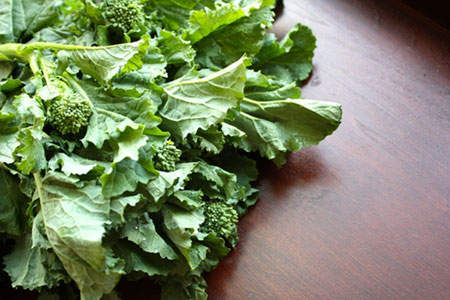
- 2 bunches rapini
- salt
- cayenne pepper
- 1/2 cup chicken stock
Bring 2 cups chicken stock and 3 cups water to a boil in medium pot. Add cornmeal in a steady stream whisking constantly. Return to a boil then reduce heat to medium and continue to whisk to prevent clumping.
While stock and water are coming to an initial boil, bring wine to a boil and a small saucepan. Continue to boil until reduced by half. Add 1 cup chicken stock and bring back to a boil. Continue to boil until reduced by half again. Reduce heat to low and stir in butter. Add salt and pepper to taste.
Meanwhile, heat 3 T. olive oil over medium high in a large saute pan. Remove sausages from casings and add to oil. Saute until almost all pink is gone breaking up with a wooden spoon as you go.
Meanwhile, finely mince onion and add to sausage while cooking. Saute until onion has softened, about five minutes. Crush garlic clove and add to pan. Saute for another minute.
Rinse rapini and slice bunch crosswise into 1 inch strips. Add to saute pan with a pinch of cayenne, or more to taste, and a few good pinches of salt. Saute rapini with sausage until leaves start to wilt. Add 1/2 cup chicken stock. Bring to a simmer and continue cooking while polenta finishes and rapini continues to wilt.
When polenta has been cooking for about 20-25 minutes, check for doneness and desired consistency. Add more liquid while you go if it is getting to dry. Taste for seasoning adding several pinches of salt and pepper to taste. Finish by stirring in a tablespoon of olive oil. Sausage will be done liquid has mostly evaporated.
To serve, spoon polenta onto each plate. Top with a portion of the sausage and rapini and drizzle with the red wine sauce.


related articles



1 comments
I liked your article and the recipe. I agree that cooking after work is very relaxing and enjoyable. We I make polenta, I always make extra. Pour the "extra in a loaf pan; cover with waxed paper and let cool before refrigerating. For breakfast; cut into 1/2 inch or so slices. Use paper towels to blot off the moisture and lightly dust with flour...to reduce splattering. Fry in extra virgin olive oil, sautéing to a light brown. Serve with fried eggs on top. My favorite breakfast includes my homemade Italian Sausage!
Comment posted by Tony
Write a comment:
©2026 CDKitchen, Inc. No reproduction or distribution of any portion of this article is allowed without express permission from CDKitchen, Inc.
To share this article with others, you may link to this page:
https://www.cdkitchen.com/cooking-experts/amy-powell/352-pressure-cooker/