

It's All in the Kraut


Summer is so close I can taste it. If I didn't know differently, I would never have guessed from the 90 degree temperatures while I was in Sacramento this week that Northern California had experienced rainfall and flooding this spring almost worthy of Noah himself. So practically overnight this region has turned from cassoulets that keep the chill out of the bones to the smell of barbecue wafting through the heat waves.
Summer can't help but make me think of barbecues, beach balls, ball parks, grilling, hot dogs, and beer. I think of CEOs in summer linen suits taking their lunch break at the hot dog stands in Battery Park. I think of smoking keilbasa over a charcoal Weber grill and knocking back a cold one for a brief respite from the heat.
I am a purist in most ways when it comes to food, but hot dogs are not one of them. Perhaps it is that hot dogs are hardly "pure" anything. Maybe it's that the whole "mystery meat" factor is sufficiently scary to warrant enough garnish to mask any flavor of origin that might come through. Regardless the reason, a hot dog, keilbasa, bratwurst or any sort of sausage served in a bun deserves a full complement of condiments.
Mustard is a must. Ketchup is always okay. But the ingredient that makes a dawg truly authentic has to be the kraut.
Ewww . . . you say. Fine, I understand that consuming "fermented cabbage" doesn't exactly have a nice ring to it, but think about it in historical context and consider that people from all over the world have been eating some form of sauerkraut for longer than you have been alive. Sauerkraut comes from German and literally means "sour cabbage." It typically consists of a finely shredded green cabbage that has been fermented with forms of lactic acid bacteria which give it both longevity and that unique sour flavor.
Colder eastern European countries consume sauerkraut alongside everything from charcuterie platters to pierogies. In Korea, kimchi, their version of sauerkraut, is a crucial ingredient in nearly every dish. And in America, we have come to associate sauerkraut with hot dogs, brats, and a cold beer that's not usually far behind.
I have done a little research and have concluded that once you have overcome the initial intimidation, you will find that the sourness of sauerkraut is quite pleasant when cutting through the glistening fattiness of any tubular meat. Once you have mastered sauerkraut on a dawg, you apparently can move on to all sorts of kraut adventures from Bloody Krauts (Bloody Marys with some sauerkraut juice) to molten chocolate sauerkraut cake (let me know how that one works out for you).
Basically, what I am trying to say is if you have yet to give the kraut a chance, it may be about time. Judging by millions of loyal followers, whether it be with a dog, or in a drink, it is all about the kraut.
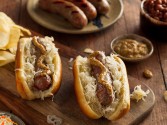

Made with Dijon mustard, sub rolls or hoagie buns, sauerkraut, yellow onion, bay leaf, bratwurst, German beer
Serves/Makes: 4
- 1 can (16 ounce size) sauerkraut, rinsed and drained
- 1 medium yellow onion, thinly sliced
- 1 bay leaf
- 4 links bratwurst
- 2 bottles dark German beer
- 4 sub rolls or hoagie buns
- Dijon mustard
Place the sauerkraut in the bottom of a large saucepan or deep skillet. Top with the sliced onion and tuck the bayleaf into the mixture.
Place the bratwurst in a single layer on top of the onions.
Gently pour the beer into the pan. Bring to a boil over medium-high heat then reduce the heat to a low simmer. Cover the pan and let cook for 10 minutes.
While the brats are cooking, heat a grill pan over medium-high heat. Turn on the oven broiler.
Slice the rolls lengthwise, being careful not to cut all the way through. Gently open the rolls and place cut-side up on a baking sheet. Place under the broiler and heat until just toasty. Remove immediately.
Transfer the brats to the grill pan with tongs and cook just long enough, turning as needed, to form grill marks.
Remove the bay leaf from the sauerkraut. Drain the beer from sauerkraut.
Spread mustard on the cut sides of the rolls. Top with a layer of sauerkraut and a bratwurst. Serve immediately.


related articles



Write a comment:
©2026 CDKitchen, Inc. No reproduction or distribution of any portion of this article is allowed without express permission from CDKitchen, Inc.
To share this article with others, you may link to this page:
https://www.cdkitchen.com/cooking-experts/amy-powell/270-hot-dogs-with-sauerkraut/